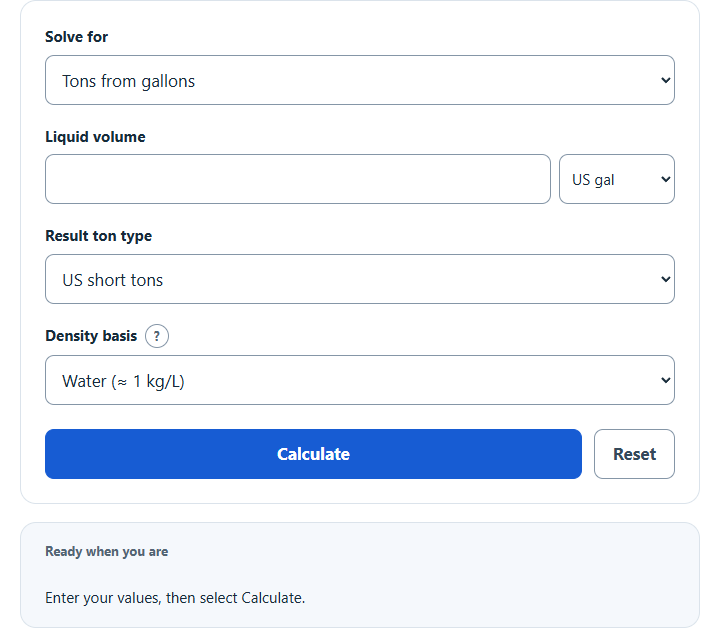
Convert gallons to tons (US short, metric or long) for water, diesel, gasoline or a custom density, or convert tons back to gallons or liters.
Calculator Functions
| Function | What it does | What it requires |
|---|---|---|
| Tons from gallons | Converts a liquid volume into US short tons, metric tonnes or Imperial long tons | Requires the volume in US gallons, Imperial gallons or liters, the result ton type and the density basis |
| Gallons from tons | Converts a mass in tons into US gallons, Imperial gallons or liters | Requires the mass in US short tons, metric tonnes or Imperial long tons, the result gallon type and the density basis |
Both functions need a density basis, because a gallon measures volume and a ton measures mass. The choices are water (1 kg/L), seawater (1.025 kg/L), diesel (0.84 kg/L), gasoline (0.74 kg/L), crude oil (0.87 kg/L) or a custom density in kg/L, lb/US gal or lb/Imperial gal. Every result also lists the mass in kg and the volume in liters.
Gallons to Tons Formulas
| T | Mass in the selected ton unit |
| G | Volume in gallons |
| L | Liters per gallon: 3.785411784 for a US gallon [1], 4.54609 for an Imperial gallon |
| ρ | Density of the liquid (kg/L) |
| K | Kilograms per ton: 907.18474 for a US short ton, 1000 for a metric tonne, 1016.0469088 for an Imperial long ton [1] |
Tons from gallons
The formula above applies directly. For 1,000 US gallons of water, T = 1,000 × 3.785411784 × 1 ÷ 907.18474 = 4.1727 US short tons. The same 1,000 gallons of diesel is 1,000 × 3.785411784 × 0.84 ÷ 1000 = 3.1797 metric tonnes. A volume entered in liters skips the gallon factor.
Gallons from tons
One US short ton of water is 907.18474 ÷ (1 × 3.785411784) = 239.65 US gallons. One metric tonne of water is 264.17 US gallons, and one metric tonne of diesel is 1000 ÷ (0.84 × 3.785411784) = 314.49 US gallons.
Gallons to Tons Conversion Table
These values are for US gallons of water at 1 kg/L.
| US gallons | US short tons | Metric tonnes | Imperial long tons |
|---|---|---|---|
| 1 | 0.0042 | 0.0038 | 0.0037 |
| 5 | 0.0209 | 0.0189 | 0.0186 |
| 10 | 0.042 | 0.038 | 0.037 |
| 50 | 0.209 | 0.189 | 0.186 |
| 55 | 0.229 | 0.208 | 0.205 |
| 100 | 0.417 | 0.379 | 0.373 |
| 250 | 1.043 | 0.946 | 0.931 |
| 500 | 2.086 | 1.893 | 1.863 |
| 1,000 | 4.17 | 3.79 | 3.73 |
| 1,500 | 6.26 | 5.68 | 5.59 |
| 2,000 | 8.35 | 7.57 | 7.45 |
| 3,000 | 12.52 | 11.36 | 11.18 |
| 5,000 | 20.86 | 18.93 | 18.63 |
| 10,000 | 41.73 | 37.85 | 37.26 |
The liquid changes the answer. This table gives the tons in 1,000 US gallons for each density basis in the calculator.
| Liquid | Density used | US short tons | Metric tonnes | Imperial long tons |
|---|---|---|---|---|
| Water | 1 kg/L | 4.173 | 3.785 | 3.726 |
| Seawater | 1.025 kg/L | 4.277 | 3.880 | 3.819 |
| Diesel | 0.84 kg/L | 3.505 | 3.180 | 3.130 |
| Gasoline | 0.74 kg/L | 3.088 | 2.801 | 2.757 |
| Crude oil | 0.87 kg/L | 3.630 | 3.293 | 3.241 |
Limits of This Estimate
- The preset densities are typical values near 15 °C, and real densities change with temperature, pressure and composition. Fuel standards allow diesel from 820 to 845 kg/m³ and gasoline from 720 to 775 kg/m³ at 15 °C [2], so the 0.84 and 0.74 kg/L presets sit inside those ranges but a given batch can differ by a few percent.
- Crude oil varies far more between sources than refined fuels, so 0.87 kg/L is a mid-range figure only. The water and seawater values are rounded. These estimates are based on the best available data and estimations.
- For a liquid that is not listed, or when the result matters for billing or load limits, enter a custom density measured or documented for that liquid.
- A register ton is a shipping volume of 100 cubic feet. It is not a mass, and it is not one of the tons calculated here.
Sources
- NIST Handbook 44 (2026), Appendix C, General Tables of Units of Measurement: liters in a US gallon and an Imperial gallon, and kilograms in a short ton and a long ton
- IEA Advanced Motor Fuels, Fuel properties of diesel and gasoline: density ranges for diesel and gasoline at 15 °C