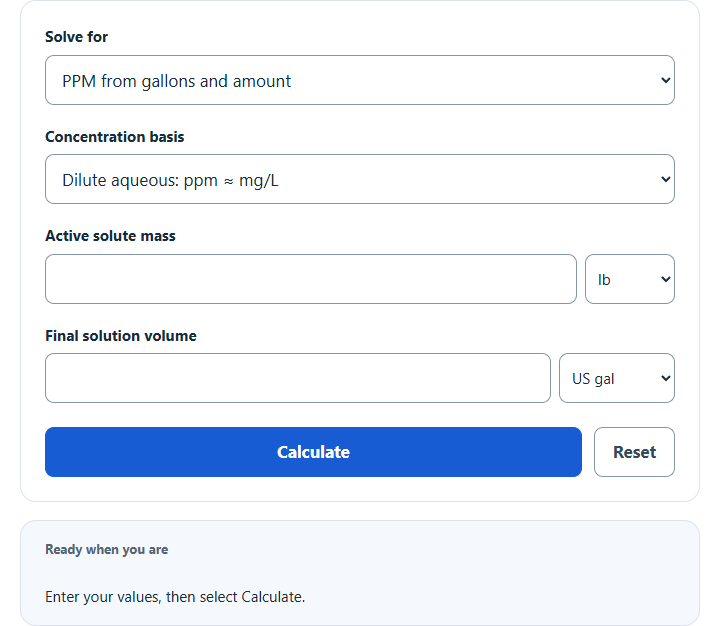
Convert an amount of solute in gallons of water to PPM, or find how much to add for a target PPM, with mg/L, g/L and grains per gallon (gpg) shown.
- All Unit Converters
- GPM (gallons/min) Calculator
- MCG to PPM Calculator
- PPM to Molarity Calculator
- Area To Gallons Calculator
Calculator Functions
| Function | What it does | What it requires |
|---|---|---|
| PPM from gallons and amount | Finds the concentration in ppm of a solute dissolved in a known volume of solution | Requires the active solute mass and the final solution volume |
| Amount to add for a target PPM | Finds the mass of active solute that brings a volume of solution to a target concentration | Requires the target ppm and the final solution volume |
| Gallons for a target PPM | Finds the solution volume that a mass of solute brings to a target concentration | Requires the active solute mass and the target ppm |
Every function starts with the concentration basis. Dilute aqueous treats 1 ppm as 1 mg/L, which suits water-like solutions. Mass fraction gives ppm by mass and also requires the final solution density in kg/L. Solute mass is entered in lb, oz, g, mg, kg or grains, and volume in US gallons, Imperial gallons or liters. Each result also shows the concentration in mg/L, g/L and grains per US gallon (gpg).
Gallons to PPM Formulas
| ppm | Concentration in parts per million, taken as mg/L for a dilute water-based solution [1] |
| m | Active solute mass (mg) |
| V | Final solution volume (L) |
With the solute in pounds and the volume in US gallons, the same formula is ppm = lb ÷ gal × 119,826.4, because 1 lb is 453,592.37 mg and 1 US gallon is 3.785411784 L [2]. On the mass fraction basis the volume is turned into a mass first:
ρ is the final solution density in kg/L, so V × ρ is the solution mass in kg and the result is in mg/kg.
PPM from gallons and amount
One pound of solute in 100 US gallons is 453,592.37 mg in 378.54 L, or 1,198.26 ppm. On the mass fraction basis at 1.2 kg/L the same mix is 998.55 ppm. The gpg figure uses 1 grain = 64.79891 mg, so 1 gpg is 17.12 mg/L [2].
The table gives the dilute aqueous figures for common tank sizes. The last column times the target ppm is the grams needed: 3 ppm in 3,000 gallons takes 3 × 11.3562 = 34.07 g.
| US gallons | ppm from 1 lb | ppm from 1 kg | Grams for 1 ppm |
|---|---|---|---|
| 5 | 23,965.3 | 52,834.4 | 0.0189 |
| 10 | 11,982.6 | 26,417.2 | 0.0379 |
| 25 | 4,793.1 | 10,566.9 | 0.0946 |
| 50 | 2,396.5 | 5,283.4 | 0.1893 |
| 55 | 2,178.7 | 4,803.1 | 0.2082 |
| 100 | 1,198.3 | 2,641.7 | 0.3785 |
| 250 | 479.3 | 1,056.7 | 0.9464 |
| 500 | 239.7 | 528.3 | 1.8927 |
| 1,000 | 119.8 | 264.2 | 3.7854 |
| 2,000 | 59.9 | 132.1 | 7.5708 |
| 3,000 | 39.9 | 88.1 | 11.3562 |
| 5,000 | 24.0 | 52.8 | 18.9271 |
| 10,000 | 12.0 | 26.4 | 37.8541 |
| 20,000 | 6.0 | 13.2 | 75.7082 |
Amount to add for a target PPM
ρ is 1 on the dilute aqueous basis. The mass comes out in mg and is shown in the chosen unit: g, lb, oz, mg, kg or grains. A 5 gallon batch at 50 ppm needs 50 × 18.927 = 946.4 mg, or 0.9464 g.
Gallons for a target PPM
One pound of solute at 100 ppm treats 453,592.37 ÷ 100 = 4,535.92 L, or 1,198.26 US gallons. The target must be above zero, because no volume gives 0 ppm from a positive mass.
Limits of This Estimate
- Dilute aqueous ppm equals mg/L only when a liter of the solution weighs about 1 kg [1]. Brines, syrups and concentrates need the mass fraction basis with a measured density.
- The solute is treated as pure active ingredient. A product that is 50% active needs twice the mass shown, and label directions still apply.
- A volume in gallons has no ppm value by itself, and neither does a flow rate in gallons per minute. A mass of solute is always needed.
- The result is mg/L or ppm by mass. It is not the ppm by volume used for gases.
Sources
- U.S. EPA, Test Methods, Data Reporting Questions: 1 ppm equals 1 mg/kg, and 1 mg/L for water samples
- NIST, Guide for the Use of the International System of Units (SP 811), Appendix B.8: factors for pounds, grains, US gallons and Imperial gallons