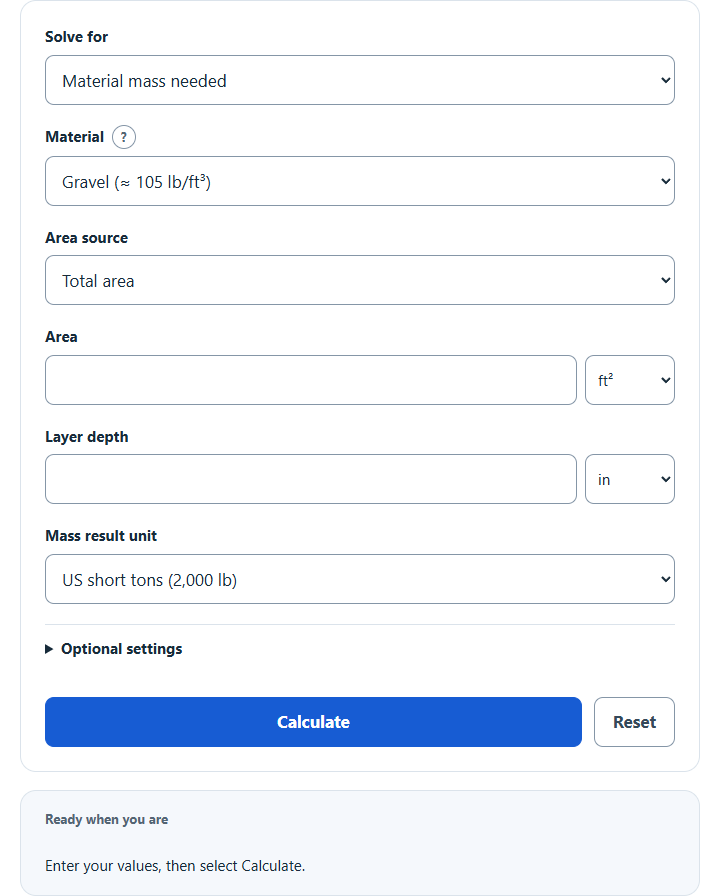
Convert area to tons of gravel, stone, sand, soil or mulch from square feet and depth using typical densities, or find the area a given tonnage covers.
- All Unit Converters
- Area to Weight Conversion Calculator
- Square Feet to Tons Calculator
- Cubic Feet to Tons Calculator
- Bulk Density Calculator
- Soil Stockpile Volume Calculator
Calculator Functions
| Function | What it does | What it requires |
|---|---|---|
| Material mass needed | Converts an area and a layer depth into the tons of gravel, stone, sand, soil, mulch, asphalt or concrete needed | Requires the material or its bulk density, the area (or a length and width), the layer depth and the result unit |
| Coverage area | Finds how much area a given tonnage covers at a chosen depth | Requires the material or its bulk density, the available mass, the layer depth and the area unit |
| Volume to tons | Converts a bulk volume straight to tons, with no area or depth | Requires the material or its bulk density and the volume in 100 ft³ units, ft³, yd³ or m³ |
| Tons to volume | Converts tons into the bulk volume they fill | Requires the material or its bulk density, the mass and the volume unit |
Areas can be entered in ft², yd², m² or acres, depths in inches, feet or centimeters, and mass in US short tons, metric tonnes or long tons. The material list has 12 preset densities and a custom option that takes lb/ft³, short tons per yd³ or kg/m³. Material mass needed also takes an extra allowance in percent and a price per short ton.
Area to Tons Formulas
| Tons | Mass in US short tons of 2,000 lb [3] |
| A | Area (ft²) |
| D | Layer depth in feet, which is inches ÷ 12 |
| ρ | Bulk density of the material (lb/ft³) |
Area times depth is the volume, and volume times density is the weight in pounds. Dividing by 2,000 gives short tons. For metric tonnes the pounds are divided by 2,204.62, and for long tons by 2,240 [3].
The material list uses typical loose bulk densities, from 25 lb/ft³ for wood mulch to 150 lb/ft³ for concrete, with gravel at 105. Real loads vary. One state highway maintenance manual lists loose weights of 82 to 103 lb/ft³ and compacted weights of 105 to 131 lb/ft³ for crushed rock, sand, slag and asphalt mixes [1], and a state design manual estimates compacted granular materials at 110 to 140 lb/ft³ and hot mix asphalt at 145 [2].
Material mass needed
For 500 ft² of gravel 3 inches deep: 500 × 0.25 × 105 = 13,125 lb, which is 6.5625 short tons or 5.9534 metric tonnes. An extra allowance of 10% raises that to 7.2188 short tons.
Coverage area
M is the mass in pounds. One short ton of gravel covers 2,000 ÷ 105 ÷ (2 ÷ 12) = 114.29 ft² at a depth of 2 inches. One metric tonne covers 125.98 ft², or 11.7 m², at the same depth. Coverage falls as the layer gets deeper:
| Depth | 1 short ton covers | 1 metric tonne covers |
|---|---|---|
| 1 in | 228.57 ft² | 251.96 ft² (23.41 m²) |
| 2 in | 114.29 ft² | 125.98 ft² (11.70 m²) |
| 3 in | 76.19 ft² | 83.99 ft² (7.80 m²) |
| 4 in | 57.14 ft² | 62.99 ft² (5.85 m²) |
| 6 in | 38.10 ft² | 41.99 ft² (3.90 m²) |
The table is for gravel at 105 lb/ft³. A lighter material covers more area per ton and a heavier one covers less.
Volume to tons
V is the volume in cubic feet. One cubic yard of gravel is 27 × 105 = 2,835 lb, or 1.4175 short tons. One 100 ft³ unit of gravel is 10,500 lb, or 5.25 short tons.
Tons to volume
5 short tons of gravel is 10,000 ÷ 105 = 95.238 ft³, which is 3.5273 yd³.
How to Work Out Tonnage from Square Meters
Multiply the area in m² by the depth in meters and by the density in tonnes per cubic meter. Gravel at 105 lb/ft³ is about 1.682 t/m³. For 26 m² at a depth of 5 cm: 26 × 0.05 × 1.682 = 2.1865 tonnes. In the calculator, set the area unit to m², the depth unit to cm and the result unit to metric tonnes.
Limits of This Estimate
- Bulk density changes with the product, its moisture and how tightly it is compacted. The preset densities are typical loose values, not product specifications, so confirm the density with the supplier for an order. These estimates are based on the best available data and estimations.
- The extra allowance adds mass. It is not a prediction of how much a layer will settle or compact.
- A unit in the volume functions means exactly 100 ft³. Suppliers do not all use the same unit size.
- These are tons of weight. Air-conditioning tons measure cooling capacity and cannot be found from an area and a material density. The Cooling Capacity Calculator estimates those from a room size.
Sources
- Missouri Department of Transportation, Highway Maintenance Tables and Conversion Factors: loose and compacted weights per cubic foot of rock, sand, slag and asphalt mixes
- Iowa Department of Transportation, Design Manual, Section 1B-4, Densities for Use in Estimating Quantities: densities used to estimate quantities of granular material and hot mix asphalt
- NIST Special Publication 811, Appendix B.8, Factors for Units Listed Alphabetically: short ton, long ton and metric tonne in pounds and kilograms