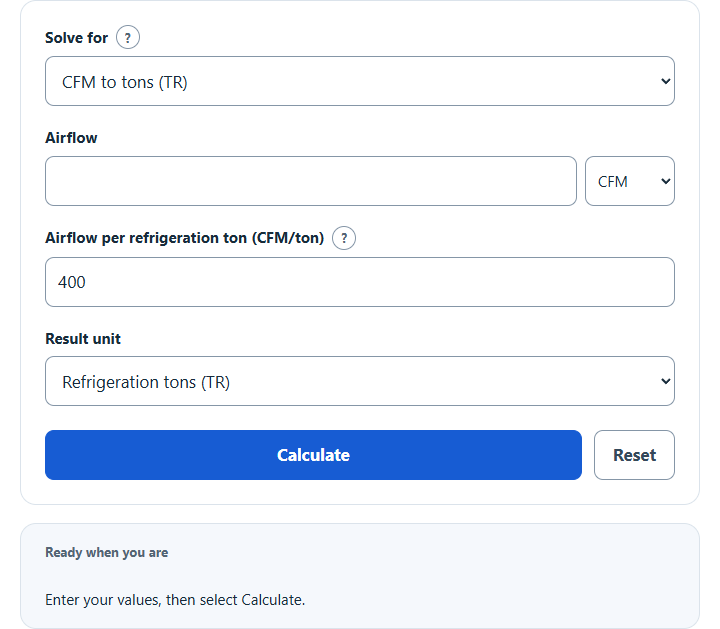
Convert CFM to tons (TR) of cooling with the common 400 CFM per ton rule, or tons to CFM, and enter your own CFM per ton if your equipment differs.
- All Unit Converters
- CFM Per Ton Calculator
- Air Flow Calculator
- CFM to Static Pressure Calculator
- Cooling Capacity Calculator
- kW Per Ton Calculator
- GPM Per Ton Calculator
Calculator Functions
| Function | What it does | What it requires |
|---|---|---|
| CFM to tons (TR) | Converts an airflow into the cooling capacity that airflow normally goes with, in refrigeration tons, Btu/h or kW | Requires the airflow in CFM or m³/min and the airflow per ton, which starts at 400 CFM/ton |
| Tons (TR) to CFM | Converts a cooling capacity into the airflow a system of that size is normally set to move, in CFM or m³/min | Requires the cooling capacity in tons, Btu/h or kW and the airflow per ton |
Both functions share one setting, the airflow per refrigeration ton. It starts at 400 CFM/ton and can be changed to the figure on the equipment data sheet. Every result also lists the airflow for system sizes from 1 to 10 tons at the rate entered.
CFM to Tons Formulas
| TR | Cooling capacity in refrigeration tons. 1 TR = 12,000 Btu/h, about 3.517 kW [2] |
| CFM | Airflow across the indoor coil (cubic feet per minute) |
| R | Airflow per ton (CFM/ton). 400 unless changed |
400 CFM per ton sits in the middle of the range field specifications call for. One utility specification for heat pumps and air conditioners recommends 375 to 425 CFM per ton across the indoor coil and allows no less than 350 [1]. Systems in hot, dry climates are often set higher: a U.S. Department of Energy field study worked to a target of 400 to 480 CFM per ton [3].
CFM to tons (TR)
The airflow is divided by the airflow per ton. 2,000 CFM ÷ 400 = 5 tons, which is 60,000 Btu/h or 17.584 kW. At 350 CFM/ton the same 2,000 CFM works out to 5.7143 tons. An airflow entered in m³/min is first converted at 1 m³/min = 35.3147 CFM [2].
Tons (TR) to CFM
1 ton is 400 CFM at the default rate, and 3 tons is 1,200 CFM. At 350 CFM/ton, 1 ton is 350 CFM. A capacity entered in Btu/h is divided by 12,000 first, so 36,000 Btu/h is 3 tons and 1,200 CFM.
CFM to Tons Chart
These values use 400 CFM per ton. For another rate, divide the CFM by that rate instead.
| CFM | Tons (TR) | Btu/h |
|---|---|---|
| 400 | 1 | 12,000 |
| 600 | 1.5 | 18,000 |
| 800 | 2 | 24,000 |
| 1,000 | 2.5 | 30,000 |
| 1,200 | 3 | 36,000 |
| 1,400 | 3.5 | 42,000 |
| 1,600 | 4 | 48,000 |
| 2,000 | 5 | 60,000 |
| 3,000 | 7.5 | 90,000 |
| 4,000 | 10 | 120,000 |
| 6,000 | 15 | 180,000 |
| 8,000 | 20 | 240,000 |
| 10,000 | 25 | 300,000 |
| 12,000 | 30 | 360,000 |
| 16,000 | 40 | 480,000 |
| 20,000 | 50 | 600,000 |
Limits of This Estimate
- Airflow does not measure cooling capacity. The result is the system size that normally goes with that airflow, and the real capacity depends on the equipment, the coil and the operating conditions. Check the equipment data and the building load before sizing a system.
- The airflow per ton is a rule of thumb. Specifications range from about 350 to 480 CFM per ton depending on climate and equipment [1] [3], so use the rated airflow when it is known.
- A refrigeration ton is a rate of heat removal, 12,000 Btu/h [2]. It is not a short ton or metric tonne of mass.
Sources
- Bonneville Power Administration, PTCS Airflow Test (Detailed Instructions): recommended and minimum airflow per ton, and dividing measured airflow by system tons
- NIST Special Publication 811, Appendix B.8, Factors for Units Listed Alphabetically: ton of refrigeration in Btu/h and watts, and cubic feet per minute in metric units
- U.S. Department of Energy, Building America, Retrofitting Air Conditioning and Duct Systems in Hot, Dry Climates: higher airflow per ton targets in hot, dry climates