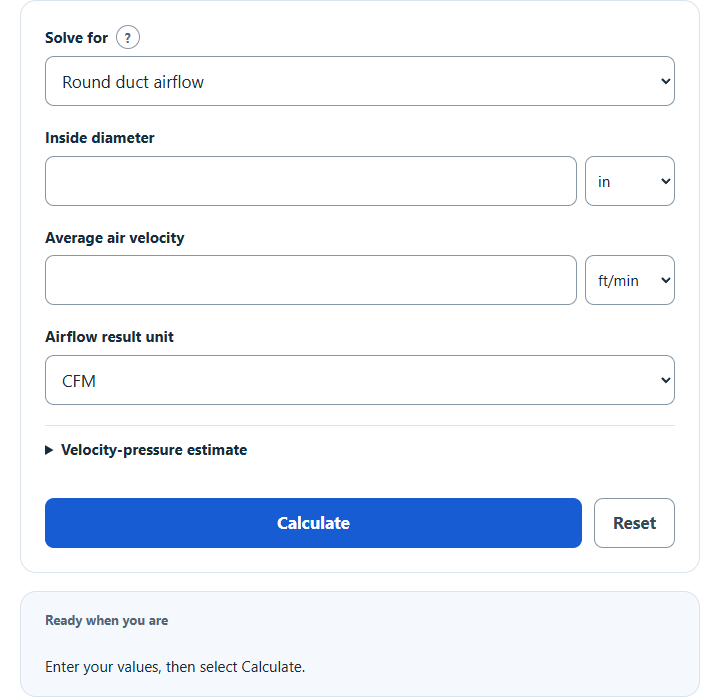
Calculate air flow in CFM from duct size and air velocity, find duct velocity from CFM, convert airflow units, or get room CFM from air changes per hour.
- All Physics Calculators
- Duct Velocity Calculator
- Pipe Flow Calculator
- Flow Rate Pressure Calculator
- CFM Per Ton Calculator
- Return Air Duct Size Calculator
- SCCM Calculator
- Pneumatic Cylinder Airflow Calculator
Calculator Functions
| Function | What it does | What it requires |
|---|---|---|
| Round duct airflow | Finds the volume of air moving through a round duct | Requires the inside diameter, the average air velocity and the airflow result unit |
| Rectangular duct airflow | Finds the volume of air moving through a rectangular duct | Requires the inside width and height, the average air velocity and the airflow result unit |
| Round duct velocity | Finds the average air speed in a round duct from a known airflow | Requires the inside diameter, the actual volume flow and the velocity result unit |
| Rectangular duct velocity | Finds the average air speed in a rectangular duct from a known airflow | Requires the inside width and height, the actual volume flow and the velocity result unit |
| Convert airflow units | Converts an airflow between CFM, m³/h, L/s and m³/s | Requires the airflow, its unit and the result unit |
| Room airflow from ACH | Finds the airflow that gives a room a chosen number of air changes per hour | Requires the room length, width and height, the air changes per hour and the airflow result unit |
Duct sizes are entered in mm, cm, in, m or ft, velocity in m/s, ft/min or ft/s, and airflow in CFM, m³/h, L/s or m³/s. Every result is also listed in CFM, m³/h and L/s. The four duct functions have one optional setting, air density, which is used only for the dynamic velocity pressure and is taken as 1.2 kg/m³ when left blank.
Air Flow Formulas
| Q | Volumetric airflow (m³/s, or CFM when V is in ft/min and A is in ft²) |
| V | Average air velocity across the duct (m/s or ft/min) |
| A | Inside cross-sectional area of the duct (m² or ft²) |
Air moving at velocity V through an area A sweeps out a volume of A × V in every unit of time [1]. Airflow in CFM is cubic feet per minute, so feet per minute times square feet gives CFM directly.
Round duct airflow
D is the inside diameter. A 12 in duct has an area of 0.7854 ft², so air averaging 800 ft/min gives 800 × 0.7854 = 628.3 CFM, which is 1,067.5 m³/h or 296.5 L/s.
Rectangular duct airflow
A 12 in × 8 in duct has an area of 0.6667 ft², so 800 ft/min gives 533.3 CFM. The results also list the hydraulic diameter, 2 × width × height ÷ (width + height), which is 9.6 in for this duct.
Round duct velocity
This is the main formula rearranged, with the round duct area. A flow of 600 CFM in a 12 in round duct averages 600 ÷ 0.7854 = 763.9 ft/min.
Rectangular duct velocity
The same rearrangement with the rectangular area: 600 CFM in a 12 in × 8 in duct averages 600 ÷ 0.6667 = 900 ft/min.
Dynamic velocity pressure
ρ is the air density in kg/m³ and V is in m/s, which gives q in pascals. At 800 ft/min (4.064 m/s) and 1.2 kg/m³ it is 9.91 Pa. This is the pressure tied to the motion of the air [2]. It is not the static pressure in the duct, the fan pressure or the pressure lost to friction.
Convert airflow units
Airflow is a volume per unit of time, and the four units differ only by fixed factors. One CFM is 0.4719474 L/s [3], so 100 CFM is 47.19 L/s, 169.9 m³/h and 0.0472 m³/s.
| Airflow unit | Meaning | Equal to 1 CFM |
|---|---|---|
| CFM | Cubic feet per minute | 1 |
| m³/h | Cubic meters per hour | 1.699011 |
| L/s | Liters per second | 0.4719474 |
| m³/s | Cubic meters per second | 0.0004719474 |
Room airflow from ACH
With the room volume in cubic feet, Q is in CFM. With the volume in m³ and a divisor of 3,600, Q is in m³/s. A 12 ft × 10 ft room with an 8 ft ceiling holds 960 ft³, so 5 air changes per hour needs 960 × 5 ÷ 60 = 80 CFM. This is the CDC formula for air changes per hour, ACH = CFM × 60 ÷ (floor area × height), solved for the airflow [4].
Limits of This Estimate
- The velocity has to be the average across the whole duct. Air in a duct is turbulent and one reading may not be enough: OSHA describes a traverse of six or ten readings on each of two or three passes, and puts the average in a long straight round duct at about 90% of the centerline velocity [5].
- Duct sizes are inside dimensions. Lining, insulation or an outside measurement changes the area and the result with it.
- The duct functions use the flow at actual conditions and do not model compressibility, friction or fan performance. The 1.2 kg/m³ default density suits air near room temperature at sea level.
- A chosen air change rate does not show how much outdoor air a space needs or whether it meets a standard. CDC describes 5 air changes per hour as a rough guide that lowers exposure without guaranteeing safe air [4].
Sources
- NASA Glenn Research Center, Mass Flow Rate: volume swept by a flow as area × velocity × time
- NASA Glenn Research Center, Dynamic Pressure: dynamic pressure as density × velocity² ÷ 2
- NIST, Guide for the Use of the International System of Units (SP 811), Appendix B.8: cubic foot per minute in m³/s and L/s, and foot per minute in m/s
- CDC, National Institute for Occupational Safety and Health, How Much Ventilation Is Enough?: air changes per hour from airflow in CFM and room volume, and the limits of the 5 ACH target
- OSHA Technical Manual, Section III, Chapter 3, Ventilation Investigation: duct velocity measurement, the traverse method and the 90% centerline estimate