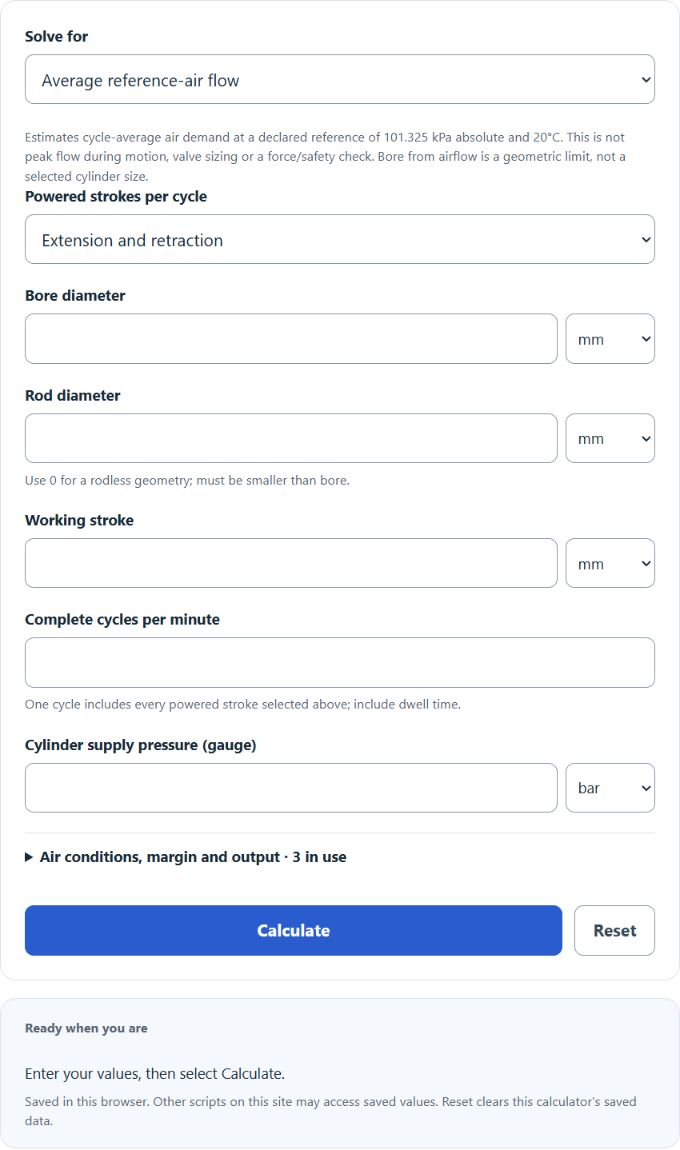
Estimate cycle-average reference-air consumption from bore, rod, stroke, gauge pressure and complete cycles per minute, or solve an average-flow cycle limit or geometric bore. The declared reference is 101.325 kPa absolute and 20°C; other SCFM conventions can differ.
- All Physics Calculators
- Air-Flow Calculator
- CFM Per Ton Calculator
- Air Exchange Calculator (Air Change Per Hour & Minute)
- Pneumatic Cylinder Velocity Calculator
Pneumatic Cylinder Airflow Formula
The calculator sums powered chamber swept volumes per complete cycle, corrects them to the declared reference pressure and temperature, and multiplies by complete cycles per minute and the selected allowance. It estimates average consumption, not the instantaneous motion flow needed for valve sizing. The SMC technical data, Data 2 (printed page 1574) distinguishes cycle air use from motion-flow requirements.
Geometric and inverse relationships used by the three solve modes:
- Qref is volume per minute at 101.325 kPa absolute and 20°C.
- D and d are bore and rod diameters; S is working stroke, in consistent units.
- Ae and Ar are extension and annular retraction areas; extension-only operation sets Ar to zero.
- N counts complete cycles per minute, including dwell time.
- C = (gauge pressure + local ambient absolute pressure) / 101.325 kPa × 293.15 K / cylinder temperature K.
- M = 1 + added allowance percent / 100. For the bore solve, actionFactor is 2 − (rod/bore)² for double action and 1 for extension only.
The average-flow and cycle-rate modes use bore and rod diameters; the bore mode uses a supplied rod-to-bore percentage. All lengths convert to meters before calculation. The optional allowance is applied once. It does not measure leakage or account explicitly for piping/dead volume, cushioning, transient flow or pressure loss. A bore from an average air budget is a continuous mathematical diameter, not a nominal selection or force check.
Common Unit Conversions for Pneumatic Cylinder Airflow
| Quantity | Unit | Conversion Used |
|---|---|---|
| Area | 1 sq cm | 0.155 sq in |
| Area | 1 sq ft | 144 sq in |
| Length | 1 cm | 0.393701 in |
| Length | 1 ft | 12 in |
| Flow | 1 CFM | 28.3168 LPM |
| Flow | 1 CFM | 0.0283168 m³/min |
Airflow Inputs and What They Represent
| Input | What to Enter | Important Note |
|---|---|---|
| Bore and rod diameters | Actual bore and rod dimensions, or rod/bore percentage for bore solve | For the rod side of a double-acting cylinder, use bore area minus rod area. |
| Stroke | Distance traveled during one powered stroke | Use the actual working stroke, not the full cylinder length. |
| Cycles per minute | Complete extension/retraction cycles per minute, including dwell time | Double action sums cap-end and rod-end swept volumes once; extension-only uses one powered stroke. |
| Airflow | Volume flow rate | Reference-air average, corrected for absolute pressure and stated temperature; the optional allowance is not a measured leakage correction. |
Example Calculations
Example 1: Calculate airflow
Assume a 50 mm bore, 20 mm rod, 100 mm working stroke, double action, 10 complete cycles/min and 6 bar gauge. Use 101.325 kPa local ambient, 20°C cylinder air and a 10% added allowance. These are illustrative inputs, not design recommendations.
The estimated average is 27.50699 L/min at the declared reference, including the chosen allowance. This is about 0.97140 ft³/min at the same reference conditions. Actual motion flow can be higher.
Example 2: Calculate cycles per minute
Using the same geometry and assumptions, suppose the available average-air budget is 25 L/min at the declared reference.
The average air-budget limit is 9.08860 complete cycles/min. Valve capacity, pressure loss, stroke time and load may prevent that rate. At 10 cycles/min with the same 40% rod/bore ratio, a 25 L/min budget instead implies a geometric bore of about 47.66707 mm, not a selected nominal cylinder size.
FAQ
Does this calculate SCFM or CFM?
The tool reports reference-equivalent L/min or SCFM at explicitly defined 101.325 kPa absolute and 20°C, using an ideal-gas pressure and temperature correction. It is not uncorrected chamber CFM and does not imply every supplier’s standard conditions. For valve/line selection, obtain the directional flow during actual stroke travel, not just this cycle average.
How do you find piston area if you only know the bore diameter?
For a round piston, calculate area from bore diameter with:
Use diameter in inches to get area in square inches. For example, a 4 in bore has an area of about 12.57 sq in.
Is the airflow the same for extend and retract on a double-acting cylinder?
No. The extend side usually uses the full bore area. The retract side uses the annular area, which is the bore area minus the rod area. If you need total air use for a full extend-retract cycle, calculate the extend volume and retract volume separately, then add them.