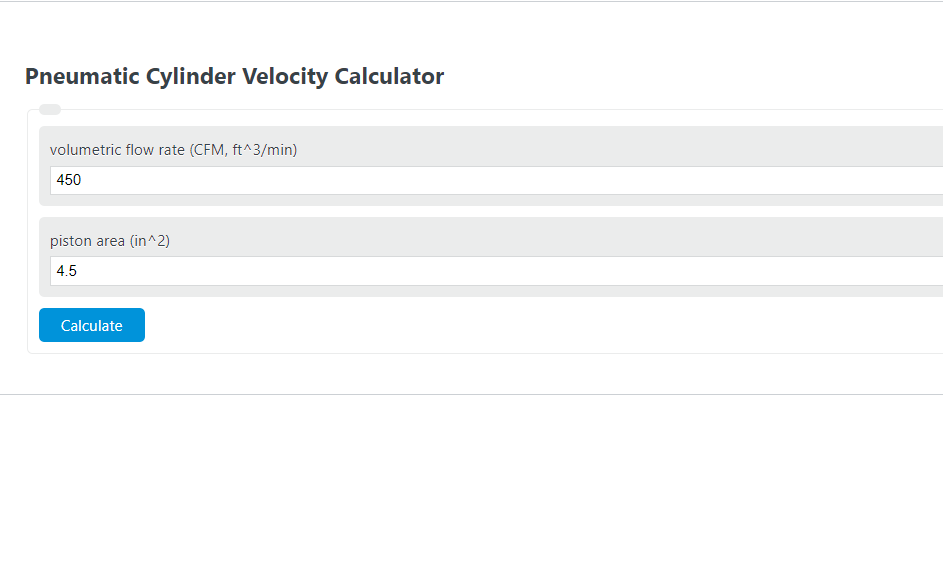
Calculate pneumatic cylinder velocity from flow rate and piston area, or solve for flow rate or area using selectable units and conversions.
- All Physics Calculators
- All Velocity Calculators
- Pneumatic Cylinder Airflow Calculator
- Air Compressor Fill Time Calculator
Pneumatic Cylinder Velocity Formula
Pneumatic cylinder velocity is the linear speed of the piston rod. In its simplest form, cylinder speed equals the volumetric flow rate divided by the effective piston area. This calculator applies that relationship and converts the units automatically when flow is entered in CFM and area is entered in square inches.
For the calculator’s imperial form, the equation is:
The conversion factor 28.8 comes from converting cubic feet per minute into cubic inches per second.
Variable Definitions
| Symbol | Description | Common Units |
|---|---|---|
| PCV or v | Pneumatic cylinder velocity | in/s, cm/s, m/s, ft/s |
| Q | Volumetric flow rate of air reaching the cylinder | CFM, L/min, m³/s |
| A | Effective piston area for the direction of travel | in², cm², m², ft² |
Important: the calculator estimates theoretical cylinder speed from flow and area. Actual speed can be lower if the valve, tubing, fittings, exhaust path, or load reduce the airflow available at the cylinder.
How to Calculate Pneumatic Cylinder Velocity
- Determine the airflow delivered to the cylinder.
- Choose the correct piston area for the motion direction.
- Use consistent units for flow and area.
- Divide flow by area, or use the converted form of the equation shown above.
Finding the Correct Piston Area
The effective area is not always the same in both directions. On extension, air acts on the full piston face. On retraction, the rod reduces the usable area.
| Direction | Area Formula | Meaning |
|---|---|---|
| Extension | Aₑₓₜ = (π D²) / (4) |
Uses the full bore diameter |
| Retraction | Aᵣₑₜ = (π (D² - d²)) / (4) |
Subtracts the rod diameter area |
Where D is the cylinder bore diameter and d is the rod diameter.
Because the retracting side usually has less area, cylinders often retract faster than they extend when the flow rate is the same.
Common Unit Forms
| Input Units | Velocity Form |
|---|---|
| CFM and in² | v = (28.8Q) / (A) |
| L/min and cm² | v = (16.667Q) / (A) |
| m³/s and m² | v = (Q) / (A) |
Example
If the airflow is 450 CFM and the piston area is 4.5 in², the estimated cylinder velocity is:
This value represents an idealized result from the entered flow and area. Real-world pneumatic systems may move more slowly because of pressure losses, compressibility, metering, cushioning, and load effects.
What Affects Actual Cylinder Speed?
- Valve capacity: undersized directional valves and flow controls can limit the air reaching the cylinder.
- Tubing and fittings: long runs, small inside diameters, and multiple elbows create additional restriction.
- Supply pressure: speed is primarily flow-driven, but inadequate pressure can reduce usable flow under load.
- Exhaust backpressure: restricted exhaust slows cylinder motion even if inlet flow is adequate.
- External load and friction: seals, guides, tooling, and side loads all affect achievable speed.
- End-of-stroke cushioning: cushions intentionally reduce speed near the end of travel.
- Direction of motion: retraction commonly differs from extension because the rod changes the active area.
Practical Design Notes
- Use the airflow available at the cylinder, not just compressor nameplate capacity.
- Calculate extension and retraction separately whenever rod diameter is significant.
- Keep units consistent before applying the equation manually.
- For high-speed applications, verify valve Cv, port size, stroke length, and manufacturer speed limits.
- If precise speed control is required, use properly sized flow controls and test under the real load.
Common Questions
Is higher pressure the same as higher speed?
Not necessarily. Cylinder speed is mainly determined by airflow rate. Higher pressure can help maintain force and support flow under load, but flow capacity is usually the main limiter.
Why is retraction often faster?
The rod occupies part of the piston area on the retract side. With less effective area and the same flow rate, the rod-side velocity is often higher.
Can the same concept be used for hydraulic cylinders?
Yes. The core relationship between flow, area, and linear speed is the same, although hydraulic systems use different operating conditions and unit conventions.