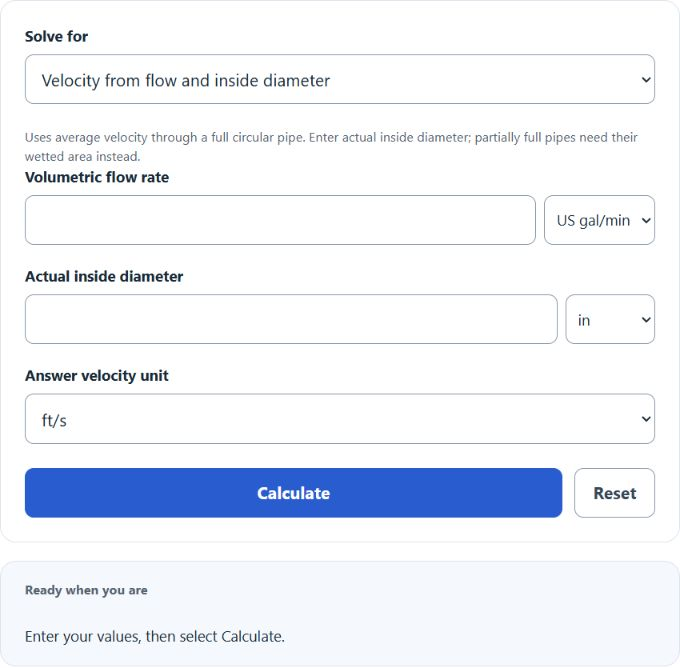
Calculate pipe flow velocity from GPM and actual inside diameter, or solve for flow rate or pipe size using US and metric flow, diameter, and velocity units.
- All Unit Converters
- Thermodynamics and Fluid Unit Converters
- All Velocity Calculators
- Fan Velocity Calculator
- Stream Velocity Calculator
- Oil Velocity Calculator
- CC/REV to GPM Calculator
Liquid Velocity Formula
Liquid velocity is the average speed of a liquid moving through a cross-sectional area. To find velocity, divide the volumetric flow rate by the flow area.
If you need to solve for flow rate or area instead, use these rearrangements:
Variables and Units
| Variable | Meaning | Typical Units |
|---|---|---|
| LV | Liquid velocity | ft/s, m/s, km/h, mph |
| FR | Volumetric flow rate | ft³/s, m³/s, L/s, GPM |
| A | Cross-sectional flow area | ft², m² |
How to Use the Calculator
- Choose the missing value: liquid velocity, flow rate, or actual inside diameter of a full circular pipe. Enter the other two values.
- Select the correct unit for each input.
- Calculate the selected value. For this widget, flow area is πD²/4; use actual inside diameter, not nominal pipe size.
This equation gives average velocity across the flow area. In real systems, the local velocity may vary across the pipe or channel due to wall friction and flow profile effects.
Common Area Formulas
If area is not already known, calculate it from the flow geometry first.
| Geometry | Area Formula | Use Case |
|---|---|---|
| Full circular pipe | A = (π D²) / (4) |
Pipe flowing full |
| Rectangular channel or duct | A = b × h |
Open channels, tanks, ducts |
| Annular flow area | A = (π (Dₒ² - Dᵢ²)) / (4) |
Flow between concentric cylinders |
If the pipe or channel is only partially full, use the actual wetted flow area, not the full inside area.
Example Calculation
If the liquid flow rate is 20 ft³/s and the flow area is 5 ft², then:
Unit Consistency Guide
| If Flow Rate Is In | And Area Is In | Velocity Comes Out In |
|---|---|---|
| m³/s | m² | m/s |
| ft³/s | ft² | ft/s |
| L/s or GPM | ft² or m² | Convert flow rate to ft³/s or m³/s first when calculating by hand |
Practical Notes
- For a fixed area, increasing flow rate increases velocity.
- For a fixed flow rate, decreasing area increases velocity.
- Higher liquid velocity can increase pressure loss, turbulence, noise, and erosion potential.
- Use the internal flow area of the pipe, tube, or channel, measured perpendicular to the direction of flow.
Common Questions
- Is liquid velocity the same as flow rate?
- No. Flow rate measures volume per time, while velocity measures distance per time.
- Can this formula be used for water, oil, or chemicals?
- Yes. The relationship between volumetric flow rate, area, and average velocity is the same as long as the inputs are in consistent units.
- What happens if I double the pipe diameter?
- The flow area increases significantly, so velocity drops unless the flow rate also increases.