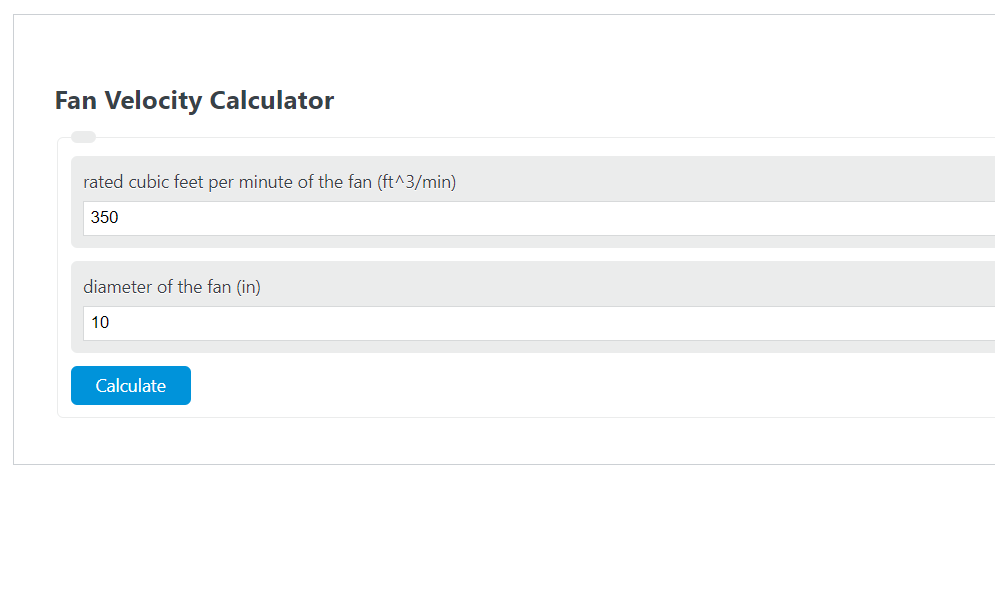
Calculate average fan or duct air velocity, airflow, or required diameter for round, rectangular, and custom free areas in metric or imperial units.
- All Velocity Calculators
- All Physics Calculators
- CFM to HP Calculator
- Duct Velocity Calculator
- Fan Efficiency Calculator
Fan Velocity Formula
- V — air velocity (ft/min, convert to ft/s by dividing by 60)
- Q — volumetric airflow (CFM, ft³/min)
- A — cross-sectional area of the fan or duct (ft²)
- D — fan or duct diameter (ft)
To solve for diameter when velocity is the target, rearrange to D = 2 × √(Q / (V × π)). The formula assumes a round duct, uniform flow across the cross-section, and standard air density. Real fans have a velocity profile that is faster in the center and slower at the walls, so treat the result as an average.
Typical Values
Use these ranges to sanity-check your inputs and result.
| Application | Recommended Velocity |
|---|---|
| Residential supply duct | 5–8 ft/s (300–500 fpm) |
| Residential return duct | 8–12 ft/s (500–700 fpm) |
| Light commercial main | 12–17 ft/s (700–1000 fpm) |
| Industrial low-pressure | 20–30 ft/s (1200–1800 fpm) |
| Dust collection / high-velocity | 35–50 ft/s (2100–3000 fpm) |
| Diameter | Area (ft²) | CFM at 10 ft/s |
|---|---|---|
| 6 in | 0.196 | 118 |
| 8 in | 0.349 | 209 |
| 10 in | 0.545 | 327 |
| 12 in | 0.785 | 471 |
| 16 in | 1.396 | 838 |
| 24 in | 3.142 | 1885 |
Example
A 12-inch duct moves 1200 CFM. What is the air velocity?
- Convert diameter to feet: 12 in ÷ 12 = 1 ft
- Area = π × (0.5)² = 0.785 ft²
- Velocity = 1200 ÷ 0.785 = 1528 ft/min
- Divide by 60: 25.5 ft/s (7.76 m/s)
That is high for a residential supply but normal for a light industrial main. If the result feels too high, increase the duct size. If it is too low, airflow may be undersized for the space.
FAQ
Why does my measured velocity differ from this calculator? Anemometers read a single point. Velocity is highest at the center of the duct and drops near the walls. Take multiple readings and average them, or use a Pitot traverse.
Does this work for rectangular ducts? Not directly. Calculate the rectangular area (width × height) and divide CFM by that area to get velocity in ft/min.
What velocity is too high? Above roughly 20 ft/s in a residential system you will hear noise at registers and grilles. Industrial systems tolerate higher velocities but pay for it in static pressure and fan power.