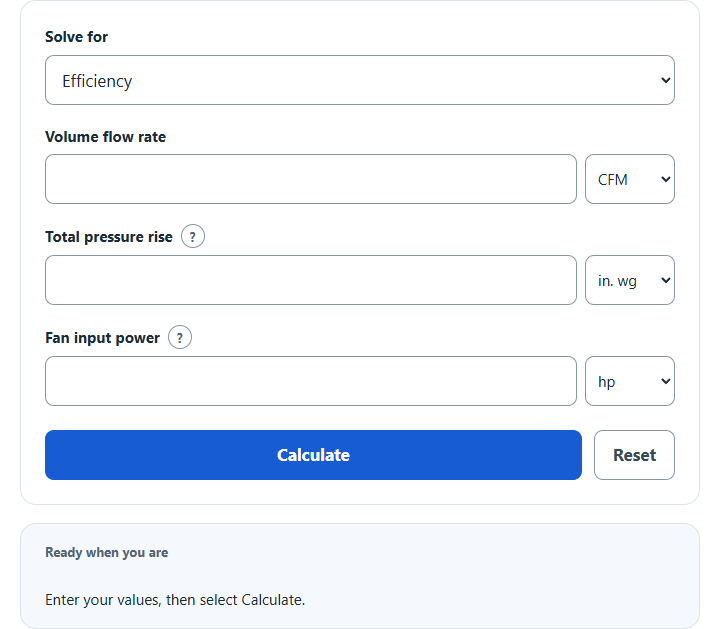
Calculate fan efficiency from airflow, pressure rise and input power, or estimate fan power, flow or pressure from typical fan efficiencies.
- All Physics Calculators
- Fan Velocity Calculator
- Fan Energy Index Calculator
- CFM to HP Calculator
- CFM to Static Pressure Calculator
Calculator Functions
| Function | What it does | What it requires |
|---|---|---|
| Efficiency | Finds fan efficiency as the share of input power that reaches the air | Requires the volume flow rate, the total pressure rise and the fan input power |
| Flow rate | Finds the airflow a fan delivers at a given pressure rise and input power | Requires a fan efficiency, the total pressure rise and the fan input power |
| Pressure rise | Finds the total pressure rise a fan produces at a given airflow and input power | Requires a fan efficiency, the volume flow rate and the fan input power |
| Input power | Finds the input power needed to move a given airflow against a given pressure rise | Requires a fan efficiency, the volume flow rate and the total pressure rise |
Flow is entered in CFM or L/s, pressure in in. wg, psi or Pa, and power in hp or kW. The three functions that need an efficiency offer typical values by fan type: about 75% for backward-inclined centrifugal, 60% for forward-curved centrifugal, 70% for tube or vane axial and 50% for propeller fans, with a custom entry for a value read from a fan curve. Every result also shows the air power in watts.
Fan Efficiency Formulas
| η | Fan efficiency (%) |
| Q | Volume flow rate (m³/s) |
| Δp | Total pressure rise across the fan (Pa) |
| Pin | Fan input power (W) |
Q × Δp is the power delivered to the air. The calculator converts every entry to these SI units first, using 1 CFM = 0.000471947 m³/s, 1 in. wg = 249.08891 Pa and 1 hp = 745.69987 W.
Efficiency
(6,343.3 × hp) × 100
This is the main formula with the unit conversions folded into one constant. A fan moving 10,000 CFM against 4 in. wg on 10 hp of shaft power has an efficiency of 10,000 × 4 ÷ (6,343.3 × 10) × 100 = 63.06%. The U.S. Department of Energy prints the same equation with a constant of 6,362 [1], which reflects a slightly different inch of water and gives 62.87% for this fan. A result above 100% is rejected, because it means the readings or units do not belong together.
Flow rate
At the 75% backward-inclined value, 10 hp and 4 in. wg, the flow is 0.75 × 10 × 6,343.3 ÷ 4 = 11,894 CFM.
Pressure rise
At the 60% forward-curved value, 10 hp and 10,000 CFM, the pressure rise is 0.60 × 10 × 6,343.3 ÷ 10,000 = 3.81 in. wg.
Input power
Moving 10,000 CFM against 4 in. wg at the 70% axial value takes 10,000 × 4 ÷ (6,343.3 × 0.70) = 9.01 hp at the fan shaft. The motor draws more than this: electrical input is the shaft power divided by the motor efficiency [1], so with a 90% efficient motor it is about 10 hp, or 7.5 kW.
Limits of This Estimate
- The result is total efficiency when total pressure is entered and static efficiency when static pressure is entered. The two differ, so a figure should be compared only with one of the same kind [1].
- Shaft power gives the efficiency of the fan alone. Electrical input power also contains motor and drive losses, so it gives a lower, whole-system figure.
- The fan-type values are typical figures, not ratings. The Department of Energy describes forward-curved fans as 55 to 65% efficient, airfoil-bladed vaneaxial fans as reaching 85% and propeller fans as relatively inefficient, without one number for each type [1]. A fan’s own curve at its operating point is the real value. These estimates are based on the best available data and estimations.
- Air is treated as incompressible, which suits ordinary ventilation pressures. Flow, pressure and power must be measured at the same operating point, and this is not a certified fan test.
Sources
- U.S. Department of Energy, Improving Fan System Performance: A Sourcebook for Industry (DOE/GO-102003-1294, 2003): total efficiency equation, total and static efficiency, efficiency by fan type, and shaft power against electrical power