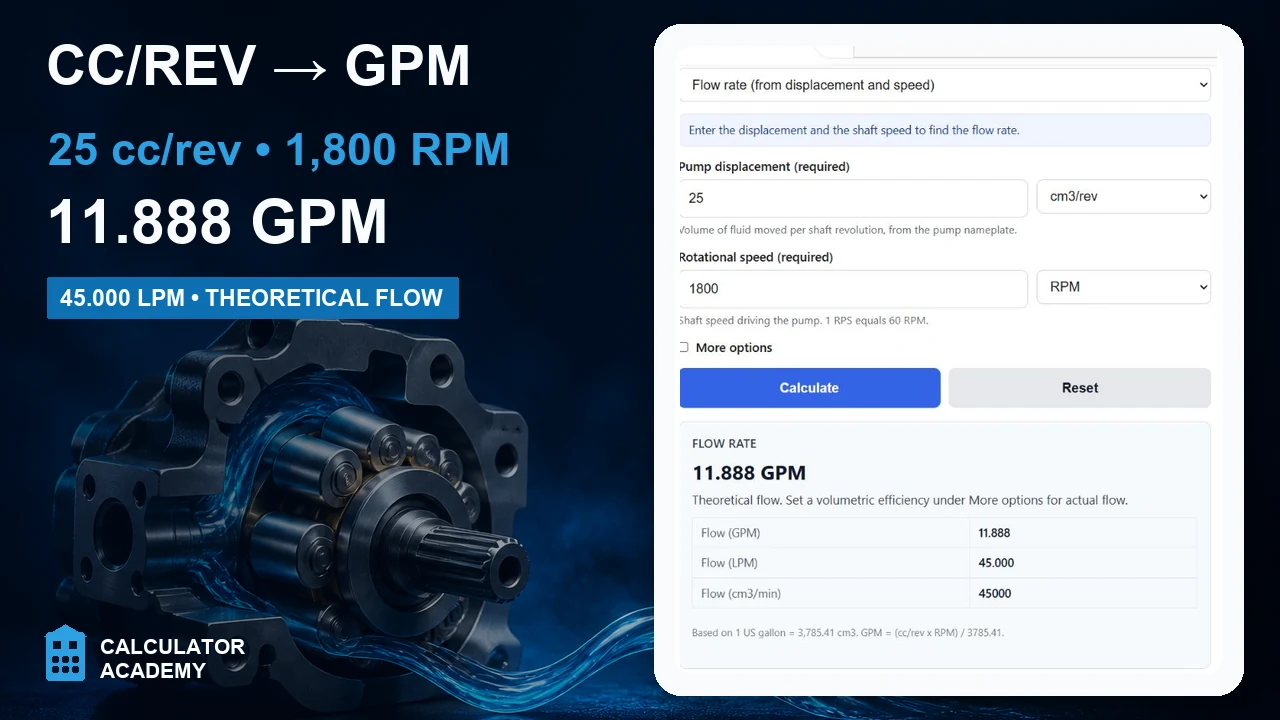
Calculate hydraulic flow in GPM from pump displacement in cc/rev and RPM, or find missing displacement or speed using metric and US units.
- All Unit Converters
- M3/H to GPM Calculator
- GPM Calculator
- Volumetric Flow Rate Calculator
- Hydraulic Horsepower Calculator
- Pump Power Calculator
CC/REV to GPM Formula
CC/REV (cubic centimeters per revolution) is the displacement of a hydraulic pump or motor, representing the volume of fluid moved in one full shaft rotation. GPM (gallons per minute) is the volumetric flow rate. Converting between them requires knowing the shaft speed in RPM.
Where 3,785 is the number of cubic centimeters in one US gallon (3,785.41 cm3). This formula gives theoretical flow. Actual delivered flow is always lower due to internal leakage within the pump.
Alternate forms of the same relationship:
- Using cubic inches: GPM = (in3/rev x RPM) / 231
- Solving for displacement: CC/REV = (GPM x 3785) / RPM
- Solving for speed: RPM = (GPM x 3785) / CC/REV
- Metric output: LPM = (CC/REV x RPM) / 1000
CC/REV to GPM Conversion Table
| CC/Rev (cm3/rev) | RPM | Flow (GPM) |
|---|---|---|
| 5 | 900 | 1.189 |
| 5 | 1800 | 2.378 |
| 7.5 | 900 | 1.783 |
| 7.5 | 1800 | 3.567 |
| 10 | 900 | 2.378 |
| 10 | 1800 | 4.756 |
| 12.5 | 900 | 2.972 |
| 12.5 | 1800 | 5.944 |
| 16 | 900 | 3.804 |
| 16 | 1800 | 7.609 |
| 19 | 900 | 4.518 |
| 19 | 1800 | 9.036 |
| 20 | 900 | 4.756 |
| 20 | 1800 | 9.511 |
| 25 | 900 | 5.944 |
| 25 | 1800 | 11.888 |
| 32 | 900 | 7.609 |
| 32 | 1800 | 15.218 |
| 40 | 900 | 9.511 |
| 40 | 1800 | 19.023 |
| * Rounded to 3 decimals. Formula: GPM = (cc/rev x RPM) / 3785. Uses US gallon (1 gal = 3,785 cm3). | ||
Volumetric Efficiency and Actual Flow
The formula above calculates theoretical flow, which assumes zero internal leakage. Every hydraulic pump loses some fluid internally as pressure increases, so the actual delivered flow is always less than theoretical. The ratio of actual to theoretical flow is called volumetric efficiency.
Actual GPM = Theoretical GPM x Volumetric Efficiency
Typical volumetric efficiency ranges by pump type at rated pressure:
| Pump Type | Volumetric Efficiency | Typical Displacement Range | Max Pressure (bar) |
|---|---|---|---|
| External Gear | 80 - 91% | 1 - 200 cm3/rev | 250 |
| Internal Gear (Gerotor) | 85 - 93% | 4 - 250 cm3/rev | 175 |
| Vane (Balanced) | 85 - 95% | 5 - 160 cm3/rev | 210 |
| Axial Piston (Swashplate) | 95 - 98% | 5 - 500 cm3/rev | 420 |
| Axial Piston (Bent Axis) | 96 - 98% | 10 - 750 cm3/rev | 450 |
| Radial Piston | 96 - 98% | 20 - 7000 cm3/rev | 700 |
| Efficiency decreases as pressure approaches maximum rated value. Values shown at approximately 70% of rated pressure. | |||
For example, a 25 cm3/rev external gear pump running at 1,800 RPM has a theoretical flow of 11.89 GPM, but with 88% volumetric efficiency, actual delivered flow is approximately 10.46 GPM.
Common Displacement Values by Application
Pump displacement is selected based on the required flow rate and available drive speed. Standard electric motors in North America run at 1,750 RPM (4-pole, 60 Hz), while PTO-driven pumps on mobile equipment typically run at 540 or 1,000 RPM. The table below shows common displacement values matched to typical applications.
| Application | Typical CC/Rev | Drive Speed (RPM) | Approx. GPM |
|---|---|---|---|
| Small power pack / clamping | 1.6 - 4 | 1,750 | 0.7 - 1.8 |
| Log splitter | 8 - 16 | 3,450 | 7.3 - 14.6 |
| Tractor 3-point hitch | 12 - 20 | 540 | 1.7 - 2.9 |
| Skid steer loader | 30 - 60 | 2,200 | 17.4 - 34.9 |
| Industrial press | 40 - 80 | 1,750 | 18.5 - 37.0 |
| Excavator (main pump) | 100 - 250 | 1,800 - 2,100 | 47.6 - 138.7 |
| Marine deck crane | 60 - 180 | 1,500 | 23.8 - 71.3 |
| Injection molding machine | 80 - 200 | 1,750 | 37.0 - 92.5 |
| GPM values are theoretical. Actual flow depends on pump type and system pressure. | |||
How to Calculate GPM from CC/REV
- Determine the pump displacement in cm3/rev. This is printed on the pump nameplate or listed in the manufacturer datasheet. If given in in3/rev, multiply by 16.387 to convert to cm3/rev.
- Determine the shaft speed in RPM. For electric motor drives, this is the motor nameplate speed (commonly 1,750 or 3,450 RPM). For engine-driven pumps, use the operating RPM at the pump input shaft.
- Multiply displacement by RPM, then divide by 3,785.
- For actual (not theoretical) flow, multiply the result by the pump's volumetric efficiency (typically 0.85 to 0.97 depending on pump type and pressure).
Example: A 50 cm3/rev axial piston pump is driven by a 1,750 RPM electric motor. The system operates at 200 bar, and the pump's volumetric efficiency at this pressure is 96%.
Theoretical GPM = (50 x 1750) / 3785 = 23.12 GPM
Actual GPM = 23.12 x 0.96 = 22.19 GPM
Related Hydraulic Formulas
Once you know the flow rate, several other hydraulic system parameters can be derived from it:
- Hydraulic Horsepower: HHP = (GPM x PSI) / 1714
- Input Torque (in-lbs): T = (Displacement in3/rev x PSI) / (2 x pi)
- Electric Motor HP Required: HP = (GPM x PSI) / (1714 x Overall Efficiency)
- Cylinder Speed (in/min): V = (GPM x 231) / Piston Area (in2)
These formulas allow you to size the complete hydraulic system once the pump's flow rate is known.