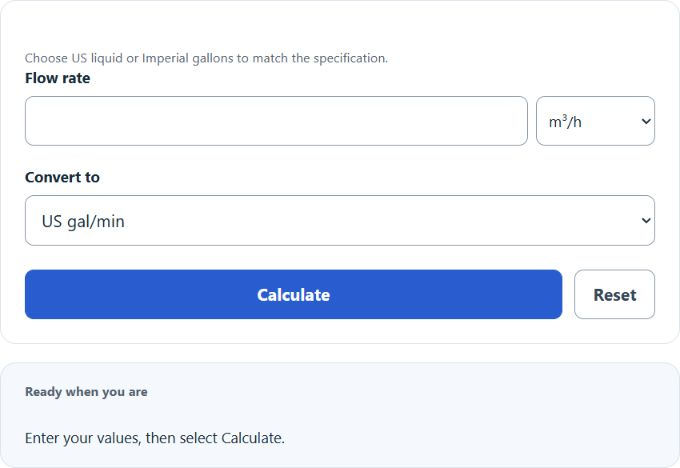
Convert between m³/h and GPM, plus L/s, LPM, CFS, and ft³/h, to find equivalent flow rates in US or imperial units for any one entered value.
Watch the full explanation with transcript and sources →
Typical Flow Rates by Application
If you are using this calculator to verify a measurement or sanity-check a specification, it helps to know what typical flow rates look like for common applications. The table below gives approximate ranges in both unit systems.
| Application | Typical Range (US GPM) | Typical Range (m³/h) |
|---|---|---|
| Residential kitchen faucet | 1.0 – 2.2 | 0.23 – 0.50 |
| Residential showerhead (WaterSense) | 1.5 – 2.0 | 0.34 – 0.45 |
| Whole-house residential supply | 6 – 12 | 1.4 – 2.7 |
| Residential irrigation zone (per zone) | 10 – 15 | 2.3 – 3.4 |
| Commercial kitchen pre-rinse spray | 1.3 – 5.0 | 0.30 – 1.14 |
| Small farm well | 6 – 16 | 1.4 – 3.6 |
| Agricultural irrigation pump | 50 – 500 | 11 – 114 |
| HVAC chiller (per 100 tons, evaporator side) | ~240 | ~55 |
| Cooling tower (500-ton, condenser side) | ~1,500 | ~341 |
| Commercial fire sprinkler (demand area) | 100 – 500 | 23 – 114 |
| Fire hydrant (full flow) | 500 – 1,500 | 114 – 341 |
| Industrial centrifugal pump | 100 – 5,000+ | 23 – 1,136+ |
| Municipal water treatment plant | 1,000 – 50,000+ | 227 – 11,356+ |
m³/h to GPM Formula
Cubic meters per hour and gallons per minute both measure volumetric flow rate — the volume of fluid passing a point in a given amount of time. The conversion factor accounts for two differences: the volume of a US gallon versus a cubic meter, and the time unit (hours versus minutes).
GPM = m³/h × 4.402868
US GPM → m³/h
m³/h = GPM × 0.22712470704
The rounded factor 4.402868 comes from 1,000 ÷ (3.785411784 × 60) ≈ 4.4028675393 US GPM per m³/h. To reverse the conversion, multiply US GPM by 0.22712470704 to obtain m³/h; this reciprocal factor is exact.
Where This Conversion Factor Comes From
A cubic meter is exactly 1,000 liters. One US liquid gallon is defined as 3.785411784 liters. That gives 1,000 ÷ 3.785411784 = 264.172 gallons per cubic meter. Since we are converting from a per-hour rate to a per-minute rate, we divide by 60, which produces the 4.402868 multiplier. The unit definitions are exact. The factors shown here may be rounded; the calculator uses the exact definitions before rounding the displayed result.
Worked Examples
Example 1 — Pump Spec Sheet (m³/h to GPM)
A European-manufactured centrifugal pump is rated at 12 m³/h. You need to verify that it meets your system’s requirement of at least 50 GPM for a process cooling loop.
GPM = 12 × 4.402868 = 52.83 GPM
The pump exceeds the 50 GPM requirement with roughly 6% headroom, which is within typical engineering margins.
Example 2 — Fire Suppression System (GPM to m³/h)
A fire sprinkler design calls for 200 GPM to the most demanding area. You need to specify a supply pump from a manufacturer that lists capacity in m³/h.
m³/h = 200 × 0.22712470704 = 45.42 m³/h
In practice, you would select a pump rated above this value to account for friction losses in the piping network, elevation changes, and the required residual pressure at the sprinkler heads.
Example 3 — HVAC Chiller Sizing
A building’s 500-ton cooling tower operates at a design flow of 1,500 GPM on the condenser water side. An engineer reviewing a global vendor’s specification needs the metric equivalent.
m³/h = 1,500 × 0.22712470704 = 340.69 m³/h
This is consistent with the HVAC industry standard of roughly 3 GPM per ton of cooling capacity on the condenser loop (1,500 GPM ÷ 500 tons = 3 GPM/ton).
US Gallons vs. Imperial Gallons — Why It Matters
There are two different gallons in common use, and confusing them when sizing equipment can cause serious problems. The US liquid gallon (3.785 liters) is the standard in the United States and is what “GPM” almost always refers to in North American engineering specs, pump catalogs, and plumbing codes. The Imperial gallon (4.546 liters) is used in the UK, parts of Canada, and some former Commonwealth countries.
Because the Imperial gallon is about 20% larger than the US gallon, the conversion factors are substantially different:
| Conversion | US Gallon | Imperial Gallon | Difference |
|---|---|---|---|
| 1 m³/h = | 4.4029 GPM | 3.6662 GPM | ~20% |
| 1 GPM = | 0.2271 m³/h | 0.2728 m³/h | ~20% |
When You Need This Conversion
The m³/h to GPM conversion comes up whenever fluid-handling equipment crosses the boundary between metric and US customary measurement systems. In practice, this happens frequently because pumps, valves, and flow meters are manufactured globally, but installed into systems engineered using local standards. Here are the most common scenarios:
Pump selection and specification. Pump manufacturers in Europe, Asia, and much of the world rate performance in m³/h, while system designers in the United States work in GPM. When reviewing a pump curve from a European manufacturer — or comparing bids from vendors in different countries — you need to convert flow rates to make an apples-to-apples comparison of capacity, head, and efficiency at the operating point.
HVAC chilled and condenser water systems. Commercial HVAC design frequently involves chillers and cooling towers from global manufacturers. Chilled water flow rates in the US are typically expressed at 2.4 GPM per ton of cooling on the evaporator side, while metric specs express the same values in m³/h or liters per second. Accurate conversion is essential for verifying that pipe sizing, pump selection, and control valve Cv ratings are all consistent.
Water and wastewater treatment. Treatment plant design involves flow rates ranging from a few m³/h for small package plants to thousands of m³/h for municipal facilities. Equipment like dosing pumps, UV disinfection systems, and membrane filtration units may be rated in either unit system depending on the manufacturer.
Fire protection engineering. Fire suppression systems in the US are designed and coded in GPM (NFPA standards), but internationally, flow requirements may be expressed in m³/h or L/min. Converting correctly is critical — undersizing a fire pump or riser because of a unit error can have life-safety consequences.
Industrial process engineering. Chemical plants, food and beverage processing, pharmaceutical manufacturing, and oil and gas facilities all move fluids through piped networks. Process flow diagrams from international engineering firms often use m³/h, while field instruments and local codes in the US reference GPM.
Related Flow Rate Units
Cubic meters per hour and gallons per minute are just two of many volumetric flow rate units you may encounter. Here is how m³/h relates to the other common ones:
| Unit | Abbreviation | 1 m³/h = |
|---|---|---|
| Liters per second | L/s | 0.2778 |
| Liters per minute | L/min or LPM | 16.667 |
| US gallons per minute | GPM (US) | 4.4029 |
| Imperial gallons per minute | GPM (Imp) | 3.6662 |
| Cubic feet per second | CFS or ft³/s | 0.009810 |
| Cubic feet per minute | CFM or ft³/min | 0.5886 |
| Cubic feet per hour | ft³/h | 35.315 |
| US barrels per day (petroleum) | bbl/day | 150.96 |
Note that “CMH” (cubic meters per hour) is simply another abbreviation for m³/h. You may also see m³/hr or cu.m/hr — these all mean the same thing.