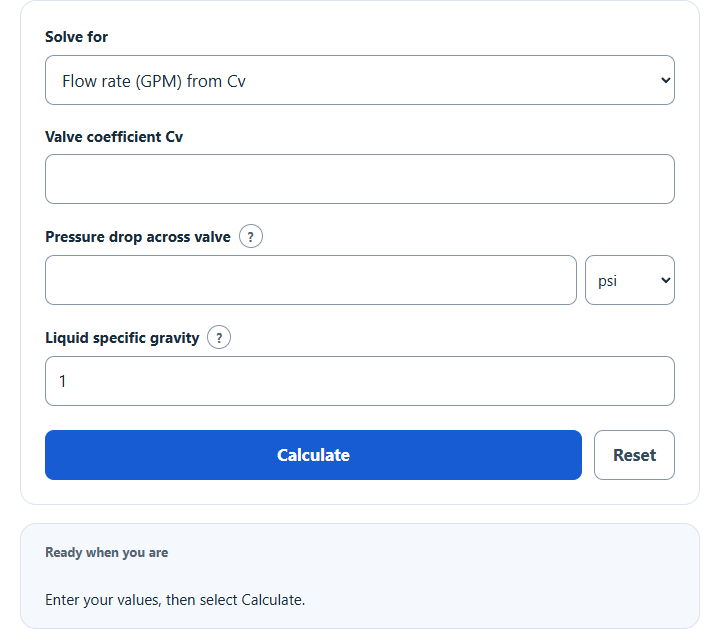
Convert Cv to GPM from a valve’s Cv and pressure drop, or GPM to Cv, for water or any liquid by specific gravity, with L/min, m³/h and Kv results.
- All Unit Converters
- Siphon Flow Rate Calculator
- Flow Rate Pressure Calculator
- CFM from Differential Pressure Calculator
GPM from CV Formula
The following two example problems outline the steps and information needed to calculate the GPM from CV.
GPM = CV × SQRT (P / SG)
Variables:
- GPM is the GPM from CV (gallons per minute)
- CV is the valve flow coefficient (CV)
- P is the pressure differential (PSI)
- SG is the specific gravity of the liquid (1 for water).
To calculate US GPM, multiply Cv by the square root of pressure differential in psi divided by liquid specific gravity. This simplified relationship applies to clean, non-choked incompressible liquid flow.
| Cv (unitless) | Flow (GPM) |
|---|---|
| 0.5 | 0.500 |
| 0.75 | 0.750 |
| 1 | 1.000 |
| 1.5 | 1.500 |
| 2 | 2.000 |
| 3 | 3.000 |
| 4 | 4.000 |
| 5 | 5.000 |
| 7.5 | 7.500 |
| 10 | 10.000 |
| 12 | 12.000 |
| 15 | 15.000 |
| 20 | 20.000 |
| 25 | 25.000 |
| 30 | 30.000 |
| 40 | 40.000 |
| 50 | 50.000 |
| 75 | 75.000 |
| 100 | 100.000 |
| 150 | 150.000 |
| * Rounded to 3 decimals. US customary: Q (GPM) = Cv × √(ΔP/SG). With SG = 1.00 and ΔP = 1 psi, Q = Cv. | |
How to Calculate GPM from CV?
The following steps outline how to calculate the GPM from CV.
- First, determine the valve flow coefficient (CV).
- Next, determine the pressure differential (PSI).
- Next, gather the formula from above: GPM = CV * SQRT (P/SG).
- Finally, calculate the GPM from CV.
- After inserting the variables and calculating the result, check your answer with the calculator above.
Example Problem :
Use the following variables as an example problem to test your knowledge.
valve flow coefficient (CV) = 2.5
pressure differential (PSI) = 30
For water (SG = 1), GPM = 2.5 × √(30/1) ≈ 13.693 US gpm.