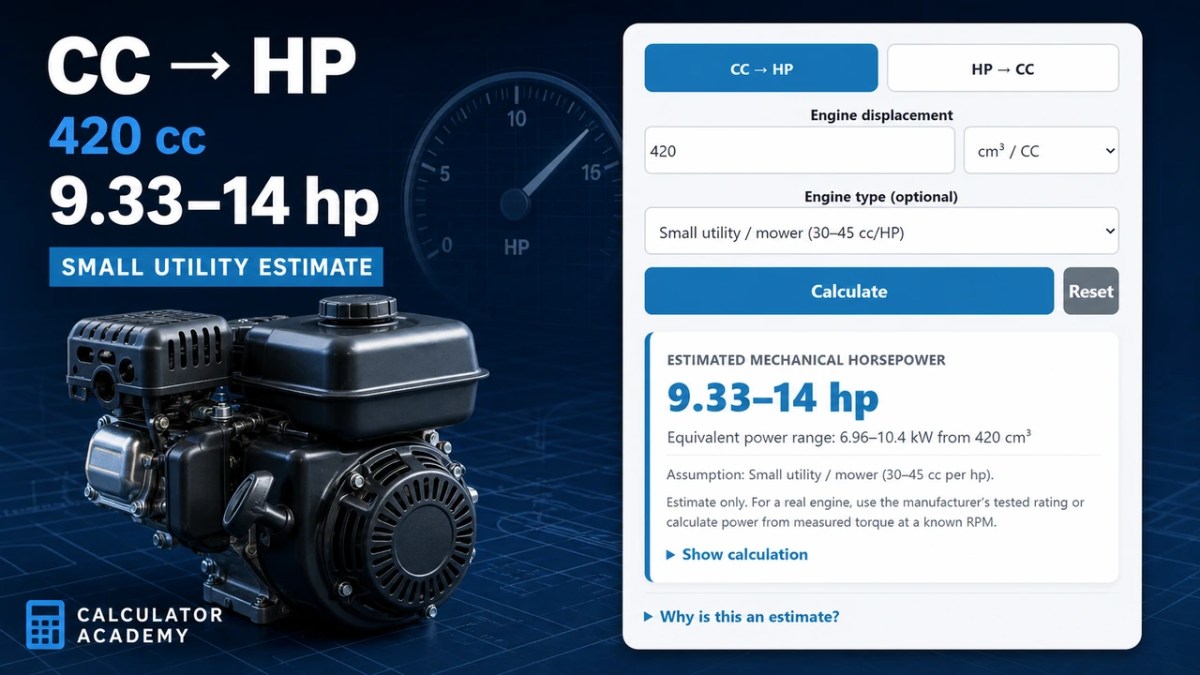
No exact conversion exists—enter a value to estimate a CC-to-HP or HP-to-CC range by engine type.
How the CC to HP estimate works
The calculator uses a transparent cc-per-horsepower assumption. For a single assumption, estimated horsepower equals displacement divided by the assumed cc per hp:
Estimated mechanical HP = engine displacement (cm³) ÷ assumed cm³ per HP
When you choose a range, the calculator divides by both ends of that range. The higher cc-per-hp number gives the lower horsepower estimate; the lower cc-per-hp number gives the higher estimate. For the reverse direction:
Estimated displacement (cm³) = mechanical HP × assumed cm³ per HP
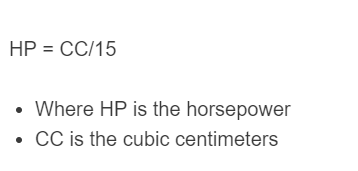
The familiar 15 cc per hp rule remains available as a legacy comparison, but it is not a physical conversion constant and should not be the default for every engine.
Which engine profile should I choose?
| Profile | Built-in assumption | Best use |
|---|---|---|
| Not sure | 5–45 cc per hp | A deliberately broad first look when the engine design is unknown. |
| Small utility / mower | 30–45 cc per hp | Conservative estimate for many mower, generator, pump, and similar utility engines. |
| General four-stroke | 15–30 cc per hp | Rule-of-thumb band for a non-specific four-stroke engine. |
| High-output / sport | 5–15 cc per hp | Illustrative band for engines producing more power per unit of displacement. |
| Legacy rule | 15 cc per hp | Single-number comparison used by many quick-conversion tables. |
| Custom | You choose | Use a known manufacturer, class, or project-specific assumption. |
These bands are estimating choices, not universal specifications. A turbocharged road engine, a naturally aspirated mower engine, and a racing motorcycle can have very different power outputs at the same displacement.
Why displacement alone cannot determine horsepower
Displacement tells you the swept volume of the cylinders. Horsepower describes the rate at which an engine does work. Actual output depends on torque at engine speed, along with airflow, compression, aspiration, fuel and ignition strategy, mechanical efficiency, tune, emissions hardware, and the test standard used.
Honda publishes a useful real-world comparison: its GX340, GX390, and GXV390 are each listed at 389 cm³, yet their SAE J1349 net ratings are 10.7, 11.7, and 10.2 hp. The same displacement therefore corresponds to three different tested outputs.
| Honda engine | Displacement | Published net power | Implied cc per hp |
|---|---|---|---|
| GX340 | 389 cm³ | 10.7 hp at 3,600 rpm | 36.4 |
| GX390 | 389 cm³ | 11.7 hp at 3,600 rpm | 33.2 |
| GXV390 | 389 cm³ | 10.2 hp at 3,600 rpm | 38.1 |
Honda also notes that installed power varies with operating speed, environment, maintenance, and other conditions. Briggs & Stratton’s published mower-engine table likewise shows different outputs for the same 190 cm³ displacement and, across its listed 125–223 cm³ models, implies roughly 33–45 cc per hp. That evidence is why this page returns ranges instead of false four-decimal precision.
CC to HP quick-reference table
The table below compares three assumption bands. These are estimated mechanical-horsepower ranges; they are not manufacturer ratings.
| Displacement | Small utility 30–45 cc/hp | General four-stroke 15–30 cc/hp | High-output / sport 5–15 cc/hp |
|---|---|---|---|
| 49 cc | 1.1–1.6 hp | 1.6–3.3 hp | 3.3–9.8 hp |
| 50 cc | 1.1–1.7 hp | 1.7–3.3 hp | 3.3–10 hp |
| 80 cc | 1.8–2.7 hp | 2.7–5.3 hp | 5.3–16 hp |
| 100 cc | 2.2–3.3 hp | 3.3–6.7 hp | 6.7–20 hp |
| 110 cc | 2.4–3.7 hp | 3.7–7.3 hp | 7.3–22 hp |
| 125 cc | 2.8–4.2 hp | 4.2–8.3 hp | 8.3–25 hp |
| 150 cc | 3.3–5 hp | 5–10 hp | 10–30 hp |
| 200 cc | 4.4–6.7 hp | 6.7–13.3 hp | 13.3–40 hp |
| 212 cc | 4.7–7.1 hp | 7.1–14.1 hp | 14.1–42.4 hp |
| 250 cc | 5.6–8.3 hp | 8.3–16.7 hp | 16.7–50 hp |
| 300 cc | 6.7–10 hp | 10–20 hp | 20–60 hp |
| 350 cc | 7.8–11.7 hp | 11.7–23.3 hp | 23.3–70 hp |
| 400 cc | 8.9–13.3 hp | 13.3–26.7 hp | 26.7–80 hp |
| 420 cc | 9.3–14 hp | 14–28 hp | 28–84 hp |
| 450 cc | 10–15 hp | 15–30 hp | 30–90 hp |
| 500 cc | 11.1–16.7 hp | 16.7–33.3 hp | 33.3–100 hp |
| 600 cc | 13.3–20 hp | 20–40 hp | 40–120 hp |
| 750 cc | 16.7–25 hp | 25–50 hp | 50–150 hp |
| 1,000 cc | 22.2–33.3 hp | 33.3–66.7 hp | 66.7–200 hp |
| 1,500 cc | 33.3–50 hp | 50–100 hp | 100–300 hp |
| 2,000 cc | 44.4–66.7 hp | 66.7–133.3 hp | 133.3–400 hp |
HP to CC quick-reference table
Reverse estimates are just as assumption-dependent. Select the calculator’s HP → CC tab for any value or unit.
| Mechanical HP | Small utility 30–45 cc/hp | General four-stroke 15–30 cc/hp | High-output / sport 5–15 cc/hp |
|---|---|---|---|
| 1 hp | 30–45 cc | 15–30 cc | 5–15 cc |
| 2 hp | 60–90 cc | 30–60 cc | 10–30 cc |
| 5 hp | 150–225 cc | 75–150 cc | 25–75 cc |
| 10 hp | 300–450 cc | 150–300 cc | 50–150 cc |
| 20 hp | 600–900 cc | 300–600 cc | 100–300 cc |
| 50 hp | 1,500–2,250 cc | 750–1,500 cc | 250–750 cc |
| 100 hp | 3,000–4,500 cc | 1,500–3,000 cc | 500–1,500 cc |
How to calculate actual horsepower
If you know measured torque and engine speed, mechanical horsepower is calculated from those two quantities—not from displacement:
Mechanical HP = torque (lb-ft) × RPM ÷ 5,252
A dynamometer measures torque through the engine’s speed range. Be sure to compare like with like: manufacturer net horsepower, gross horsepower, metric horsepower, and wheel horsepower are not interchangeable labels. For related calculations, use the HP to Torque Calculator or the WHP to HP Calculator.
Common CC and HP questions
Can I convert CC to HP?
You can estimate HP from CC only after choosing an engine-class or cc-per-hp assumption. There is no exact unit conversion because CC is volume and HP is power. Use a tested manufacturer rating whenever accuracy matters.
How many CC equals 1 HP?
There is no fixed answer. This estimator uses about 30–45 cc per hp for many small utility engines, 15–30 for a general four-stroke estimate, and 5–15 for a high-output estimate. The common 15 cc-per-hp rule is only one assumption.
How much horsepower is 1000 CC?
Using the profiles on this page, 1,000 cc is roughly 22.2–33.3 hp for a small utility estimate, 33.3–66.7 hp for a general four-stroke estimate, or 66.7–200 hp for a high-output estimate. The legacy 15 cc-per-hp rule gives 66.7 hp.
How much horsepower is 2000 CC?
At 2,000 cc, the same profiles give about 44.4–66.7 hp, 66.7–133.3 hp, or 133.3–400 hp. The wide spread is the point: displacement alone does not determine the result.
Does a larger engine always make more horsepower?
No. Within the same engine family and design, more displacement often supports more torque and power, but a smaller high-output engine can outperform a larger low-output engine. The Honda 389 cm³ examples above also show that identical displacement does not guarantee identical horsepower.
Are kW and metric horsepower the same?
No. NIST lists one U.S. mechanical horsepower as 745.6999 watts and one metric horsepower as 735.4988 watts. The calculator treats mechanical hp, kW, and metric hp (PS/CV) as separate units.
Methodology and sources
- Honda GX340/GX390 specifications: 389 cm³ displacement and 10.7/11.7 net hp ratings, plus Honda’s SAE J1349 testing note.
- Honda GXV390 specifications: 389 cm³ and 10.2 net hp.
- Briggs & Stratton mower power measurements: displacement, horsepower, kW, test procedures, and the torque/RPM formula.
- NIST power conversion factors: mechanical and metric horsepower in watts.
- NIST SI volume guidance: cubic measure and the formal cm³ notation.
Editorial method: The built-in profiles are intentionally broad rule-of-thumb bands. The small-utility band is informed by the cited Honda and Briggs & Stratton examples; the other bands are estimation scenarios for comparison, not claimed manufacturer standards. Calculations use 1 in³ = 16.387064 cm³, 1 mechanical hp = 745.6999 W, and 1 metric hp = 735.4988 W.