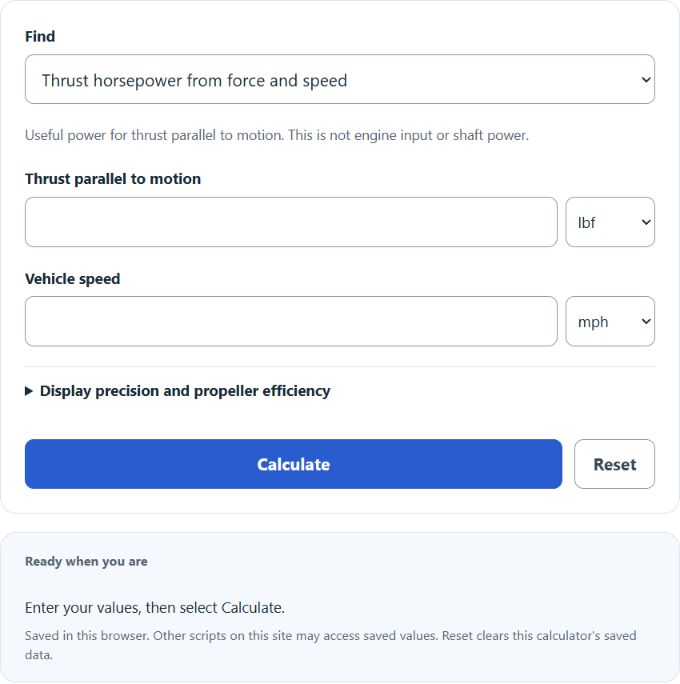
Enter thrust parallel to the vehicle motion and vehicle speed to calculate useful mechanical thrust horsepower. Reverse modes use useful thrust power, rather than engine, shaft or electrical-input power, to solve for thrust or speed.
| Thrust to Horsepower | Horsepower to Thrust |
|---|---|
| 10 lbf @ 60 mph = 1.6 HP | 1 HP @ 60 mph = 6.25 lbf |
| 20 lbf @ 60 mph = 3.2 HP | 2 HP @ 60 mph = 12.5 lbf |
| 25 lbf @ 60 mph = 4 HP | 3 HP @ 60 mph = 18.75 lbf |
| 30 lbf @ 60 mph = 4.8 HP | 5 HP @ 60 mph = 31.25 lbf |
| 40 lbf @ 60 mph = 6.4 HP | 7.5 HP @ 60 mph = 46.88 lbf |
| 50 lbf @ 60 mph = 8 HP | 10 HP @ 60 mph = 62.5 lbf |
| 75 lbf @ 60 mph = 12 HP | 15 HP @ 60 mph = 93.75 lbf |
| 100 lbf @ 60 mph = 16 HP | 20 HP @ 60 mph = 125 lbf |
| 125 lbf @ 60 mph = 20 HP | 25 HP @ 60 mph = 156.25 lbf |
| 150 lbf @ 60 mph = 24 HP | 30 HP @ 60 mph = 187.5 lbf |
| 200 lbf @ 60 mph = 32 HP | 40 HP @ 60 mph = 250 lbf |
| 250 lbf @ 60 mph = 40 HP | 50 HP @ 60 mph = 312.5 lbf |
| 300 lbf @ 60 mph = 48 HP | 60 HP @ 60 mph = 375 lbf |
| 400 lbf @ 60 mph = 64 HP | 75 HP @ 60 mph = 468.75 lbf |
| 500 lbf @ 60 mph = 80 HP | 100 HP @ 60 mph = 625 lbf |
| 750 lbf @ 60 mph = 120 HP | 125 HP @ 60 mph = 781.25 lbf |
| 1000 lbf @ 60 mph = 160 HP | 150 HP @ 60 mph = 937.5 lbf |
| 1500 lbf @ 60 mph = 240 HP | 200 HP @ 60 mph = 1250 lbf |
| 2000 lbf @ 60 mph = 320 HP | 250 HP @ 60 mph = 1562.5 lbf |
| 3000 lbf @ 60 mph = 480 HP | 300 HP @ 60 mph = 1875 lbf |
| Formulas: HP = (Thrust(lbf) x V(mph)) / 375 | Thrust(lbf) = (HP x 375) / V(mph) | |
| Thrust to Horsepower | Horsepower to Thrust |
|---|---|
| 50 lbf @ 100 mph = 13.33 HP | 10 HP @ 100 mph = 37.5 lbf |
| 100 lbf @ 100 mph = 26.67 HP | 25 HP @ 100 mph = 93.75 lbf |
| 250 lbf @ 100 mph = 66.67 HP | 50 HP @ 100 mph = 187.5 lbf |
| 500 lbf @ 100 mph = 133.33 HP | 100 HP @ 100 mph = 375 lbf |
| 1000 lbf @ 100 mph = 266.67 HP | 200 HP @ 100 mph = 750 lbf |
| Formulas: HP = (Thrust(lbf) x V(mph)) / 375 | Thrust(lbf) = (HP x 375) / V(mph) | |
- All Physics Calculators
- Thrust Calculator
- Thrust to Power Calculator
- Pounds of Thrust to Horsepower Calculator
- Horsepower to Force Calculator
- Power to Torque Calculator
| Calculator Operations | Required Inputs |
|---|---|
| Convert Horsepower and Velocity to Thrust | Horsepower, Velocity |
| Convert Horsepower and Thrust to Velocity | Horsepower, Thrust |
| Convert Thrust and Velocity to Horsepower | Thrust, Velocity |
Thrust to Horsepower Formula
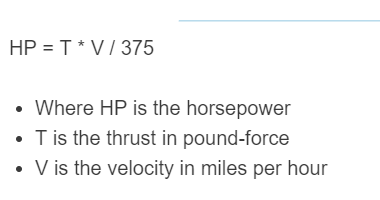
The standard formula for converting thrust to horsepower is:
- Where HP is useful mechanical thrust horsepower
- T is the thrust in pound-force (lbf)
- V is the velocity in miles per hour (mph)
The constant 375 comes from the definition of one mechanical horsepower: 550 ft-lbf/s. Since 1 mile = 5,280 ft and 1 hour = 3,600 seconds, the product (lbf x mph) must be divided by (550 x 3600 / 5280) = 375 to yield horsepower. For speed in international knots and thrust in lbf, the exact divisor is 150876/463, approximately 325.866091.
Why Thrust and Horsepower Are Not Equivalent
Thrust is a force, measured in pounds-force or newtons. Horsepower is a rate of work (power), measured in ft-lbf/s or watts. You cannot convert one to the other without knowing velocity because power equals force times velocity. A stationary engine can produce thrust while useful thrust power in the test-stand reference frame is zero. This does not mean its engine, shaft, electrical-input or exhaust-jet power is zero. At nonzero vehicle speed, useful thrust power is F times V for force parallel to motion. This velocity dependence is the single most important concept in thrust-to-horsepower conversion.
Types of Horsepower in Propulsion
In aviation and marine engineering, several distinct horsepower measurements exist. Shaft horsepower (SHP) is the power delivered by the engine’s output shaft before any propeller losses. Brake horsepower (BHP) is the power measured at the engine’s crankshaft or dynamometer. Thrust horsepower (THP) is the actual useful power propelling the vehicle forward, calculated from thrust and velocity using the formula above. For an applicable propeller operating point, THP = SHP × efficiency. The calculator accepts an entered efficiency greater than zero and up to 100%; 100% is an ideal reference. It supplies no assumed equipment efficiency. At zero vehicle speed, F × V does not identify actual shaft power.
Illustrative Thrust and Horsepower Calculations
| Application | Thrust (lbf) | Typical Speed | Approx. THP |
|---|---|---|---|
| Illustrative trolling-motor pair | 55 | 4 mph | 0.59 |
| Illustrative outboard pair | 180 | 25 mph | 12 |
| Illustrative piston-aircraft pair | ~300 | 140 mph | 112 |
| Illustrative turboprop pair | ~850 | 300 mph | 680 |
| Illustrative jet pair A | ~5,500 | 530 mph | 7,773 |
| Illustrative jet pair B | ~11,000 | 570 mph | 16,720 |
| Illustrative high-speed jet pair | 28,600 | 915 mph | 69,784 |
| Illustrative booster pair | 3,300,000 | ~100 mph (early ascent) | 880,000 |
| Arithmetic illustrations using the displayed force and speed pairs and HP = (T x V) / 375. These are not independently verified equipment operating points or performance ratings. Real net thrust and speed must describe the same operating condition. | |||
The table illustrates that useful thrust power changes with vehicle speed even if the entered thrust stays constant. For example, an assumed 3.3 million lbf at 100 mph represents 880,000 hp of useful thrust power; at 1,000 mph the same assumed force represents 8.8 million hp. These are conditional arithmetic examples, not measured engine or booster ratings.
Marine Trolling Motors: Thrust vs. Horsepower
A static-thrust rating alone does not identify useful power while a boat is moving. Use measured thrust and boat speed at the same operating point. For a DC supply, voltage multiplied by current gives electrical input power; 24 V × 50 A is 1,200 W, approximately 1.61 mechanical-horsepower units of electrical input. This is not shaft horsepower or useful thrust horsepower. Motor and propeller losses require their own operating-point information.
Alternate Unit Formulas
| Velocity Unit | Formula | Divisor |
|---|---|---|
| mph (with lbf) | HP = T x V / 375 | 375 |
| knots (with lbf) | HP = T x V / (150876/463) | ≈ 325.866091 |
| ft/s (with lbf) | HP = T x V / 550 | 550 |
| m/s (with N) | kW = T x V / 1000 | 1000 |
The ft/s version uses 550 directly because 1 HP = 550 ft-lbf/s by definition. The SI version outputs kilowatts since power in watts equals force (N) times velocity (m/s), and dividing by 1,000 converts to kW. To convert kW to HP, multiply by 1.341.
Propulsive Efficiency and Its Effect on the Conversion
The formula HP = T x V / 375 gives useful thrust horsepower for parallel thrust and velocity. At a nonzero operating speed, an applicable propeller efficiency relates it to shaft power: THP = SHP × efficiency. Enter that operating-point efficiency in percent to obtain SHP = THP / efficiency fraction; no equipment efficiency is assumed. At rest, useful thrust power is zero and this relation does not identify actual shaft power. For jets and rockets, F × V likewise describes useful vehicle power in the chosen frame, not engine-input or exhaust-jet power.
Worked Example
A turboprop aircraft in cruise produces 1,200 lbf of net thrust at an airspeed of 310 mph. Calculate the thrust horsepower.
HP = T x V / 375 = 1,200 x 310 / 375 = 992 HP
If the propeller efficiency is 0.85, the engine’s shaft horsepower is: SHP = THP / efficiency = 992 / 0.85 = 1,167 SHP
FAQ
Where does the 375 constant come from?One mechanical horsepower equals 550 foot-pounds per second. Since the formula uses mph, the unit conversion is 550 x 3,600 s/hr / 5,280 ft/mi = 375. It is a pure unit conversion factor, not an approximation.
Can you convert thrust to horsepower without knowing velocity?No. Thrust is a force and horsepower is power. Power = force x velocity, so without a velocity value the conversion is impossible. A stationary engine can produce thrust while useful thrust power in the test-stand frame is zero; its input and exhaust power need not be zero.
How do I compare a trolling motor’s thrust rating to outboard HP?A static-thrust rating does not establish useful power at a moving operating point. Use thrust and boat speed measured for the same condition. DC voltage times current estimates electrical input watts; converting those watts to horsepower units does not convert them into shaft or useful thrust horsepower.
Does the formula work for jet engines and rockets?Yes. The formula applies to any propulsion system where thrust is a measured force. For jets, use the net thrust (gross thrust minus ram drag) at the flight speed of interest. For rockets, thrust changes as chamber pressure and ambient pressure vary during ascent.
What is the difference between thrust horsepower and shaft horsepower?Shaft horsepower (SHP) is measured at the engine’s output shaft before the propeller. Thrust horsepower (THP) is the useful power that actually propels the vehicle, after accounting for propeller losses. THP = SHP x propeller efficiency. For jets and rockets, F × V is useful vehicle power in the chosen frame. It does not measure engine-input or exhaust-jet power.