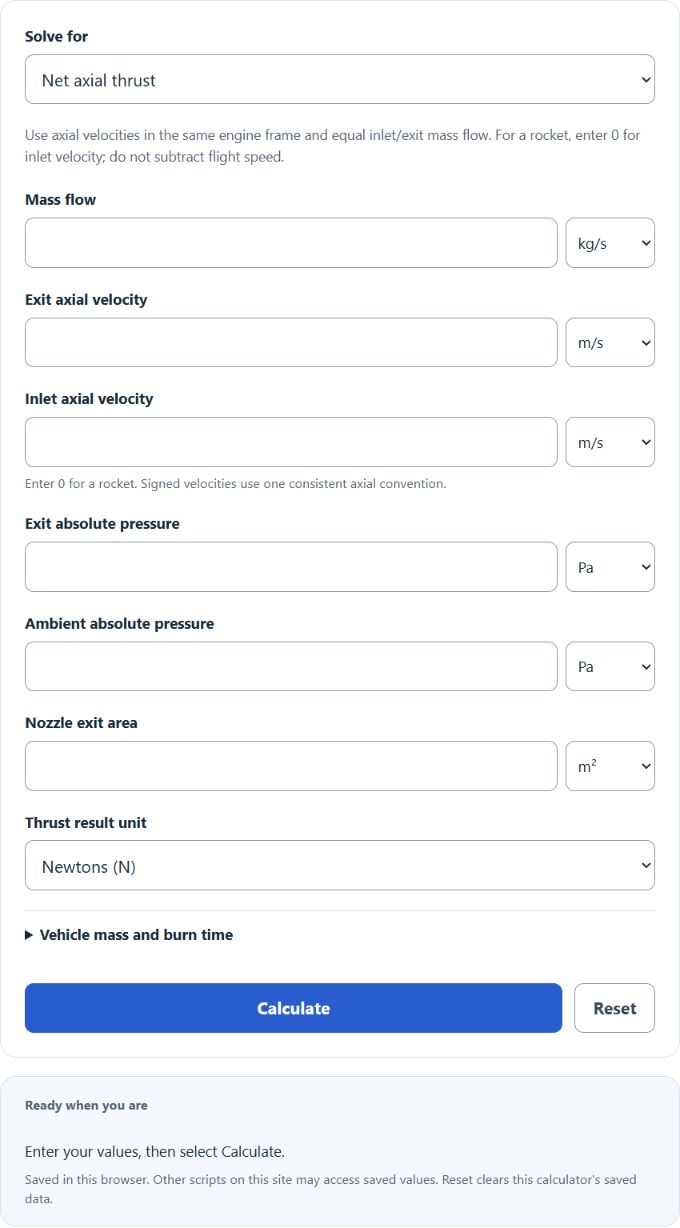
Calculate signed axial thrust from mass flow, velocity, pressure, and exit area, with reverse sizing, a flow-normalized thrust ratio, optional TWR, and total impulse.
- All Physics Calculators
- Pressure to Thrust Calculator
- Propeller Thrust Calculator
- Rocket Acceleration Calculator
- Thrust Coefficient Calculator
- Thrust to Horsepower Calculator
- Thrust to Power Calculator
- Pounds of Thrust to Horsepower Calculator
Thrust Formula
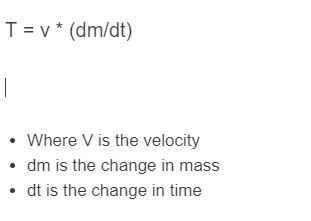
The following formula applies to a rocket using actual nozzle exit velocity relative to the rocket and zero inlet velocity. The calculator also supports the equal-inlet/exit-mass-flow approximation F = ṁ(Vₑ − Vᵢ) + (Pₑ − Pₐ)Aₑ, with axial velocities in one engine/control-volume frame. Do not subtract rocket flight speed as inlet velocity. F/(ṁg₀) is rocket specific impulse only when ṁ is total propellant flow and the rocket-frame inlet term is zero; it is not fuel-based Isp for an air-breathing engine.
T = ṁ Ve + (Pe − Pa) Ae
- ṁ – propellant mass-flow rate (kg/s)
- Ve – actual nozzle exit velocity relative to the rocket (m/s), not pressure-adjusted effective exhaust velocity
- Pe – static pressure at the nozzle exit (Pa)
- Pa – ambient (back-) pressure (Pa)
- Ae – exit area of the nozzle (m²)
Thrust Definition
Thrust is the force produced by an engine (such as a rocket or jet) when it expels mass as exhaust. For a rocket nozzle, thrust includes both the exhaust momentum term (ṁVe) and the nozzle pressure-difference term (Pe − Pa)Ae.
Thrust Example
How to calculate thrust?
- First, determine the exhaust velocity.
Use the actual nozzle exit velocity Vₑ relative to the rocket, and enter 0 for inlet velocity.
- Next, determine the propellant mass flow.
Measure the propellant mass used (Δm) over a burn time (Δt), then compute ṁ = Δm/Δt.
- Next, determine the pressure/area terms.
Find the nozzle exit pressure Pₑ, ambient pressure Pₐ, and nozzle exit area Aₑ (or set Pₑ = Pₐ to neglect the pressure-thrust term).
- Finally, calculate the thrust.
Compute T = ṁVₑ + (Pₑ − Pₐ)Aₑ.
FAQ
Thrust is the force produced by an engine when it expels mass (exhaust). For rocket nozzles, it includes both the exhaust momentum term and (when applicable) a nozzle pressure-difference term.