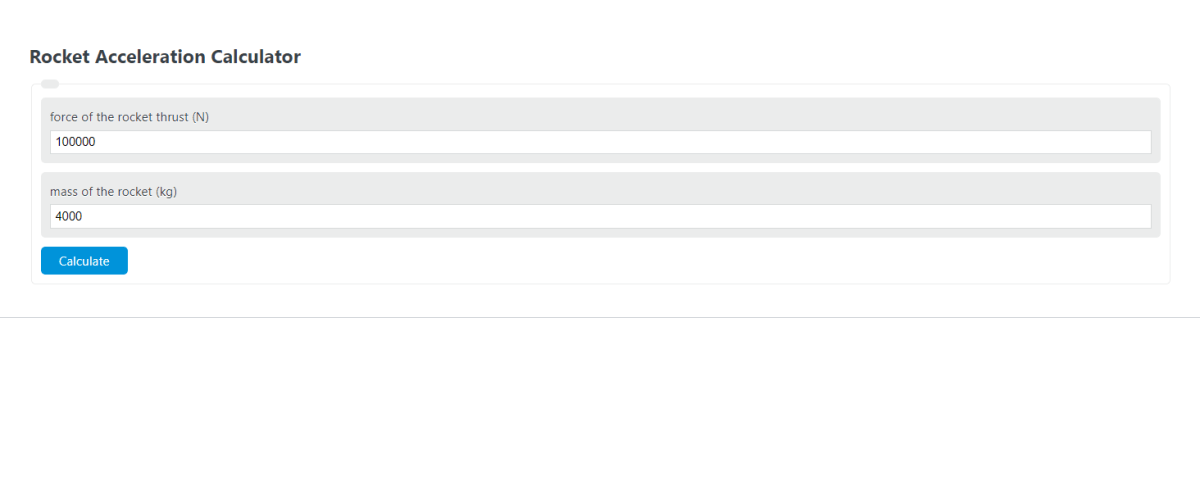
Calculate rocket thrust, mass or acceleration from any two values using F = ma, with Newtons, pounds-force, kilograms and feet per second squared.
- All Physics Calculators
- All Acceleration Calculators
- Thrust Calculator
- Thrust To Acceleration Calculator
Rocket Acceleration Formula
Rocket acceleration describes how quickly a rocket’s velocity changes when thrust acts on its mass. For a simple instantaneous calculation, acceleration is found by dividing thrust by mass:
| Variable | Meaning | Typical Units |
|---|---|---|
| a | Rocket acceleration | m/s² or ft/s² |
| Ft | Rocket thrust force | N or lbf |
| m | Rocket mass | kg or lb |
This relationship comes directly from Newton’s second law. If thrust stays the same, a lighter rocket accelerates more. If mass stays the same, a higher thrust produces more acceleration.
Rearranged Forms
If you need to solve for thrust or mass instead of acceleration, use these forms:
How to Use the Calculator
- Enter the rocket thrust.
- Enter the rocket mass at the same moment in flight.
- Select the correct units for each value.
- Leave the unknown field blank and calculate.
The result is the rocket’s instantaneous acceleration for the values entered. That matters because a rocket’s mass changes continuously as propellant is burned.
Example
If a rocket produces 100,000 N of thrust and has a mass of 4,000 kg, then:
That means the rocket’s speed is increasing by 25 meters per second every second, assuming the thrust and mass remain constant over that interval.
What the Result Means
- Higher thrust increases acceleration.
- Higher mass decreases acceleration.
- Fuel burn usually causes acceleration to rise during flight because the rocket gets lighter.
- Very low acceleration may indicate the rocket is heavily loaded or underpowered for the current stage of flight.
Ideal Acceleration vs. Real Flight Acceleration
This calculator uses the simplified thrust-to-mass relationship. In real flight, rockets are also affected by gravity, drag, and changing mass. A more realistic vertical-flight net acceleration model is:
Where:
- T = thrust
- D = aerodynamic drag
- mg = weight due to gravity
Because of these additional forces, the calculator is best used as a quick estimate or as an instantaneous acceleration tool at a specific point in the flight profile.
Thrust-to-Weight Ratio
Rocket acceleration is closely related to thrust-to-weight ratio, especially during lift-off analysis:
For a vertical launch, a rocket generally needs a thrust-to-weight ratio greater than 1 to lift off. A higher ratio usually means a stronger initial climb and greater available acceleration after overcoming gravity.
Units Commonly Used
| Quantity | SI Unit | US Customary Unit | Notes |
|---|---|---|---|
| Thrust | Newton (N) | Pound-force (lbf) | Engine or motor force output |
| Mass | Kilogram (kg) | Pound (lb) | Vehicle mass at the instant measured |
| Acceleration | m/s² | ft/s² | Rate of change of velocity |
Useful conversions:
- 1 lbf = 4.44822 N
- 1 lb = 0.45359237 kg
- 1 m/s² = 3.28084 ft/s²
If you use mixed unit systems, make sure the calculator’s unit selectors match your entries. Consistent units are essential for a correct result.
Common Mistakes
- Entering launch mass when the problem really needs the current mass after fuel burn.
- Using engine thrust as if it were net force in a real-flight scenario.
- Mixing SI and imperial values without converting them properly.
- Assuming acceleration stays constant throughout the burn.
When This Calculator Is Most Useful
- Estimating the acceleration of a rocket at a single instant in time
- Comparing engine options for a given vehicle mass
- Checking whether a design change improves performance
- Solving classroom physics and engineering problems involving thrust and mass
Frequently Asked Questions
- Does rocket acceleration stay constant?
- No. In most real rockets, acceleration changes throughout the burn because mass decreases and external forces vary with speed and altitude.
- Why does a lighter rocket accelerate faster?
- For the same thrust, less mass means less inertia, so the rocket responds with a greater acceleration.
- Can this be used for multi-stage rockets?
- Yes. Enter the thrust and mass for the specific stage and moment you want to analyze.
- Is this the same as net upward acceleration?
- Not always. The simple formula uses thrust and mass only. Net upward acceleration must also account for gravity and drag.