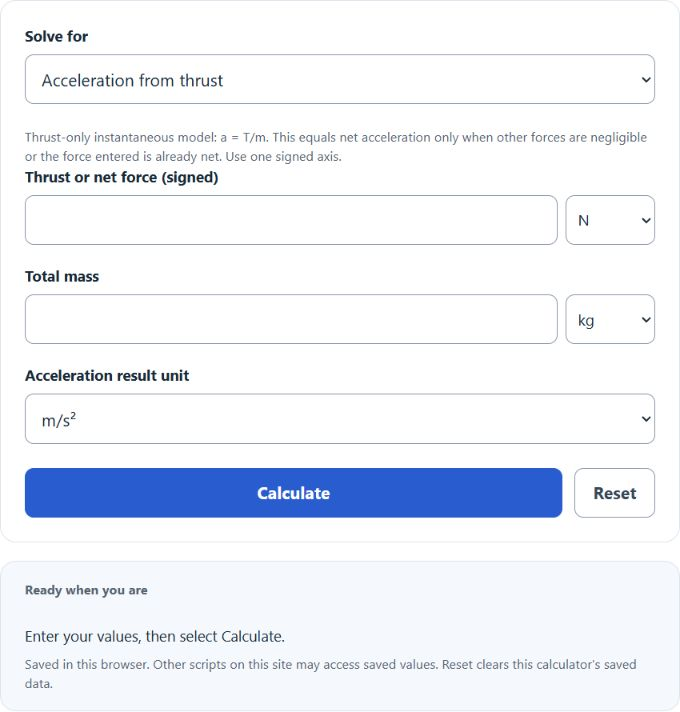
Calculate thrust, mass, or acceleration from any two inputs and show the missing value in selected units with N or lbf, kg, g, lb, and m/s² or ft/s².
- All Physics Calculators
- All Acceleration Calculators
- Rocket Acceleration Calculator
- Thrust to Horsepower Calculator
- Pressure to Thrust Calculator
- Thrust To Power Calculator
- Thrust to Weight Ratio Calculator
Acceleration From Thrust Formula
The thrust-only relationship gives the instantaneous acceleration contribution from a known thrust and mass. It equals net acceleration only when other forces are negligible, or when the force entered is already the net force along the chosen axis.
In this relationship:
- A = acceleration
- TH = thrust (or net force when calculating net acceleration)
- m = mass
This calculator is most useful for rockets, drones, propeller systems, carts, test rigs, and any moving object where you know the applied thrust and total mass.
Variable Meanings and Units
| Quantity | Meaning | Common Units |
|---|---|---|
| Total Thrust | The propulsive force pushing the object forward or upward | Newton (N), pound-force (lbf) |
| Mass | The total mass being accelerated, including payload or structure | Kilogram (kg), gram (g), pound (lb) |
| Acceleration | The rate of change of velocity caused by the thrust | m/s², ft/s² |
How to Use the Calculator
- Enter the total thrust produced by the engine, motor, or propulsion system.
- Enter the total mass of the object being accelerated.
- Click calculate to find the resulting acceleration.
- Check that the thrust and mass reflect the same moment in time, especially if fuel is being consumed.
If several engines contribute, sum their force components along the chosen axis; do not add magnitudes from different directions. If the object carries cargo, batteries, fuel, or passengers, include all of that in the total mass.
What the Result Means
The result is the ideal acceleration produced by the entered thrust and mass. A higher value means the object can gain speed more rapidly. For example, doubling thrust doubles acceleration, while doubling mass cuts acceleration in half.
In real motion, thrust is often not the only force acting on the system. Drag, rolling resistance, friction, slopes, and gravity can all reduce the actual acceleration. When resistive forces matter, the net acceleration is better described by:
For vertical upward motion near Earth, weight must also be considered. Ignoring drag, the upward acceleration can be written as:
If thrust is less than the object’s weight during vertical flight, the object will not accelerate upward. If thrust exactly matches weight, the object hovers with zero vertical acceleration.
Example 1
An object has a total thrust of 820 N and a mass of 100 kg.
The thrust-only acceleration contribution is 8.2 m/s². Net acceleration also includes gravity, drag and other forces along the axis.
Example 2
If the same 820 N of thrust is applied to a heavier 250 kg object, the acceleration is lower.
This shows the inverse relationship between mass and acceleration: more mass requires more thrust to achieve the same performance.
When This Calculator Is Most Accurate
- Thrust is applied in a single dominant direction
- Mass stays approximately constant during the time period considered
- External forces are small or intentionally ignored
- The goal is instantaneous thrust-only acceleration; time-varying force and mass require a separate time history
Common Mistakes
- Using weight instead of mass: mass is the quantity needed in the denominator.
- Ignoring payload: total mass should include the entire system being accelerated.
- Forgetting opposing forces: drag and friction can make real acceleration lower than the ideal result.
- Mixing units: force, mass, and acceleration units must be consistent.
- Using engine rating alone: rated thrust may differ from actual thrust under operating conditions.
Why Thrust and Acceleration Matter Together
Thrust alone does not tell you how responsive a system will feel. A propulsion system can generate significant force, but if the object is very heavy, acceleration may still be modest. That is why thrust and mass should always be evaluated together when comparing rockets, aircraft, drones, or vehicles.
This calculator provides a fast way to estimate performance, compare design options, and understand how changes in propulsion or system weight affect motion.