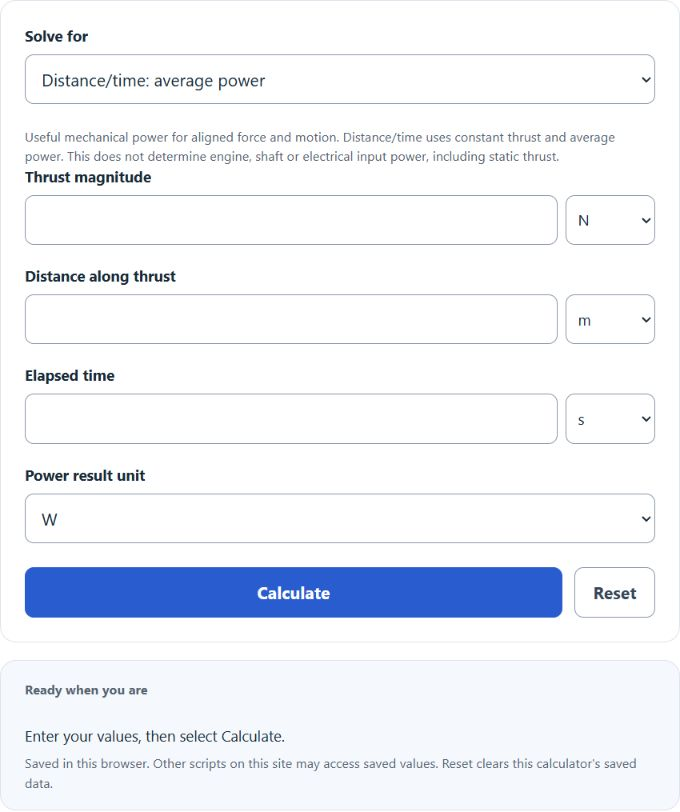
Calculate thrust, power, distance, time, or velocity from inputs, and estimate required thrust and power from drag coefficient, density, area, and speed.
- All Physics Calculators
- Propeller Thrust Calculator
- Thrust To Acceleration Calculator
- Thrust to Horsepower Calculator
- Pressure to Thrust Calculator
- Thrust Coefficient Calculator
Power From Thrust Formula
The following formula gives average useful mechanical power for constant thrust aligned with displacement. The speed modes use instantaneous useful power P = T × v. All quantities must refer to the same frame. These are not engine, shaft or electrical input power; static thrust requires a separate propulsion model.
- Where P is the Power From Thrust (watts)
- Th is the total thrust (N)
- D is the distance (m)
- t is the time (s)
For constant aligned thrust, multiply thrust by distance and divide by positive elapsed time. The drag mode estimates T = ½ C_d ρ v² A and useful P = T v using fluid-relative speed and a matching reference-area convention. Density suggestions are nominal assumptions to verify for actual conditions.
| Thrust (N) | Distance (m) | Time (s) | Power (W) |
|---|---|---|---|
| 10 | 0.5 | 1 | 5 |
| 10 | 1 | 1 | 10 |
| 10 | 2 | 1 | 20 |
| 10 | 5 | 1 | 50 |
| 50 | 0.5 | 1 | 25 |
| 50 | 1 | 1 | 50 |
| 50 | 2 | 1 | 100 |
| 50 | 5 | 1 | 250 |
| 100 | 0.5 | 1 | 50 |
| 100 | 1 | 1 | 100 |
| 100 | 2 | 1 | 200 |
| 100 | 5 | 1 | 500 |
| 200 | 0.5 | 1 | 100 |
| 200 | 1 | 1 | 200 |
| 200 | 2 | 1 | 400 |
| 200 | 5 | 1 | 1,000 |
| 500 | 0.5 | 1 | 250 |
| 500 | 1 | 1 | 500 |
| 500 | 2 | 1 | 1,000 |
| 500 | 5 | 1 | 2,500 |
| Computed using P = (Thrust × Distance) / Time. Base SI units assumed (N, m, s, W). Example: 200 N over 5 m in 1 s → 1,000 W. | |||
How to Calculate Power From Thrust?
The following example problems outline how to calculate Power From Thrust.
Example Problem #1
- First, determine the total thrust (N). In this example, the total thrust (N) is determined to be 100.
- Next, determine the distance (m). For this problem, the distance (m) is measured to be 40.
- Next, determine the time (s). In this case, the time (s) is found to be 30.
- Finally, calculate the Power From Thrust using the formula above:
P = Th * D / t
Inserting the values from above and solving yields:
P = 100 * 40 / 30 = 133.33 (watts)
Example Problem #2
Using the same method as above, determine the variables required by the formula. For this example problem, these are:
total thrust (N) = 600
distance (m) = 87
time (s) = 75
Entering these given values into the calculator or the formula above yields:
P = 600 * 87 / 75 = 696 (watts)