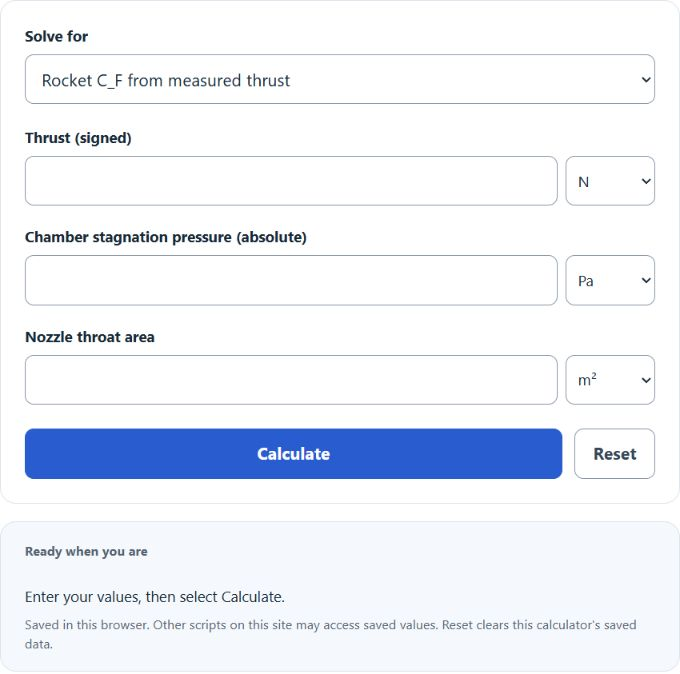
Calculate the thrust coefficient CF from thrust, chamber pressure and throat area, solve for any of them, or find ideal nozzle CF and propeller KT.
- All Physics Calculators
- Thrust to Weight Ratio Calculator
- Thrust To Power Calculator
- Pressure to Thrust Calculator
- Thrust to Horsepower Calculator
Thrust Coefficient Formula
The following formula defines rocket thrust coefficient CF. Use absolute chamber stagnation pressure. The propeller mode uses the distinct definition KT = T / (ρ n² D⁴), with n in revolutions per second.
Variables:
- TC is the dimensionless rocket thrust coefficient CF
- F is the total thrust (N)
- Pc is the absolute chamber stagnation pressure (Pa)
- At is the throat area (m2)
To calculate a thrust coefficient, divide the total thrust by the product of the chamber pressure and throat area.
How to Calculate Thrust Coefficient?
The following steps outline how to calculate the Thrust Coefficient.
- First, determine the total thrust (N).
- Next, determine the chamber pressure (Pa).
- Next, determine the throat area (m2).
- Next, gather the formula from above = TC = F / (Pc * At).
- Finally, calculate the Thrust Coefficient.
- After inserting the variables and calculating the result, check your answer with the calculator above.
Example Problem:
Use the following variables as an example problem to test your knowledge.
total thrust (N) = 300
chamber pressure (Pa) = 10
throat area (m2) = 20
TC = 300 / (10 × 20) = 1.5. This illustrates the algebra, not a realistic operating chamber pressure. The ideal nozzle mode assumes steady one-dimensional, choked, attached isentropic flow with constant γ. At Ae/At = 1 it uses the sonic limit. Overexpanded flow can develop shocks or separation; nominal γ and density suggestions are assumptions to verify for actual conditions.