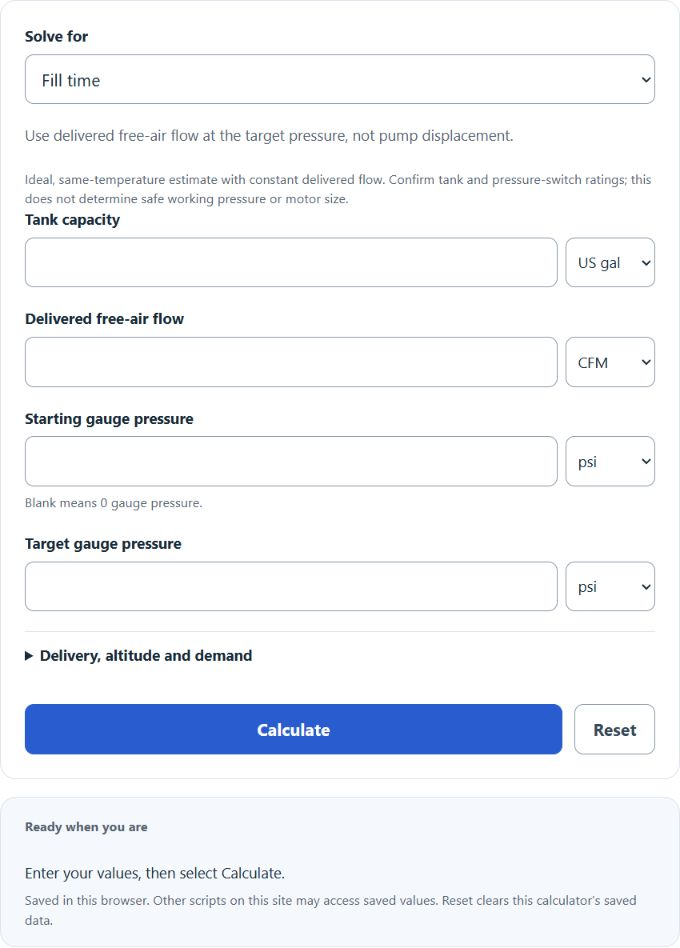
Calculate air compressor tank fill time from tank size, compressor CFM, and start and target PSI, or solve for the CFM or tank size you need.
- Compressed Air Velocity Calculator
- Pneumatic Cylinder Airflow Calculator
- Reciprocating Compressor Volumetric Efficiency Calculator
- All Construction Calculators
Air Compressor Fill Time Formula
The calculator uses an ideal-gas, equal-temperature estimate with constant delivered flow. Select local free-air delivery (FAD) at the altitude-dependent intake pressure, or SCFM referenced to 101.325 kPa. Tank and reference air are assumed to have the same temperature. Match the manufacturer’s reference conditions before using its flow rating.
- Vfree = equivalent free-air volume required, in ft³ of free air
- V = tank volume, converted to ft³
- Q = net free-air flow: delivered flow × delivery factor − concurrent demand, using the selected reference conditions
- t = fill time, converted to minutes
- P1 = initial tank pressure, gauge pressure in psi
- P2 = target tank pressure, gauge pressure in psi
- Patm = selected absolute reference pressure: estimated local atmospheric pressure for FAD, or 101.325 kPa (about 14.6959 psi) for the SCFM option
The fill time function solves for how long the compressor needs to raise the tank from the initial pressure to the target pressure. The flow rate function solves for delivered free-air flow needed at the selected reference, including demand and the delivery factor. The tank volume function solves for the tank size that matches a known flow rate, pressure rise, and time. The initial and target pressure functions rearrange the same formula to solve for the missing pressure.
Common Tank Sizes and Unit Conversions
These values are useful when checking entries before calculating. The calculator converts quantities to consistent SI units internally.
| Tank Size | Cubic Feet | Typical Use |
|---|---|---|
| 6 US gal | 0.802 ft³ | Small portable compressor |
| 20 US gal | 2.674 ft³ | Garage or light shop use |
| 60 US gal | 8.021 ft³ | Stationary shop compressor |
| 80 US gal | 10.694 ft³ | Larger stationary compressor |
Pressure and flow must also be interpreted correctly. Use gauge pressure for the tank fields and free-air flow for the compressor field.
| Input Type | Use This | Avoid This |
|---|---|---|
| Tank pressure | Gauge pressure, such as 0 psi to 120 psi | Absolute pressure unless you convert it first |
| Compressor flow | SCFM or FAD rating | Pump displacement CFM |
| Time | Seconds, minutes, or hours | Mixed time units in the same entry |
Example Calculations
Example 1: Calculate fill time
You have a 20-gallon tank, a compressor rated at 5 SCFM, an initial pressure of 0 psi, and a target pressure of 120 psi.
- Tank volume: 20 gal × 0.133680556 = 2.6736 ft³
- Pressure rise: 120 − 0 = 120 psi
- Free-air volume: 2.6736 × 120 ÷ 14.6959 = 21.83 ft³
- Fill time: 21.83 ÷ 5 = 4.37 minutes
The estimated fill time is 4.37 minutes.
Example 2: Calculate required flow rate
You want to fill a 60-gallon tank from 90 psi to 125 psi in 2 minutes.
- Tank volume: 60 gal × 0.133680556 = 8.0208 ft³
- Pressure rise: 125 − 90 = 35 psi
- Free-air volume: 8.0208 × 35 ÷ 14.6959 = 19.10 ft³
- Required flow: 19.10 ÷ 2 = 9.55 SCFM
The required compressor flow rate is 9.55 SCFM.
FAQ
Why does the calculator use SCFM or FAD instead of regular CFM?
Tank filling depends on delivered mass flow. Local FAD is referenced to intake conditions; SCFM uses specified fixed conditions. They are not interchangeable without conversion. This model assumes equal reference and tank temperatures; altitude changes the local FAD reference only. Delivery factor is a known flow derating, not motor efficiency. Do not use pump displacement.
Should the pressure inputs be gauge pressure or absolute pressure?
Use gauge pressure, which is the value normally shown on an air compressor tank gauge. For example, an empty tank open to the atmosphere is entered as 0 psi, not 14.7 psi. The calculator accounts for atmospheric pressure separately in the formula.
Why might actual fill time be different from the estimate?
The estimate assumes ideal behavior and a constant delivered flow rate. Actual fill time can change because compressor output often drops at higher pressure, air heats during compression, the pressure switch has tolerances, and there may be leaks or restrictions in the system.