Calculate daily, monthly, and yearly water loss and utility cost from drip rate, fixture count, and drop-size assumption, or reverse-solve drips per minute.
Water Drip Formula
The water drip/leak calculator estimates how much water is lost from one or more leaking faucets over a full day. It is most useful when the leak is a steady drip, but it can also convert a measured flow rate in gallons per minute or liters per minute into a daily loss.
When the leak is measured directly as a flow rate instead of counted as individual drips, use these conversions:
If you already know the total daily leak and want to estimate the average drip rate per faucet, rearrange the main formula:
Variable Definitions
- WLgal/day
- Total water lost in gallons per day.
- WLL/day
- Total water lost in liters per day.
- Dmin
- Average drip rate in drips per minute for each leaking faucet.
- Qgal/min
- Measured leak flow rate in gallons per minute.
- QL/min
- Measured leak flow rate in liters per minute.
- F
- Number of dripping faucets.
- 1440
- Minutes in one day.
- 15140
- Approximate number of drips in one U.S. gallon used as a rule-of-thumb conversion.
How to Use the Calculator
- Count how many faucets are leaking.
- If the leak is dripping, count the number of drips in 60 seconds and repeat the test a few times to get a reliable average.
- Enter either the average drip rate per faucet or the total leak per day.
- If the leak is more of a trickle than a drip, measure it as gallons per minute or liters per minute instead.
- Read the total daily water loss, then extend it to weekly, monthly, or yearly usage if needed.
If different faucets leak at different rates, the most accurate approach is to measure each faucet separately and add the totals. If they are similar, you can use the average drip rate per faucet and multiply by the number of leaking faucets.
Example
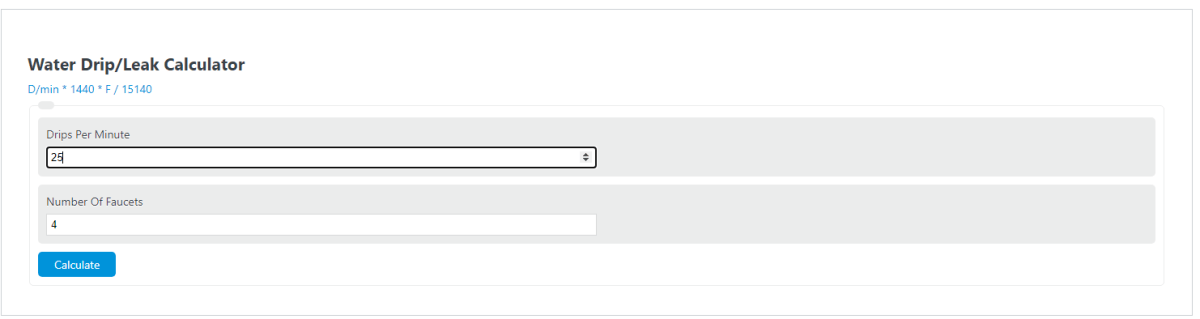
Suppose 4 faucets each drip at an average rate of 25 drips per minute.
That leak equals about 66.58 gallons per week, 285.34 gallons in a 30-day month, and 3,471.60 gallons per year.
Quick Leak Reference
| Drip Rate per Faucet | Approx. Gallons per Day | Approx. Gallons per Year |
|---|---|---|
| 1 drip/min | 0.10 | 34.72 |
| 10 drips/min | 0.95 | 347.16 |
| 30 drips/min | 2.85 | 1,041.48 |
| 60 drips/min | 5.71 | 2,082.96 |
| 120 drips/min | 11.41 | 4,165.92 |
For multiple faucets with similar leak rates, multiply the daily or yearly amount in the table by the number of leaking faucets.
Why Real-World Results May Differ
- Drop size is not perfectly constant, so actual gallons lost can vary from the estimate.
- Water pressure, faucet design, and aerator condition can change the volume of each drip.
- A leak that alternates between dripping and streaming should be measured as flow rate rather than drips per minute.
- Intermittent leaks only waste water while they are active, so time-based estimates are most accurate when the leak is continuous.
Estimating the Cost of a Leak
If your water bill is based on usage per 1,000 gallons, you can estimate the monthly cost of a leak with the formula below:
This is a simple way to translate a small daily leak into a monthly utility impact. If sewer charges are tied to water consumption, the total bill effect can be even higher.