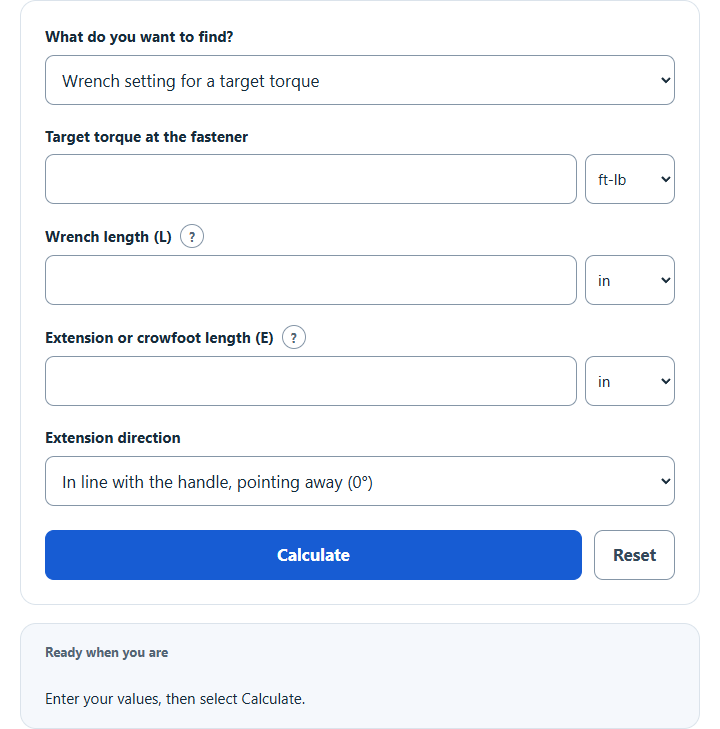
Calculate the torque wrench setting to use with an extension or crowfoot, or the actual torque delivered, from wrench length, extension length and angle.
- All Automotive Calculators
- All Torque Calculators
- Torque to Force Calculator
- N·m to ft-lbs torque conversion calculator
- Torque Calculator
- Wrench Torque Calculator
Calculator Functions
| Function | What it does | What it requires |
|---|---|---|
| Wrench setting for a target torque | Finds the value to set on the torque wrench so the fastener receives the specified torque through an extension, adapter or crowfoot | Requires the target torque at the fastener, the wrench length, the extension or crowfoot length and the extension direction |
| Actual torque at the fastener | Finds the torque the fastener really received for a given wrench setting | Requires the wrench setting, the wrench length, the extension or crowfoot length and the extension direction |
Torque can be entered in ft-lb, in-lb, N·m or kgf·m, and lengths in inches, centimeters or millimeters. The extension direction is in line with the handle (0°), at 90° to the handle, pointing back toward the handle (180°) or any other angle. The result is in the torque unit entered and is also shown in N·m or ft-lb, along with the effective lever length and the correction factor.
Torque Wrench Extension Formulas
| S | Wrench setting, the value on the dial or scale |
| T | Torque at the fastener |
| L | Wrench length, from the center of the square drive to the center of the grip |
| E | Extension or crowfoot length, from the square drive to the center of the fastener |
| θ | Angle of the extension from the handle line: 0° straight out, 90° square to the handle, 180° folded back |
A torque wrench measures torque about its own square drive. An adapter that moves the fastener away from the drive changes the effective length of the lever, so the same pull on the handle produces a different torque at the fastener, and the setting has to be adjusted to match [1]. The effective lever is L + E × cos θ. A plain socket extension that runs straight down from the drive, along the axis of the fastener, has E = 0 and needs no correction.
Wrench setting for a target torque
The main formula applies directly. With the extension in line with the handle, cos θ = 1 and the setting is T × L ÷ (L + E). A target of 80 ft-lb with an 18 inch wrench and a 2 inch crowfoot pointing away from the handle needs a setting of 80 × 18 ÷ 20 = 72 ft-lb. At 90° the lever length does not change, so the setting equals the target, 80 ft-lb. Folded back at 180° the lever is shorter and the setting rises to 80 × 18 ÷ 16 = 90 ft-lb. At 45° it is 74.17 ft-lb.
Actual torque at the fastener
This is the main formula rearranged. A wrench set to 80 ft-lb and used with the same 2 inch in-line extension, with no correction made, delivers 80 × 20 ÷ 18 = 88.89 ft-lb, which is 11% over.
Limits of This Estimate
- The result holds only when the hand is at the grip point used to measure L and the pull is square to the handle. Holding the wrench somewhere else changes the lever and the torque.
- The federal guidance requires the adjustment and shows it in a figure [1]. The formula here is the general lever-arm relationship with an angle term added. These estimates are based on the best available data and estimations.
- A torque wrench is only as accurate as its calibration, which should be checked at least once a year and after the wrench is dropped [1]. The fastener manufacturer's torque value and procedure come first.
Sources
- Federal Aviation Administration, Advisory Circular 43.13-1B, Chapter 7, Paragraph 7-40: adjusting the wrench setting when an adapter changes the effective length, and yearly calibration