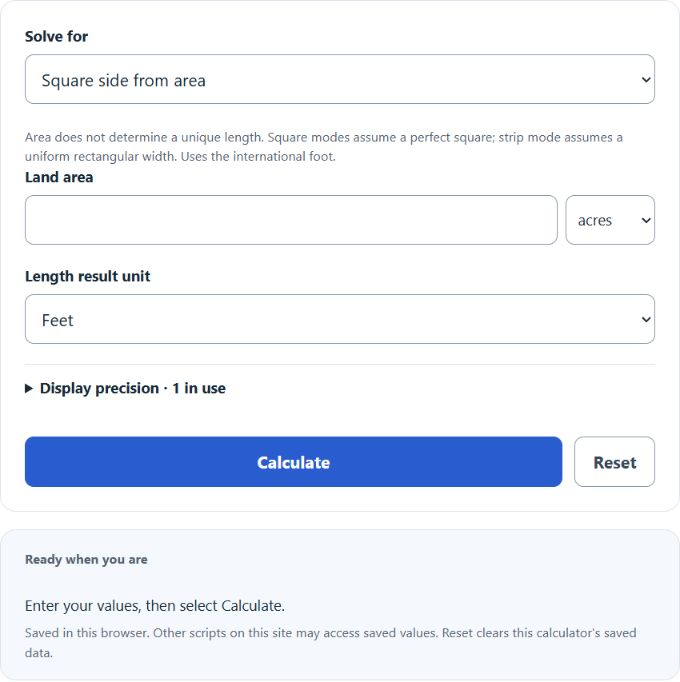
Convert acres and other area units to linear feet, meters, yards, kilometers, or miles by finding the square side length, or reverse it.
- All Unit Converters
- Linear Feet Calculator
- Acres To Square Feet Converter Calculator
- Miles To Acres Calculator
- Net Mineral Acres Calculator
- Acre To Guntha Calculator
- Acreage Calculator – Find Acres From Land Dimensions
Acres To Linear Feet Formula
The following formula gives the side length of a square with the entered acreage. Square perimeter is four times that side. Rectangle length is area divided by a known uniform width. Reverse square area is side length squared.
Unit-definition source: NIST revised unit conversion factors. Square and rectangle formulas follow their geometric definitions.
Variables:
- LF is one square side in linear feet
- A is the area in acres
- 43,560 is the number of square feet in one acre
This formula returns the side length of a square with the same total area as the given acreage. One acre contains exactly 43,560 square feet, so multiplying the acreage by that constant converts the measurement into square feet. Taking the square root then yields the length of one side of a square that encloses that area. For a single acre, the result is approximately 208.71 feet per side.
| Acres | Linear Feet (ft) |
|---|---|
| 1/16 | 52.178 |
| ⅛ | 73.790 |
| 1/6 | 85.206 |
| ¼ | 104.355 |
| ⅓ | 120.499 |
| ⅜ | 127.809 |
| ½ | 147.581 |
| ⅝ | 165.000 |
| ⅔ | 170.411 |
| ¾ | 180.749 |
| ⅞ | 195.231 |
| 1 | 208.710 |
| 1¼ | 233.346 |
| 1⅓ | 240.998 |
| 1½ | 255.617 |
| 1¾ | 276.098 |
| 2 | 295.161 |
| 2½ | 330.000 |
| 3 | 361.497 |
| 4 | 417.421 |
| * Rounded to 3 decimals. Assumes a square plot: side length = √(Acres x 43,560). Reference: 1-acre square ≈ 208.710 ft per side. | |
What is Acres To Linear Feet?
Acres and linear feet measure fundamentally different things. An acre is a unit of area equal to 43,560 square feet, while a linear foot is a straight-line measurement of distance. Converting between the two requires an assumption about the shape of the land, because an infinite number of shapes can enclose 43,560 square feet, each with a different perimeter.
The standard conversion assumes a perfect square. Under that assumption, one acre produces a side length of approximately 208.71 linear feet. In practice, however, most land parcels are not perfect squares. Rectangular lots, irregular polygons, and parcels that follow natural features like rivers or ridgelines all yield different linear-foot totals for the same acreage.
This distinction matters in real estate transactions, fencing projects, boundary surveys, and agricultural planning, where the total boundary length (not just the enclosed area) drives both cost and logistics.
How Shape Affects Linear Feet Per Acre
The shape of a parcel dramatically changes how many linear feet surround a given acreage. A circle produces the smallest perimeter for any given area, while long, narrow rectangles can produce perimeters many times larger. The table below illustrates how perimeter changes with shape for a one-acre parcel (43,560 sq ft).
| Shape | Dimensions | Total Perimeter (linear ft) |
|---|---|---|
| Circle | Radius = 117.75 ft | 739.86 |
| Square | 208.71 ft x 208.71 ft | 834.84 |
| Rectangle (2:1) | 147.58 ft x 295.16 ft | 885.49 |
| Rectangle (3:1) | 120.50 ft x 361.50 ft | 963.99 |
| Rectangle (4:1) | 104.36 ft x 417.42 ft | 1,043.55 |
| Rectangle (10:1) | 66.00 ft x 660.00 ft | 1,452.00 |
| Rectangle (25:1) | 41.74 ft x 1,043.55 ft | 2,170.59 |
| Strip (1 chain wide) | 66 ft x 660 ft | 1,452.00 |
| The circle represents the theoretical minimum perimeter. As the length-to-width ratio increases, perimeter grows substantially. A 25:1 rectangle has 2.6x the perimeter of a square. | ||
This data reveals a critical point for property buyers and fence installers: two one-acre lots can require vastly different amounts of fencing material. A narrow lot shaped 25:1 needs nearly 2.6 times as much fencing as a square lot of the same area.
The Origin and History of the Acre
The acre traces its roots to Anglo-Saxon England, where it represented the amount of land a single farmer could plow in one day using a yoke of oxen. The word itself derives from the Old English “aecer,” meaning open field. The traditional shape of an acre was long and narrow, reflecting the practical reality of ox plowing: the team would plow a furrow-long (furlong) of 660 feet before resting and turning, across a width of one chain (66 feet). This produced a strip of land measuring 66 feet by 660 feet, or exactly one acre.
The formal definition was codified in 13th-century English law as 40 perches long by 4 perches wide, where one perch (also called a rod or pole) equaled 16.5 feet. Edmund Gunter’s 17th-century surveying chain further standardized the measurement: since one acre equaled exactly 10 square chains in his system, surveyors could compute acreage by dividing chain-based area measurements by 10. The acre was carried into the United States customary system, formalized in 1832, where it remains a statutory unit of land measurement. This calculator uses the international-foot acre, exactly 4,046.8564224 m². The U.S. survey foot was deprecated at the end of 2022 and is retained for historical and legacy applications; its derived acre differs by about four parts per million.
Real-World Applications
Fencing and Property Enclosure
The most common reason to convert acres to linear feet is to estimate the amount of fencing needed to enclose a property. For a square one-acre lot, the perimeter is approximately 835 linear feet. The table below illustrates square-parcel budgets using stated hypothetical USD rates per linear foot. These rates are example inputs, not current national averages or contractor quotes. Obtain a site-specific quote that accounts for materials, gates, labor and terrain.
| Acres | Perimeter (linear ft) | Chain Link ($8-$15/ft) | Wood ($10-$20/ft) | Vinyl ($20-$25/ft) |
|---|---|---|---|---|
| ¼ | 417.42 | $3,340 – $6,260 | $4,170 – $8,350 | $8,350 – $10,440 |
| ½ | 590.32 | $4,720 – $8,850 | $5,900 – $11,810 | $11,810 – $14,760 |
| 1 | 834.84 | $6,680 – $12,520 | $8,350 – $16,700 | $16,700 – $20,870 |
| 2 | 1180.64 | $9,450 – $17,710 | $11,810 – $23,610 | $23,610 – $29,520 |
| 5 | 1866.76 | $14,930 – $28,000 | $18,670 – $37,340 | $37,340 – $46,670 |
| 10 | 2640.00 | $21,120 – $39,600 | $26,400 – $52,800 | $52,800 – $66,000 |
| Example budgets = unrounded square perimeter × stated rate, rounded to the nearest $10. These assumed rates are not market averages. Other shapes, gates, terrain and contractors change actual costs. | ||||
Land Surveying and Boundary Descriptions
Professional land surveyors use the relationship between area and linear distance constantly. Under the U.S. Public Land Survey System (PLSS), which covers roughly 30 states, land is divided into townships (36 square miles), sections (640 acres, or one square mile), and quarter-sections (160 acres). A quarter-section, the original homestead allotment under the 1862 Homestead Act, forms a square approximately 2,640 feet (half a mile) per side. Legal descriptions in metes-and-bounds states (common in the original 13 colonies) rely on sequences of linear distances and compass bearings to define boundaries, making the conversion from area to perimeter length essential for verifying survey accuracy.
Agriculture and Irrigation
Farmers use linear feet calculations for drip-line irrigation layout, row spacing, and bed-foot measurements. In drip irrigation, the total linear feet of drip tape needed per acre depends on row spacing: at 30-inch row spacing, one acre requires approximately 17,424 linear feet of drip tape; at 60-inch spacing, that drops to 8,712 feet. These calculations directly affect irrigation equipment budgets and water distribution planning.
Illustrative Residential Lot Areas
The following sample lot areas illustrate how square side and perimeter change with area. They are calculation examples, not verified current state or national median lot sizes.
| Example | Lot area (ft²) | Acres | Square Side (linear ft) | Square Perimeter (linear ft) |
|---|---|---|---|---|
| Example 1 | 78,408 | 1.800 | 280.01 | 1120.06 |
| Example 2 | 49,223 | 1.130 | 221.86 | 887.45 |
| Example 3 | 45,738 | 1.050 | 213.86 | 855.46 |
| Example 4 | 40,075 | 0.920 | 200.19 | 800.75 |
| Example 5 | 8,600 | 0.197 | 92.74 | 370.94 |
| Example 6 | 8,900 | 0.204 | 94.34 | 377.36 |
| Example 7 | 9,025 | 0.207 | 95.00 | 380.00 |
| Example 8 | 8,726 | 0.200 | 93.41 | 373.65 |
| Example 9 | 8,327 | 0.191 | 91.25 | 365.01 |
| Example 10 | 7,405 | 0.170 | 86.05 | 344.21 |
| Illustrative input areas. Acres = ft² /43,560; square side = √ft²; perimeter = 4 × side. Acres rounded to three decimals; lengths to two. Actual boundaries require measurements. | ||||
For example, a square 78,408 ft² lot has about 1,120.06 ft of perimeter, while a square 7,405 ft² lot has about 344.21 ft. Perimeter can change substantially with both area and shape.
Key Conversion Constants
| Relationship | Value |
|---|---|
| 1 acre | 43,560 square feet |
| 1 acre | 4,840 square yards |
| 1 acre | 4,046.86 square meters |
| 1 acre | 0.4047 hectares |
| 1 acre | 10 square chains (Gunter) |
| 1 chain | 66 feet (4 rods) |
| 1 furlong | 660 feet (10 chains) |
| 1 rod (perch/pole) | 16.5 feet |
| 1 section (PLSS) | 640 acres (1 square mile) |
| 1 quarter-section | 160 acres (2,640 ft per side) |
| 1 acre (square side) | 208.710 linear feet |
| 1 acre (square perimeter) | 834.841 linear feet |
| 1 acre (circle circumference) | 739.859 linear feet |