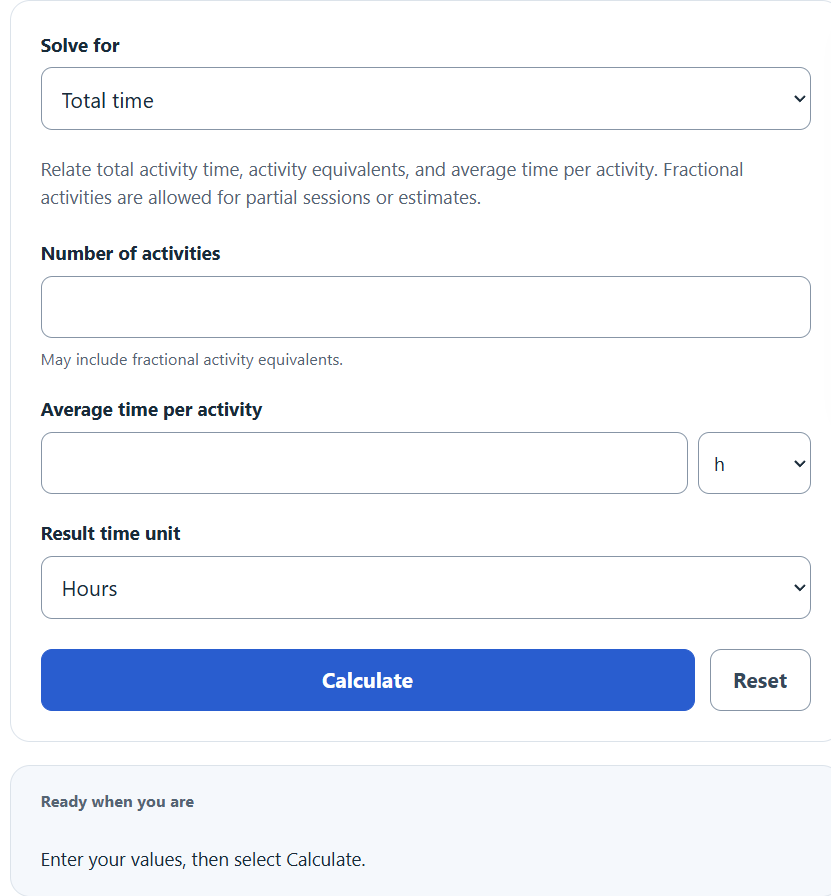
Calculate total hours, number of activities, or hours per activity by choosing the unknown in Solve for and entering the two displayed values. Time inputs support hours, minutes and seconds.
Activity Hours Formula
The activity hours calculator uses the relationship between total time, number of activities, and average time spent on each activity. Choose the unknown in Solve for and enter the two displayed values.
- Total Hours is the full amount of time spent across all activities.
- Number of Activities is how many activities, sessions, tasks, or events are included.
- Hours per Activity is the average time spent on one activity.
When solving for total hours, the calculator multiplies the number of activities by the hours per activity. When solving for the number of activities, it divides total hours by hours per activity. When solving for hours per activity, it divides total hours by the number of activities.
Common Time Conversions for Activity Planning
The unit controls convert time automatically. These equivalent values are provided for reference.
| Minutes | Hours | Decimal Entry |
|---|---|---|
| 15 minutes | 1/4 hour | 0.25 |
| 30 minutes | 1/2 hour | 0.5 |
| 45 minutes | 3/4 hour | 0.75 |
| 60 minutes | 1 hour | 1 |
| 90 minutes | 1.5 hours | 1.5 |
Activity Hours Examples
Example 1: Calculate total hours
You have 8 activities, and each activity takes 1.5 hours.
The total time is 12 hours.
Example 2: Calculate hours per activity
You spent 18 total hours on 6 activities.
Each activity took an average of 3 hours.
FAQ
Can the number of activities be a decimal?
In most real situations, the number of activities is a whole number, such as 5 meetings or 12 practice sessions. A decimal can make sense if you are working with partial activities, averages, or estimates. For example, 2.5 activities could represent two full sessions and one half session.
What should I enter for a 30-minute activity?
Select minutes and enter 30, or enter 0.5 hours.
Why do I need to enter exactly two values?
The selected calculation shows the two known values needed for the third. Division requires a nonzero divisor; zero inputs can make an inverse solution impossible or nonunique. Total activity hours are cumulative, not elapsed clock time when activities overlap.