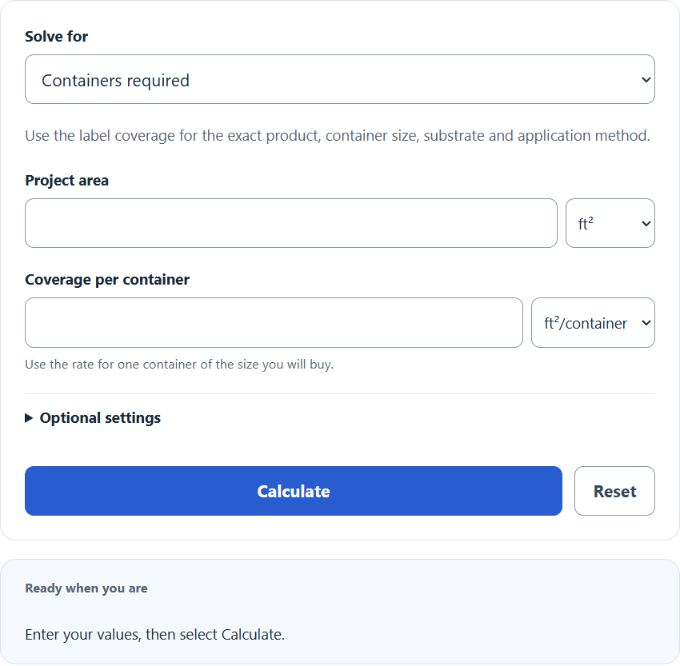
Estimate adhesive containers from project area and product coverage, or calculate covered area from available containers. Includes square feet, square meters, waste, and application factors.
Related Calculators
- Self-Leveling Coverage Calculator
- Material Cost Calculator
- Board Coverage Calculator
- Salt Coverage Calculator
- All Construction Calculators
Adhesive Coverage Formula
Estimate identical adhesive containers using the product label’s coverage for the specific container size and installation method. The calculator has two modes: containers required for a project, or base area that available containers can cover.
Exact containers = area × application factor × (1 + overage / 100) / coverage per container
Purchase containers = round exact containers upward to a whole number
Base area = available containers × coverage per container / [application factor × (1 + overage / 100)]
Area and coverage must use compatible units. The calculator converts square feet and square meters using 1 ft² = 0.09290304 m². Available containers may be fractional when estimating partially available material. Project area and available containers may be zero; label coverage and custom application factors must be positive.
Choose the Correct Label Rate
Use coverage for the exact adhesive, substrate, trowel or bead size and application method. Container size matters: a rate per gallon must be multiplied by gallons in your pail before entering a rate per pail. If a hypothetical label states 50 ft² per gallon and you plan to buy four-gallon pails, enter 200 ft² per container. A bag, tube, gallon or pail is one container only when your entered rate matches it.
There is no universal tile, mortar or flooring rate. ROBERTS 1487’s product data sheet, for example, lists different coverage ranges for its specified engineered-wood and cork applications and trowels, and warns that substrate and installation conditions affect coverage. Check your own product’s current instructions rather than transferring that product’s rates to another adhesive.
Overage and Application Factors
Open Optional settings to add overage or change the application factor. Blank overage means 0%; the allowed range is 0–100%. The factor starts at 1×. Choose 2× or a custom positive factor only for additional consumption that is not already included in the label’s full installation coverage. Avoid counting two coats, both surfaces or an existing allowance twice.
Overage is extra material relative to baseline demand. A 20% addition multiplies demand by 1.20. Losing 20% of purchased material would instead require a multiplier of 1 / 0.80 = 1.25. This calculator uses the addition convention. The inverse area estimate follows the same planning convention. Whole-container rounding creates a separate surplus.
Worked Examples
Containers: A 500 ft² project with 50 ft² per container, 10% overage and factor 1 needs 500 × 1.10 / 50 = 11 containers. A slightly larger project requires a twelfth whole container.
Available coverage: Ten containers at 50 ft² each, with 10% overage and factor 1, cover a base planning area of 500 / 1.10 = 454.5455 ft².
Custom application: Three containers at 5 m² each, factor 1.5 and 25% overage give 15 / (1.5 × 1.25) = 8 m² of base coverage.
Understanding the Results
The purchase mode shows the rounded quantity, unrounded quantity, base area, adjusted application area, purchased nominal capacity and unused adjusted capacity. The inverse mode shows nominal and usable base coverage. Displayed measurements are rounded; the whole-container ceiling uses the entered decimal quantities.
Frequently Asked Questions
Does the calculator choose a trowel or product?
No. Enter the applicable manufacturer rate and follow its installation and compatibility instructions.
Should I always add 10%?
Choose an allowance appropriate to your project and manufacturer guidance. Do not add an allowance already included in the rate or estimate.
Can I mix container sizes?
Convert them to an equivalent common container size before entering a count. The entered count and rate must describe the same size.
Is estimated coverage guaranteed?
No. Actual coverage varies with substrate, product and application. Confirm suitability and conditions before purchasing.