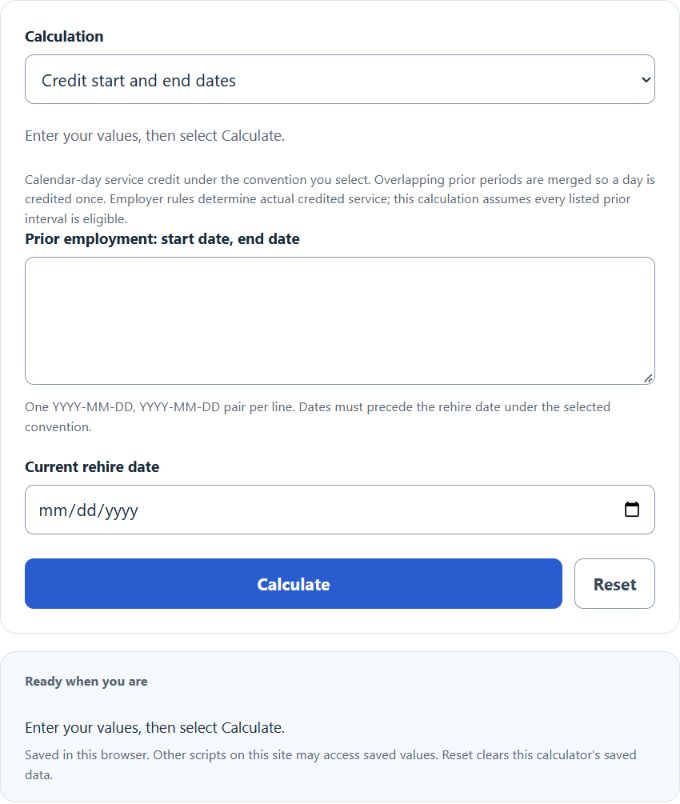
Calculate an adjusted service date by crediting prior employment intervals before a rehire date. Choose whether an interval includes its end date; overlapping service days are credited once.
Day-based formula
Inclusive interval days = end date − start date + 1. End-exclusive interval days = end date − start date. After merging overlapping intervals, adjusted service date = rehire date − unique credited days.
Example
Prior service from 2020-01-01 through 2020-01-10 gives ten days under the inclusive convention. A rehire date of 2020-02-01 minus ten days gives an adjusted date of 2020-01-22. Under the end-exclusive convention, nine days are credited and the adjusted date is 2020-01-23.
Frequently asked questions
What happens when periods overlap?
The calculator combines them and reports how many duplicate days were removed. Listing the same day twice does not add credit.
Are employment gaps credited?
No. The result separately counts uncredited days between the earliest listed start and rehire.
Can I use this as an official benefit date?
Use the result only with your employer’s eligibility and crediting rules. This model assumes every listed interval is eligible and credits whole calendar days; it does not implement a particular benefit policy.
Reference for elapsed-day units: NIST time-unit definitions.