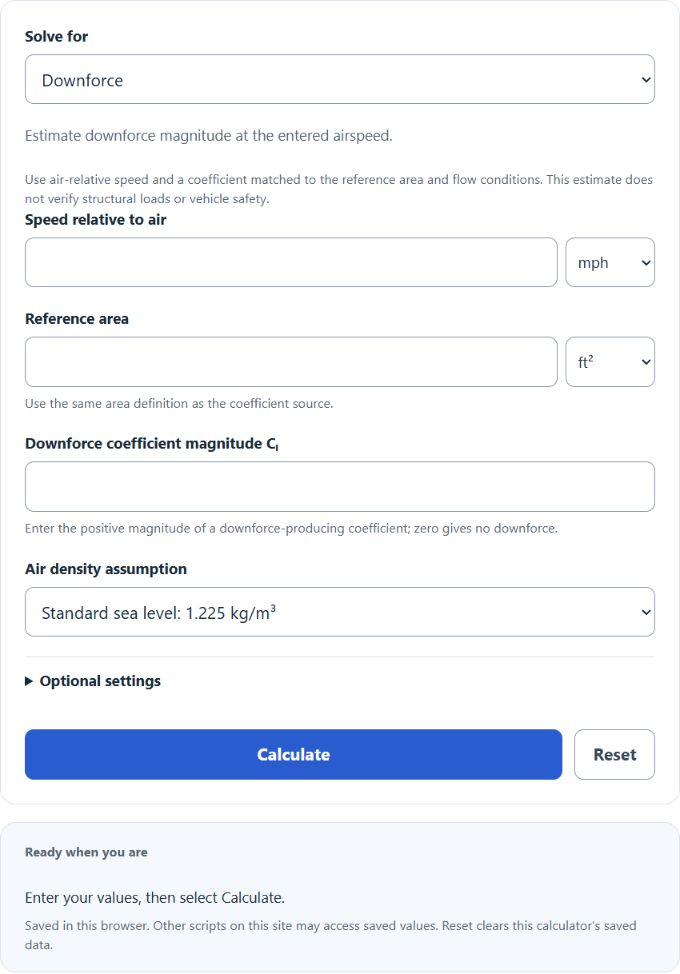
Calculate the aerodynamic downforce on a wing, splitter, or car body from speed, area, lift coefficient, and air density, or solve for the speed, area, or Cl needed to hit a downforce target.
Aerodynamic Downforce Formula
DF = 0.5 * p * V^2 * A * Cl
- DF is the aerodynamic downforce (N)
- p is the air density (kg/m^3), 1.225 at sea level and 59 F (15 C)
- V is the vehicle speed through the air (m/s)
- A is the reference area of the wing or panel (m^2), typically span times chord for a wing
- Cl is the lift coefficient of the surface, entered as a positive magnitude (dimensionless)
The calculator’s default mode evaluates this formula directly: it converts your speed and area into SI units, multiplies half the air density by the speed squared to get dynamic pressure, then multiplies by area and coefficient to get downforce in newtons, pounds-force, and kilograms-force. The three target modes rearrange the same equation to solve for the missing variable when you know the downforce you want:
V = sqrt( 2*DF / (p * A * Cl) )
A = 2*DF / (p * V^2 * Cl)
Cl = 2*DF / (p * V^2 * A)
The air-density options replace the standard 1.225 kg/m^3 with a custom value or a dry-air estimate using entered temperature and standard tropospheric pressure at altitude. The estimator supports 0–11,000 m and omits actual weather pressure and humidity; blank altitude means sea level. Optional front balance splits downforce into front and rear shares. Zero speed or coefficient gives zero forward downforce; inverse zero-denominator cases may have no solution or no unique solution.
Reference Area and Air Density Assumptions
A coefficient cannot be chosen reliably from the device name alone. Use manufacturer, CFD, or wind-tunnel data for the actual configuration and retain the reference area used to define that coefficient.
| Surface or vehicle | Reference-area requirement |
|---|---|
| Small decklid spoiler | Use the area definition supplied with the tested coefficient; device name does not determine Cl. |
| Front splitter | Use the area definition supplied with the tested coefficient; device name does not determine Cl. |
| Underbody diffuser | Use the area definition supplied with the tested coefficient; device name does not determine Cl. |
| Single-element rear wing | Use the area definition supplied with the tested coefficient; device name does not determine Cl. |
| Dual-element rear wing | Use the area definition supplied with the tested coefficient; device name does not determine Cl. |
| GT race car (whole car) | Use the area definition supplied with the tested coefficient; device name does not determine Cl. |
| Formula 1 car (whole car) | Use the area definition supplied with the tested coefficient; device name does not determine Cl. |
Because downforce is directly proportional to air density, the same car makes noticeably different downforce on a hot day or at altitude. Most calculators assume the sea-level standard of 1.225 kg/m^3; the table below shows how real conditions change the result.
| Conditions | Air density (kg/m^3) | Downforce vs standard |
|---|---|---|
| Sea level, 32 F (0 C) | 1.292 | +5.5% |
| Sea level, 59 F (15 C), standard | 1.225 | baseline |
| Sea level, 95 F (35 C) | 1.146 | -6.5% |
| 5,000 ft (1,524 m), standard atmosphere | 1.056 | -14% |
| 10,000 ft (3,048 m), standard atmosphere | 0.905 | -26% |
Aerodynamic Downforce Example Problems
Example 1: downforce from a rear wing. A dual-element rear wing has an area of 0.9 m^2 and a Cl of 1.4, and the car is traveling 180 km/h (50 m/s) at sea level (p = 1.225 kg/m^3). Dynamic pressure is 0.5 * 1.225 * 50^2 = 1,531.25 Pa. Downforce is 1,531.25 * 0.9 * 1.4 = 1,929.4 N, which is about 433.7 lbf or 196.7 kgf. If the same car reached 360 km/h, the fixed-coefficient equation predicts four times that force; actual flow behavior may change.
Example 2: speed needed for a target. You want 1,500 N of downforce from a setup with 1.2 m^2 of area and a Cl of 1.1 in standard air. V = sqrt(2 * 1500 / (1.225 * 1.2 * 1.1)) = sqrt(1,855.3) = 43.1 m/s, which is about 155.1 km/h or 96.4 mph. These are equation estimates under the stated fixed assumptions.
Aerodynamic Downforce FAQ
Why does downforce grow so fast with speed? Speed enters the formula squared, so doubling speed quadruples downforce and tripling speed gives nine times the force. This is why a wing that adds meaningful grip at 150 mph does almost nothing in a 40 mph corner, and why aero setup matters far more on fast tracks than on tight ones.
What Cl value should I enter, and does the sign matter? Enter the nonnegative magnitude of a downforce-producing coefficient, using zero only for no downforce. A negative lift coefficient often denotes downforce, but this tool reports magnitude. Get matched coefficient and reference-area data from the manufacturer, CFD, or wind-tunnel results. Angle of attack, ground clearance, speed, and body interference can change the actual coefficient.
Does adding downforce always add drag? Downforce alone does not determine drag. Finite lifting wings create induced drag, but the total drag and lift-to-drag ratio depend on the actual device, bodywork and flow conditions. Use matched drag data; this calculator does not estimate drag or top speed.