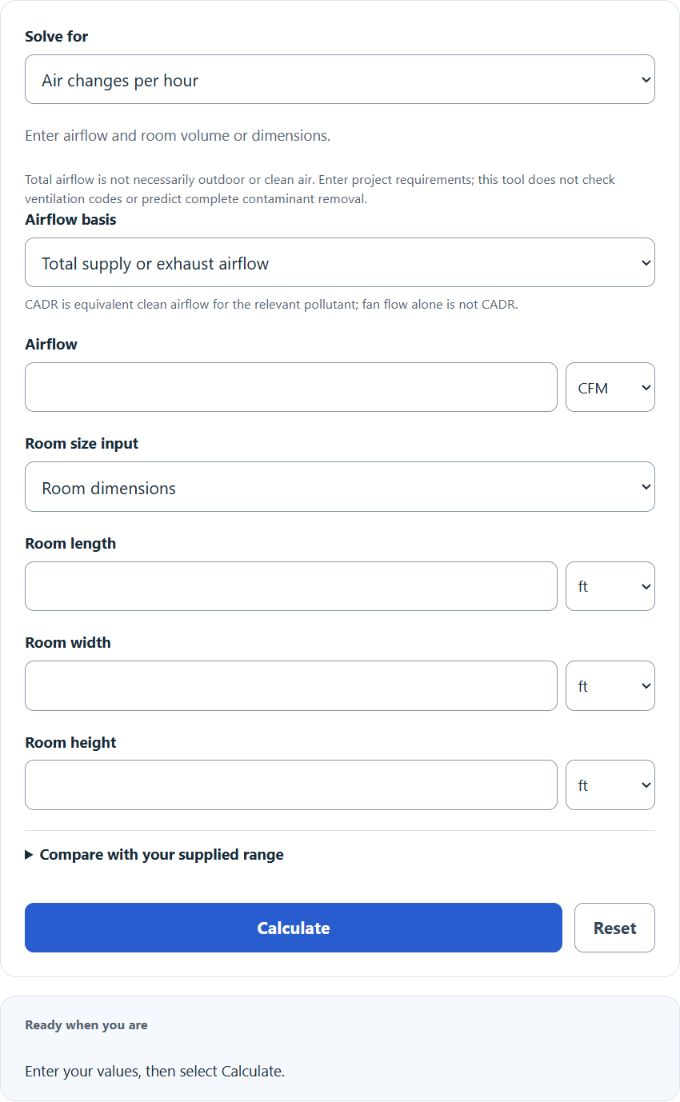
Calculate air changes per hour (ACH) from airflow and room size, or solve for required airflow or maximum room volume at your target ACH. Select total airflow, outdoor air, or effective clean air/CADR to identify what the result describes.
Air Changes Per Hour (ACH) Formula
Air changes per hour describes hourly airflow relative to room volume. It does not mean all original air is replaced: mixing and recirculation matter. The calculator uses three arrangements of the same relationship.
To find ACH from a known airflow and room volume:
ACH = (CFM * 60) / V
To find the airflow you need to hit a target ACH:
CFM = (ACH * V) / 60
To find the largest room a given airflow can serve at a target ACH:
V_max = (CFM * 60) / ACH
Variables:
- ACH is hourly airflow divided by room volume; effective clean airflow gives equivalent ACH (eACH)
- CFM is the selected total airflow, outdoor airflow, or pollutant-specific clean-air delivery rate in cubic feet per minute
- V is the room volume in cubic feet, found from length times width times height
- 60 converts airflow per minute into airflow per hour
The factor 60 converts CFM to hourly flow. The calculator also shows the nominal volume-throughput time, 60/ACH minutes. This is not a complete-air-replacement or contaminant-clearance time. Metric airflow and volume are converted consistently; the result is a rate per hour.
Illustrative ACH and Nominal Throughput Times
These numerical scenarios illustrate 60/ACH; they are not recommended ventilation rates for particular rooms. Enter targets or comparison limits from your project requirements. ASHRAE residential ventilation requirements depend on building characteristics and applicable methods, rather than a universal bedroom ACH minimum. Consult the applicable standard and local authority.
| Scenario | Example ACH | Nominal time |
| Scenario A | 0.35 to 1 | 60 to 171 min |
| Scenario B | 1 to 2 | 30 to 60 min |
| Scenario C | 4 to 6 | 10 to 15 min |
| Scenario D | 6 to 10 | 6 to 10 min |
| Scenario E | 7 to 8 | 7.5 to 8.6 min |
| Scenario F | 8 to 10 | 6 to 7.5 min |
| Scenario G | 8 to 12 | 5 to 7.5 min |
| Scenario H | 15 to 60 | 1 to 4 min |
| Scenario I | 20 to 30 | 2 to 3 min |
| Scenario J | 2 to 6 | 10 to 30 min |
The next table shows the airflow you would need to reach common ACH targets in a 2,700 cubic foot room, which is roughly a 20 by 15 foot office with a 9-foot ceiling. Use it as a quick sanity check against the calculator.
| Target ACH | Required airflow (2,700 ft³) |
| 2 | 90 CFM |
| 4 | 180 CFM |
| 6 | 270 CFM |
| 8 | 360 CFM |
| 10 | 450 CFM |
Example Problems
Example 1: Finding ACH. An office is 20 feet long, 15 feet wide, and 9 feet high, giving 2,700 cubic feet. At 400 CFM, ACH = 400 × 60 / 2,700 ≈ 8.89. The nominal volume-throughput time is 6.75 minutes. That does not mean all original air or contaminants are removed in 6.75 minutes.
Example 2: Finding required airflow. An 8 by 5 by 8 foot room has a volume of 320 cubic feet. At a chosen target of 8 ACH, required airflow = 8 × 320 / 60 ≈ 42.67 CFM. An installed fan delivering 50 CFM exceeds this mathematical target; this example does not establish a code requirement.
FAQ
What is a good number of air changes per hour?
There is no universal ACH target. Requirements depend on use, occupancy, outdoor-air needs, pollutant removal and the applicable standard. The target examples in this calculator load numbers for calculations; they do not select a compliant design.
How do I convert an air purifier’s CADR into ACH?
Select Effective clean air / CADR and use the clean-air delivery rate for the relevant pollutant and operating setting. A 250 CFM CADR in 1,200 cubic feet gives 250 × 60 / 1,200 = 12.5 eACH. CADR represents equivalent clean air; it does not supply outdoor air or necessarily remove gases and all pollutants.
Is ACH the same as CFM?
No. CFM is airflow per minute; ACH relates hourly airflow to room volume. The same 400 CFM gives a higher ACH in a smaller room. Total airflow, outdoor airflow and effective clean airflow describe different quantities, so ACH alone does not establish ventilation adequacy.