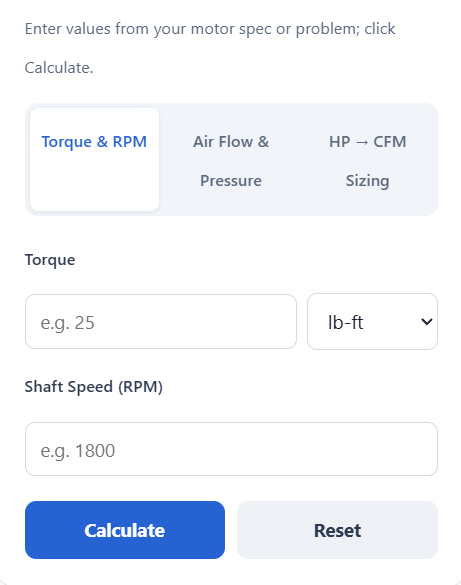
Enter either motor torque and shaft speed, air consumption and pressure, or a target power output to size the required air supply — the calculator returns horsepower (or required SCFM) for your air motor.
Related Calculators
- All Automotive Calculators
- Wind Turbine Power Output Calculator
- Fan Horsepower Calculator
- Mass Air Flow To Horsepower Calculator
- Pump Brake Horsepower Calculator
Formula
Torque & RPM mode:
HP = (T × N) / 5252
where T = torque in lb-ft, N = shaft speed in RPM.
Air Flow & Pressure mode:
HP = (P × Q × η) / 229
where P = working pressure in PSI, Q = air consumption in SCFM, η = motor efficiency (decimal).
HP → CFM Sizing mode:
Q = (HP × 229) / (P × η)
where Q = required SCFM, HP = target output, P = supply PSI, η = assumed efficiency.
Interpretation
The result is the mechanical shaft output of the air motor (or the air flow needed to produce it), not the compressor's electrical input. Air motors are less efficient than electric motors, so the same HP rating will consume more energy overall.
- Under 0.25 HP: fractional-HP tools like small drills and grinders.
- 0.25–1 HP: standard pneumatic hand tools.
- 1–5 HP: small industrial air motors for mixers, hoists, conveyors.
- 5–25 HP: mid-size industrial duty.
- Above 25 HP: heavy industrial applications with large dedicated air supplies.
For sizing, check that your compressor's continuous SCFM rating at your target pressure exceeds the calculated value — intermittent ratings will not sustain a running motor.
Typical Efficiency by Motor Type
| Motor Type | Typical Efficiency | Common Use |
|---|---|---|
| Vane (standard) | 65–75% | General tools, light industrial |
| Piston | 80–90% | High-torque, low-speed tasks |
| Gear | 60–70% | Mixing, winches |
| Turbine | 30–55% | Very high-speed, low-torque |
FAQ
What's the difference between SCFM and CFM?
SCFM (standard cubic feet per minute) is flow corrected to standard conditions (typically 14.7 PSI, 68 °F, 0% humidity). CFM without "standard" refers to actual flow at the operating pressure, which will be a smaller number. Motor specs almost always use SCFM.
Why does efficiency matter so much in the air-flow formula?
The constant 229 in HP = (P × Q) / 229 gives the theoretical maximum if all compressed-air energy converted to shaft work. Real motors lose energy to leakage, friction, and exhaust, so you multiply by η (usually 0.55–0.85) to get realistic output.
Can I use this for the compressor instead of the motor?
No. The compressor's electrical HP is much higher than the air motor's output HP for the same air flow, because you have to pay for compression losses too. Use this calculator for the air motor only.
Why is 5252 in the torque formula?
It's the constant that converts lb-ft × RPM into horsepower: 5252 = 33,000 ÷ (2π). It applies to any rotating shaft, not just air motors.