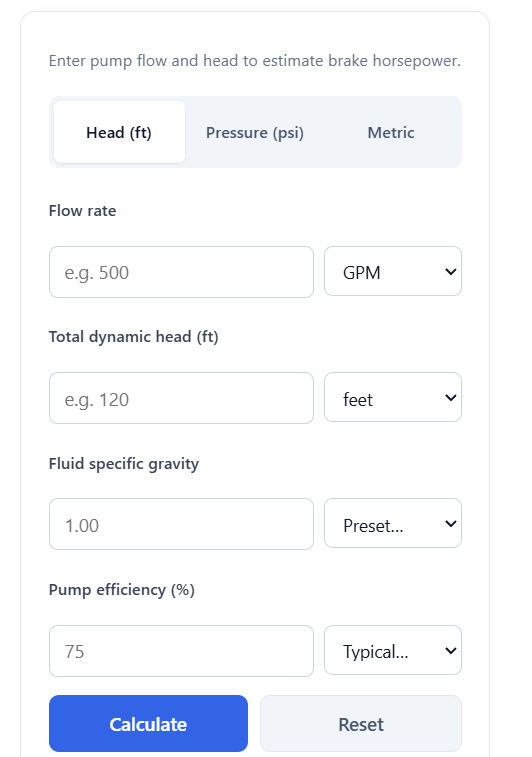
Enter your pump’s flow rate, total head (or differential pressure), fluid specific gravity, and pump efficiency to estimate the brake horsepower (BHP) required to drive the pump.
Related Calculators
- All Automotive Calculators
- Fuel Pump Horsepower Calculator
- Horsepower Head Flow Calculator
- Well Pump Horsepower Calculator
Formula
BHP = (Q × H × SG) / (3960 × η)
where Q = flow rate in GPM, H = total dynamic head in feet, SG = fluid specific gravity, η = pump efficiency as a decimal (e.g., 0.75).
If you have pressure instead of head:
H (ft) = 2.31 × Ppsi / SG
Water horsepower (the useful hydraulic output):
WHP = (Q × H × SG) / 3960, and BHP = WHP / η.
Interpretation
BHP is the shaft power the motor must deliver to the pump to produce the flow and head you entered. It is always larger than WHP because no pump is 100% efficient — the gap is friction, recirculation, and internal losses. Use BHP to size the motor, not WHP. A common practice is to add a service-factor margin (typically 10–25%) above BHP when selecting the motor, so the motor does not run at its limit at the duty point.
Efficiency benchmarks for centrifugal pumps:
- ≥ 75% — well-selected pump operating near its best efficiency point (BEP).
- 60–75% — acceptable, but check whether the pump is operating far from BEP.
- < 60% — likely oversized, worn, or running off-curve; expect higher energy cost and wear.
Motor Sizing Quick Reference
| Calculated BHP | Typical Motor Size (with margin) |
|---|---|
| Up to 0.5 hp | 3/4 hp |
| 0.5 – 1.5 hp | 2 hp |
| 1.5 – 4 hp | 5 hp |
| 4 – 8 hp | 10 hp |
| 8 – 12 hp | 15 hp |
| 12 – 16 hp | 20 hp |
| 16 – 20 hp | 25 hp |
FAQ
What is the difference between BHP and WHP?
Water horsepower (WHP) is the theoretical hydraulic power delivered to the fluid. Brake horsepower (BHP) is the shaft input power the pump actually needs, which equals WHP divided by the pump's efficiency.
What do I enter if I only know the discharge pressure, not the head?
Use the Pressure tab. The calculator converts psi to feet of head using H = 2.31 × P / SG. Make sure you're entering the differential pressure across the pump (discharge minus suction), not just the gauge reading at the outlet.
Do I include motor efficiency in this calculation?
No. The efficiency field is the pump's efficiency only. To find the electrical power draw, divide BHP by the motor efficiency (typically 0.88–0.95) and convert to kW. BHP is the mechanical power at the pump shaft.
Why does specific gravity matter?
Head is a length, but the energy required to lift a column depends on the fluid's weight. Pumping a fluid denser than water (SG > 1) requires proportionally more power for the same head and flow; lighter fluids require less.