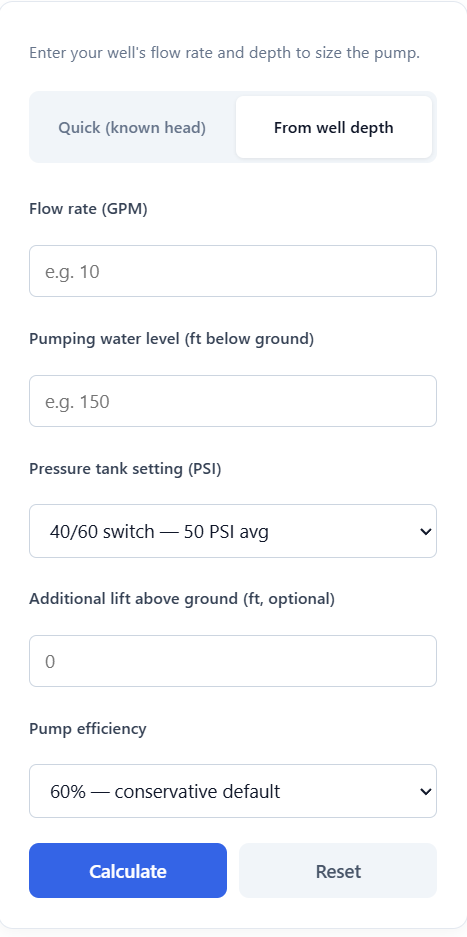
Enter your well’s flow rate (GPM) and either the total dynamic head or the pumping water level to find the horsepower your well pump needs to deliver water at the required pressure.
Related Calculators
- All Automotive Calculators
- Pump Brake Horsepower Calculator
- Horsepower Head Flow Calculator
- Fuel Pump Horsepower Calculator
Formula
Brake horsepower (what the motor must deliver):
HP = (GPM × TDH) ÷ (3960 × η)
where GPM = flow in gallons per minute, TDH = total dynamic head in feet, η = pump efficiency (decimal, e.g. 0.60).
Total dynamic head from well depth:
TDH = pumping water level (ft) + extra lift above ground (ft) + (PSI × 2.31)
where 2.31 ft of head = 1 PSI of pressure at the tank.
Interpretation
The calculated number is the brake horsepower required at the pump shaft. Round up to the nearest standard motor size (⅓, ½, ¾, 1, 1½, 2, 3, 5 HP) — motors are only manufactured at discrete sizes, and slight oversizing is normal to handle startup loads and worst-case drawdown.
- Under 0.5 HP: shallow wells under ~100 ft or very low flow.
- 0.5–1.5 HP: typical residential submersible, 100–250 ft deep, 5–15 GPM.
- 1.5–3 HP: deep residential (250–500 ft) or high-demand homes with irrigation.
- 3 HP and up: deep wells past 500 ft, small farm, or commercial use.
If your result is an oddly high number (e.g., 6 HP for a house), recheck your pumping water level — many users enter static depth instead of the drawdown level during active pumping, which inflates the head.
Sizing Reference Table
| Well Depth (pumping level) | Flow (GPM) | 40/60 PSI Tank | Typical Motor Size |
|---|---|---|---|
| 100 ft | 8 | 50 PSI | ½ HP |
| 200 ft | 10 | 50 PSI | ¾ HP |
| 300 ft | 10 | 50 PSI | 1 HP |
| 400 ft | 12 | 50 PSI | 1½ HP |
| 500 ft | 15 | 50 PSI | 2 HP |
| 700 ft | 15 | 50 PSI | 3 HP |
Values assume 60% pump efficiency and no significant friction loss in the drop pipe. Add roughly 5–10% head for long horizontal runs or undersized pipe.
FAQ
What’s the difference between static water level and pumping water level?
Static level is the depth to water when the pump is off. Pumping level (also called drawdown level) is how far the water drops while the pump is running — this is the number you want for sizing. If you only have static level, add 10–25% as a rough drawdown estimate, or ask your well driller for the test data.
Should I use 50% or 70% efficiency?
Use 60% as a safe default for a typical 4-inch submersible. Modern high-efficiency submersibles run 65–75%; older or jet pumps often fall to 40–55%. Lower efficiency means you need a bigger motor to deliver the same water HP.
Why does pressure tank setting matter?
The pump has to push water up the well and compress air in the pressure tank to your cut-off pressure. Each PSI equals 2.31 feet of added head, so a 40/60 switch (50 PSI average) adds about 115 ft of equivalent lift to the calculation.
Do I round up or down to a standard motor size?
Always round up. If you calculate 0.82 HP, install a 1 HP pump. Pumps run most efficiently near their design point, and undersizing causes the motor to run continuously and overheat during peak demand.