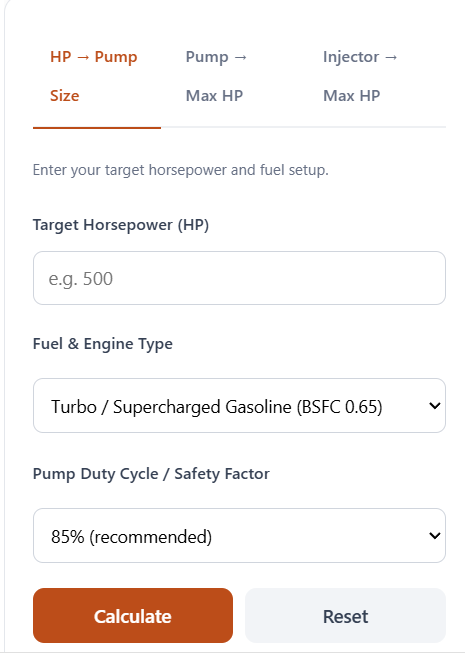
Use this calculator to size a fuel pump for your horsepower target, estimate the maximum HP a pump can support, or check whether your injectors are the limiting factor. Enter flow rate, fuel type, and duty cycle to get matched results across all three modes.
Formula
Fuel mass flow required:
Mfuel = HP × BSFC
where Mfuel = fuel flow (lb/hr), HP = target horsepower, BSFC = brake specific fuel consumption (lb/hp·hr).
Pump size needed (volumetric):
Qpump = (HP × BSFC) ÷ (ρ × duty)
where Qpump = pump flow (gal/hr), ρ = fuel density (lb/gal), duty = usable duty cycle (0–1). Multiply gal/hr by 3.785 to get L/h.
Max HP from a given pump:
HPmax = (Q × ρ × duty) ÷ BSFC
where Q = pump flow in gal/hr (convert L/h ÷ 3.785).
BSFC and Fuel Density Reference
| Fuel / Setup | BSFC (lb/hp·hr) | Density (lb/gal) |
|---|---|---|
| NA Gasoline | 0.50 | 6.01 |
| Forced Induction Gasoline | 0.65 | 6.01 |
| NA E85 | 0.63 | 6.59 |
| Forced Induction E85 | 0.80 | 6.59 |
| Diesel | 0.40 | 7.10 |
| Methanol | 1.20 | 6.59 |
Interpretation
The result tells you either the pump flow rate you need (L/h or gal/hr) or the horsepower ceiling your current fuel system can safely support. Always size above your peak HP target — a pump running at 100% duty bleeds voltage, heats up, and can't recover if fuel pressure drops under load. Use these rough brackets as a sanity check on pump flow at the wheels of forced-induction gasoline builds:
- Up to ~300 HP: 190 L/h OEM-style pump
- 300–450 HP: 255 L/h drop-in pump
- 450–600 HP: 340 L/h high-flow pump
- 600–800 HP: 450 L/h or dual 255/340 setup
- 800+ HP: Single 500+ L/h or dual/triple pump system
E85 shifts every bracket down roughly 20–25% because it demands more fuel mass per horsepower. Diesel shifts up because BSFC is lower.
FAQ
What BSFC should I use if I'm not sure?
For street gasoline builds, 0.50 naturally aspirated and 0.55–0.65 for boost are safe defaults. Go higher (0.65–0.70) on high-boost or high-compression setups where you plan to run rich for safety.
Does fuel pressure affect these results?
Yes. Pump flow ratings drop as pressure rises, so a pump rated at 255 L/h at 40 psi may only deliver ~200 L/h at 60 psi. Use the pump's flow curve at your actual system pressure, not the headline rating.
Why do my injector and pump results differ?
They answer different questions. The pump sets the fuel supply ceiling; the injectors set the metering ceiling. The lower of the two is your real HP limit — upgrade whichever is smaller first.
Should I use flywheel HP or wheel HP?
Use crank/flywheel horsepower. BSFC is based on engine output, not drivetrain-losses-adjusted wheel HP. If you only have wheel HP, add roughly 15% for manual transmissions or 20–25% for automatics.