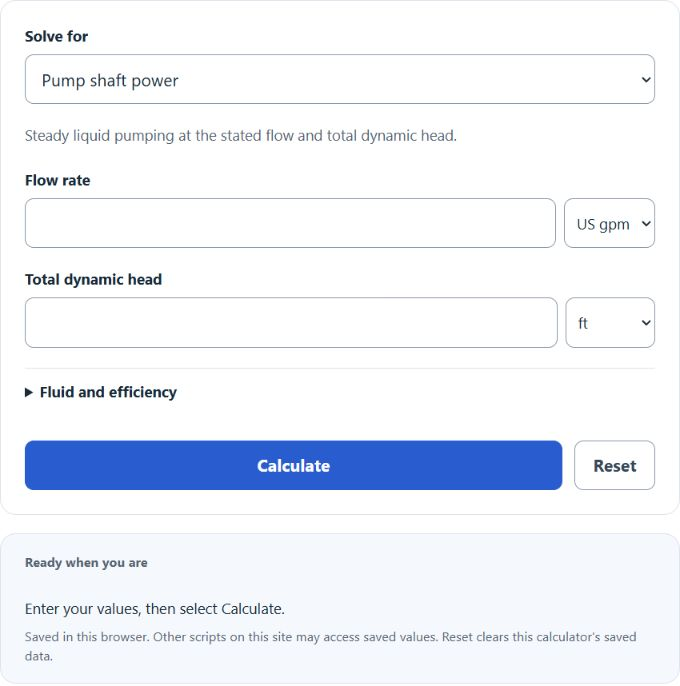
Choose pump shaft power, flow rate or total dynamic head, then enter the other two quantities. Fluid specific gravity defaults to 1 for water and efficiency defaults to an ideal 100%; set the operating values under Fluid and efficiency.
Formula
The calculator uses the standard pump hydraulic equation, rearranged for each mode:
HP = (Q × H × SG) / (3960 × η)
Q = (HP × 3960 × η) / (H × SG)
H = (HP × 3960 × η) / (Q × SG)
where HP = pump shaft horsepower, Q = flow in GPM, H = total head in feet, SG = specific gravity of the fluid, and η = pump efficiency as a decimal (1.0 = 100%). The conventional 3960 factor approximately converts US GPM × feet of water head into mechanical horsepower; the formula is an energy balance, not a pump selection model.
Interpretation
Hydraulic power is the ideal power delivered to the stated fluid. Pump shaft power, also called brake horsepower, is hydraulic power divided by pump efficiency. At an ideal 100% efficiency they are equal. Electrical input also depends on motor and drive efficiency.
- Under 1 HP: fractional-HP pumps (small circulators, aquarium, light transfer).
- 1–5 HP: residential well, pool, and booster pumps.
- 5–50 HP: commercial HVAC, irrigation, and process pumps.
- 50–500 HP: industrial and large irrigation pumps.
- Over 500 HP: municipal water, mining, and power plant service.
Use efficiency from the manufacturer’s pump curve at the intended operating point. The 100% default is an ideal reference, not a typical pump efficiency. This calculation does not determine motor ratings or a suitable service factor.
Quick Unit Reference
| From | To | Multiply by |
|---|---|---|
| m³/h | GPM | 4.40287 |
| L/s | GPM | 15.8503 |
| meters of head | feet of head | 3.28084 |
| feet of head (water) | psi | 0.4335 |
| kW | HP | 1.341 |
FAQ
What is “total head” — is it the same as the vertical lift?
No. Total dynamic head (TDH) is the sum of static lift, friction losses in the piping, and any pressure differential between the source and discharge. Using only vertical lift will undersize the pump.
Do I use water horsepower or brake horsepower to pick a motor?
Use the required shaft power (BHP), which includes pump efficiency. Motor selection also requires the pump manufacturer’s load envelope, applicable ratings, starting conditions and service requirements; this tool does not prescribe a service factor.
Why does specific gravity matter if I’m pumping water?
For water, SG = 1.00 and the term drops out. For heavier fluids like brine (1.25) or sulfuric acid (1.84), the pump must do proportionally more work at the same head and flow, so HP scales directly with SG.
What efficiency should I use if I don’t know the pump curve?
Use the manufacturer’s efficiency at the intended operating point. If it is unknown, the ideal 100% reference shows hydraulic power but does not establish the required real shaft or electrical input power.