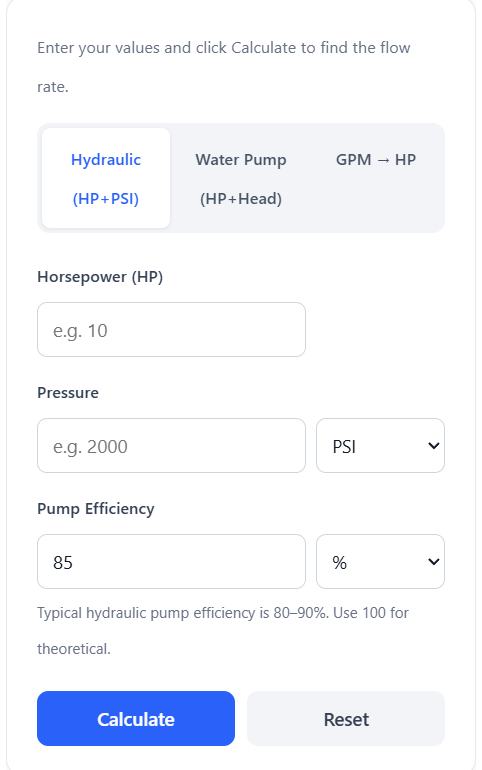
Enter horsepower and pressure (or head) along with pump efficiency to convert HP into flow rate in gallons per minute, or switch to the reverse mode to size the horsepower needed for a target GPM.
Related Calculators
- All Automotive Calculators
- Fuel Pump Horsepower Calculator
- Pump Brake Horsepower Calculator
- Horsepower Head Flow Calculator
Formula
Hydraulic (pressure-based):
GPM = (HP × 1714 × η) / P
where HP = input horsepower, P = pressure in PSI, η = pump efficiency as a decimal.
Water pump (head-based):
GPM = (HP × 3960 × η) / H
where H = total dynamic head in feet, η = pump efficiency as a decimal.
Reverse (GPM → HP):
HP = (GPM × P) / (1714 × η)
where the output is the horsepower required to deliver that flow at pressure P.
Interpretation
The result tells you the volumetric flow a pump can deliver for the horsepower you've applied, after efficiency losses. The constants 1714 (hydraulic, HP·PSI basis) and 3960 (water, HP·ft basis) already bundle the unit conversions — you only need to supply the efficiency.
- Under 5 GPM: small hand pumps, compact hydraulic circuits, lab-scale flow.
- 5–20 GPM: typical mobile and light industrial hydraulics.
- 20–60 GPM: mid-size industrial pumps and machine tool systems.
- 60+ GPM: heavy industrial or large water-transfer pumps.
If your calculated GPM is far from the pump's rated flow on its curve, check that you're using the right pressure (system PSI, not peak relief setting) and a realistic efficiency — hydraulic pumps run 80–90%, centrifugal water pumps 60–80%.
Quick Reference Table
| HP | Pressure (PSI) | Efficiency | Flow (GPM) |
|---|---|---|---|
| 5 | 1500 | 85% | 4.86 |
| 10 | 2000 | 85% | 7.28 |
| 20 | 2500 | 85% | 11.66 |
| 25 | 3000 | 85% | 12.14 |
| 50 | 3000 | 90% | 25.71 |
FAQ
Which tab should I use — hydraulic or water pump?
Use the hydraulic tab when you know the system pressure in PSI (oil hydraulics, power units). Use the water pump tab when you know the total dynamic head in feet, meters, or PSI of lift — that's how centrifugal pump curves are published.
What efficiency value should I enter?
For hydraulic gear and vane pumps, 80–85% is typical; piston pumps can reach 90–92%. For centrifugal water pumps, use 60–70% for small units and 75–80% for larger well-matched pumps. Enter 100 only for theoretical maximums.
Why do the formulas use 1714 and 3960?
They're unit-conversion constants. 1714 converts HP × PSI to GPM for hydraulic fluid power. 3960 converts HP × feet-of-head to GPM for water (it includes water's specific weight). Swapping them gives wrong answers by a factor of ~2.3.
Does this account for pipe friction or elevation losses?
No. The pressure or head you enter must already be the total the pump has to overcome — static lift plus friction losses plus discharge pressure. Calculate those separately and use the sum as your input.