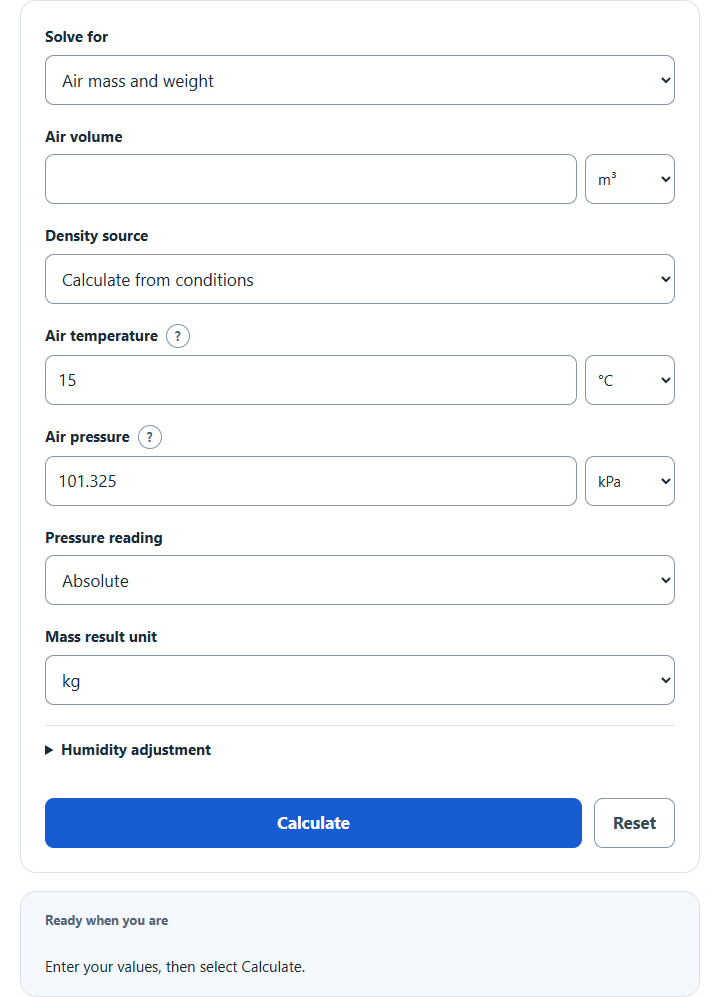
Calculate the weight of air in kg or lb from its volume at standard sea-level conditions, or enter your own temperature and pressure for compressed air.
Related Calculators
- Air-Flow Calculator
- Pressure Coefficient Calculator
- Joule Thomson Effect Calculator
- Joule–Thomson Coefficient Calculator
- All Physics Calculators
Calculator Functions
| Function | What it does | What it requires |
|---|---|---|
| Air mass and weight | Finds the mass of a volume of air, with its weight force in newtons and pounds-force | Requires the air volume and a density source: temperature and pressure, standard dry air, or a custom density |
| Air volume from mass | Finds the volume that a mass of air occupies | Requires the air mass and a density source: temperature and pressure, standard dry air, or a custom density |
| Air density | Finds the density of air in kg/m³ and lb/ft³ | Requires a density source: temperature and pressure, standard dry air, or a custom density |
Volume can be entered in m³, L, ft³, yd³ or US gal, and mass in kg, g, lb or oz. With Calculate from conditions, temperature is in °C, °F or K and pressure in kPa, hPa, Pa, bar, atm, psi or inHg. A Gauge reading, as on a compressed air tank or line, has 1 atm (101.325 kPa) added to make it absolute. The optional humidity adjustment takes relative humidity in percent, and a blank means dry air.
Air Weight Formulas
| m | Mass of the air (kg) |
| ρ | Density of the air (kg/m³) |
| V | Volume of the air (m³) |
Air mass and weight
The volume is multiplied by the air density. The weight force then comes from the mass and standard gravity:
W is in newtons, and the result also shows it in pounds-force. With Standard dry air, the density is 1.225 kg/m³, so 1 m³ of air has a mass of 1.225 kg and weighs about 12.01 N. A room of 50 m³ holds 61.25 kg of air.
Air volume from mass
This is the main formula rearranged. At 1.225 kg/m³, 1 kg of air fills 0.816 m³.
Air density
This is the equation of state for an ideal gas [1]. p is the absolute pressure in Pa, T is the temperature in kelvin and Rd is the gas constant of dry air, 287.05 J/(kg·K). At 15 °C and 101.325 kPa it gives 1.225 kg/m³, the Standard dry air value. Compressed air at 100 psi gauge and 15 °C has an absolute pressure of 790.8 kPa and a density of 9.56 kg/m³.
Air density with humidity
pv ÷ (Rv × T)
When a relative humidity is entered, the dry air and the water vapor are each treated as an ideal gas and their densities are added. pv is the pressure of the water vapor and Rv is the gas constant of water vapor, 461.495 J/(kg·K). The vapor pressure comes from the relative humidity RH and the temperature t in °C:
exp(17.625t ÷ (243.04 + t)) [2]
This approximation of the saturation vapor pressure over water is stated for −40 °C to 50 °C, with an error below 0.384% [2]. The calculator accepts humidity from 0 °C to 50 °C. At 30 °C, 101.325 kPa and 50% relative humidity the density is 1.155 kg/m³, a little below the 1.164 kg/m³ of dry air at the same temperature and pressure.
Limits of This Estimate
- Air is treated as an ideal gas. At very high pressures or very low temperatures real air departs from this, and a measured value entered as Custom air density is the better choice.
- Kilograms and pounds measure mass, while newtons and pounds-force measure weight, the force of gravity on that mass [4]. The weight force uses standard gravity, 9.80665 m/s² [3], and local gravity differs slightly.
- The gas constants 287.05 and 461.495 J/(kg·K) are rounded values in common use. NASA rounds the constant for air to 0.286 kJ/(kg·K) [1]. These estimates are based on the best available data and estimations.
- The humidity adjustment is relative to liquid water and is not offered below 0 °C or above 50 °C.
Sources
- NASA Glenn Research Center, Equation of State: ideal gas relation between pressure, density and temperature
- Alduchov and Eskridge, Improved Magnus Form Approximation of Saturation Vapor Pressure (NOAA National Climatic Data Center report): saturation vapor pressure equation, Equation 25
- NIST, Guide for the Use of the International System of Units (SP 811), Appendix B.8: standard gravity and the factors for pounds, cubic feet and pounds-force
- NIST, Guide for the Use of the International System of Units (SP 811), Section 8.3: difference between mass and weight