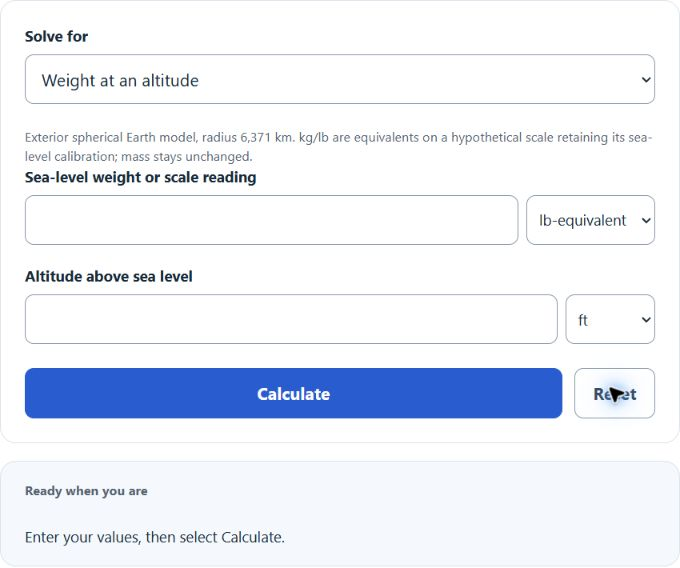
Calculate weight at altitude, compare weights between elevations, or find altitude for a target weight with the exterior spherical Earth model at nonnegative altitudes.
Altitude Weight Formula
Your weight changes with altitude because gravity weakens with distance from Earth’s center. The calculator uses Newton’s inverse-square law of gravitation.
Compare mode (known weight at one altitude, solving for another):
Find-altitude mode (solving for h given a target weight):
- W — weight at altitude
- W₀ — weight at sea level
- R — Earth’s mean radius (6,371,000 m)
- h — altitude above sea level (m)
The model applies outside a spherical Earth with a 6,371 km reference radius, at nonnegative altitudes. It ignores rotation, local density variations, and buoyancy. Negative altitude requires an interior or local Earth model; a target weight above the sea-level reference has no solution here. Mass does not change with altitude; only the gravitational force on that mass does. For everyday altitudes the effect is small, around 0.03% loss per 1,000 m.
Reference Values
Weight change for a 150 lb person at common altitudes:
| Location | Altitude | Scale-equivalent (lb) | Change |
|---|---|---|---|
| Sea level | 0 m | 150.000 | 0% |
| Denver | 1,609 m | 149.924 | −0.05% |
| Mexico City | 2,240 m | 149.895 | −0.07% |
| Mt. Everest | 8,849 m | 149.584 | −0.28% |
| Cruising airliner | 10,668 m | 149.499 | −0.33% |
| Low orbit (ISS) | 408 km | 132.488 | −11.7% |
Effective gravity at altitude:
| Altitude | g (m/s²) | % of sea level |
|---|---|---|
| 0 m | 9.807 | 100.00% |
| 1,000 m | 9.804 | 99.97% |
| 10,000 m | 9.776 | 99.69% |
| 100 km | 9.506 | 96.93% |
| 408 km | 8.662 | 88.33% |
| 1,000 km | 7.326 | 74.71% |
Common Questions
Do astronauts on the ISS feel weightless because gravity is gone? No. Gravity at 408 km is still about 89% of sea level. They feel weightless because the station is in continuous free fall around Earth, not because gravity has vanished.
Does my mass change at altitude? No. Mass is constant. Only weight, the force gravity exerts on that mass, decreases as you climb.
Will a bathroom scale show this difference? A typical scale on Mt. Everest would read about 0.42 lb less for a 150 lb person. Most household scales lack the resolution to display the change clearly.
Why does the calculator ignore air buoyancy and Earth’s spin? Both effects influence real scale readings and can exceed small altitude effects. Earth’s rotation reduces apparent weight by roughly 0.3% at the equator versus the poles. The calculator isolates the spherical distance effect. kg/lb outputs are hypothetical scale equivalents retaining the sea-level calibration; they are not changes in mass.
Example: A 70 kg climber at 8,849 m. Factor = (6,371,000 / 6,379,849)² = 0.99723. Weight = 70 × 0.99723 = 69.81 kg-equivalent, a loss of about 190 grams of apparent weight.