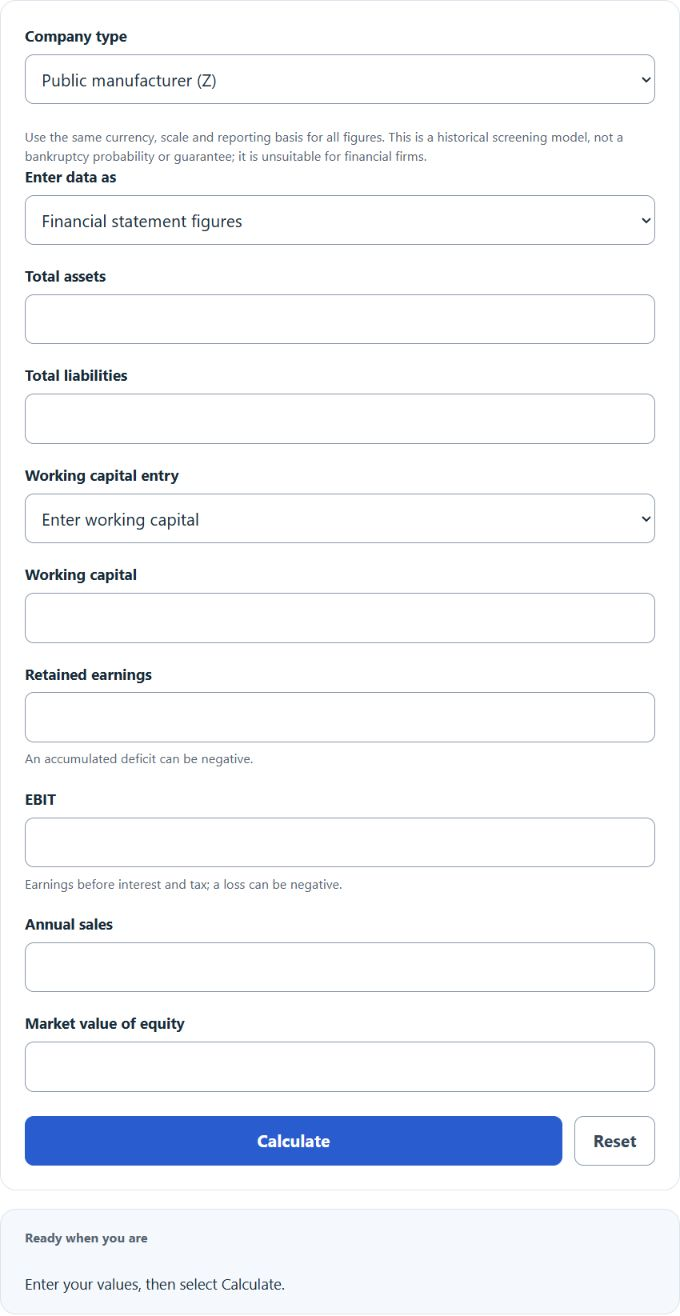
Calculate a company’s Altman Z-Score and historical financial-distress screening zone using the public, private, and non-manufacturer models from balance sheet and income data.
Altman Z-Score Formula
The original Z-Score, developed by Edward Altman in 1968 for publicly traded manufacturers, is:
Z = 1.2*X1 + 1.4*X2 + 3.3*X3 + 0.6*X4 + 1.0*X5
For private manufacturers, the Z’-Score replaces market value of equity with book value and re-estimates the weights:
Z' = 0.717*X1 + 0.847*X2 + 3.107*X3 + 0.420*X4 + 0.998*X5
For non-manufacturers and service companies, the Z”-Score drops the sales ratio entirely:
Z'' = 6.56*X1 + 3.26*X2 + 6.72*X3 + 1.05*X4
- X1 = working capital / total assets, a measure of short-term liquidity relative to firm size
- X2 = retained earnings / total assets, cumulative profitability retained in the business
- X3 = EBIT / total assets, the operating earning power of the asset base
- X4 = equity / total liabilities, using market value of equity in the original model and book value in the Z’ and Z” models
- X5 = sales / total assets, the asset turnover ratio, which is dropped in the Z” model because turnover varies too much across non-manufacturing industries
The calculator applies whichever formula matches the company type you select. You can enter raw financial statement figures and it computes the five ratios for you, or you can switch the input mode and enter the ratios X1 through X5 directly. If you select the non-manufacturer model, an emerging-market option adds the 3.25 constant Altman specified for emerging-market issuers. The result shows the score, the historical screening zone, the distance from its safe-zone boundary, and each ratio’s contribution in Calculation details. The emerging-market offset and shifted boundaries preserve the unadjusted classification; this score alone does not reproduce the full emerging-market assessment or supply a current bankruptcy probability.
Zone Cutoffs by Model and Predictive Accuracy
Each model has its own zone boundaries, so a score of 2.0 can be a grey-zone result for a public manufacturer but a distress signal is avoided for a service company only above 1.1. Use the cutoffs for the model you actually calculated.
| Model | Company type | Equity measure | Distress zone | Grey zone | Safe zone |
|---|---|---|---|---|---|
| Z | Public manufacturer | Market value | Below 1.81 | 1.81 to 2.99 | Above 2.99 |
| Z’ | Private manufacturer | Book value | Below 1.23 | 1.23 to 2.90 | Above 2.90 |
| Z” | Non-manufacturer or service | Book value | Below 1.10 | 1.10 to 2.60 | Above 2.60 |
| Z” + 3.25 | Emerging-market issuer | Book value | Below 4.35 | 4.35 to 5.85 | Above 5.85 |
The score is most meaningful close to the event it was built to predict. The following rates refer to the original bankrupt sample at a 2.67 classification cutoff, as reported in Altman’s 2000 review, rather than to the zone boundaries above or a current probability forecast:
| Years before bankruptcy filing | Original bankrupt-sample classification rate |
|---|---|
| 1 year | 94% |
| 2 years | 72% |
| 3 years | 48% |
| 4 years | 29% |
| 5 years | 36% |
Treat the score as a one-to-two-year early warning signal rather than a long-range forecast, and recalculate it every reporting period so you can watch the trend, which is often more informative than any single reading.
Example Problems
Example 1: A publicly traded manufacturer reports total assets of 500,000, total liabilities of 250,000, working capital of 60,000, retained earnings of 100,000, EBIT of 50,000, sales of 600,000, and a market capitalization of 400,000. The ratios are X1 = 0.12, X2 = 0.20, X3 = 0.10, X4 = 1.60, and X5 = 1.20. Applying the original weights: Z = 1.2(0.12) + 1.4(0.20) + 3.3(0.10) + 0.6(1.60) + 1.0(1.20) = 0.144 + 0.28 + 0.33 + 0.96 + 1.20 = 2.914 (about 2.91). That falls in the grey zone, 0.076 below the 2.99 safe-zone boundary; the safe zone is strictly above it.
Example 2: A private software company (non-manufacturer) has total assets of 200,000, total liabilities of 110,000, working capital of 30,000, retained earnings of 40,000, EBIT of 24,000, and book equity of 90,000. The ratios are X1 = 0.15, X2 = 0.20, X3 = 0.12, and X4 = 0.818. Applying the Z” weights: Z” = 6.56(0.15) + 3.26(0.20) + 6.72(0.12) + 1.05(0.818) = 0.984 + 0.652 + 0.806 + 0.859 = 3.30. That is above the 2.60 cutoff, so the company is in the safe zone.
FAQ
What is a good Altman Z-Score? A score in the safe zone for the model you used: above 2.99 for the original model, above 2.90 for the private-company Z’, or above 2.60 for the non-manufacturer Z”. Higher is better, but compare against the correct model’s cutoffs, and give more weight to a stable or improving trend across several quarters than to one strong reading.
Can the Z-Score be negative? Yes. Negative working capital, an accumulated deficit in retained earnings, or operating losses make X1, X2, or X3 negative, or negative book equity in the book-equity variants, and a large enough drag pushes the whole score below zero. A negative score is deep in the distress zone and usually reflects a company whose liabilities and losses overwhelm its asset base.
Does the Z-Score work for banks and financial companies? No. Altman excluded financial firms when building the model because their balance sheets are dominated by financial assets and high leverage that the five ratios were never calibrated for. For banks and insurers, use regulatory capital measures and sector-specific ratings instead.