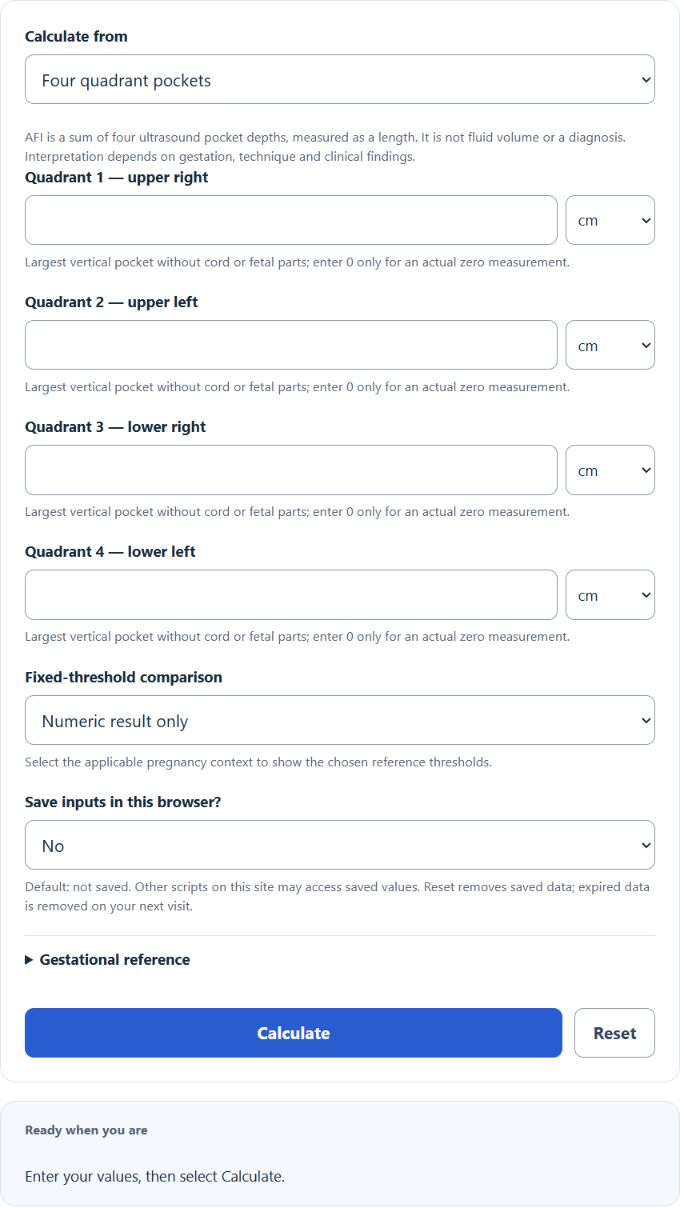
Calculate AFI from four measured quadrant pocket depths, or enter a known AFI. Optional settings provide a historical gestational reference comparison.
- All Health and Medical Calculators
- Baby Percentile Calculator
- Fundal Height Calculator
- Crown Rump Length Calculator
- CRL to Weeks Calculator
- HCG to Weeks Calculator
- Naegele’s Rule Calculator
Amniotic Fluid Index Formula
The following formula is used to calculate the Amniotic Fluid Index (AFI).
Variables:
- AFI is the Amniotic Fluid Index (cm)
- D1, D2, D3, D4 are the depths of the largest vertical pockets of amniotic fluid in each of the four quadrants of the uterus (cm)
To calculate the Amniotic Fluid Index, add the depths of the largest vertical pockets of amniotic fluid in each of the four quadrants of the uterus.
What is an Amniotic Fluid Index?
The Amniotic Fluid Index (AFI) is an ultrasound-based estimate formed by adding the deepest vertical fluid-pocket measurement in each of four uterine quadrants, excluding cord and fetal parts. Its unit is a length, usually centimeters; it is not a direct fluid volume. Gestational age, measurement technique and clinical findings determine interpretation. A value within a reference interval does not by itself establish that a pregnancy is healthy.
How to Calculate Amniotic Fluid Index?
The following steps outline how to calculate the Amniotic Fluid Index (AFI).
- First, measure the depth of the largest vertical pocket of amniotic fluid in the first quadrant of the uterus (D1) in centimeters.
- Next, measure the depth of the largest vertical pocket of amniotic fluid in the second quadrant of the uterus (D2) in centimeters.
- Next, measure the depth of the largest vertical pocket of amniotic fluid in the third quadrant of the uterus (D3) in centimeters.
- Next, measure the depth of the largest vertical pocket of amniotic fluid in the fourth quadrant of the uterus (D4) in centimeters.
- Finally, calculate the Amniotic Fluid Index (AFI) using the formula AFI = D1 + D2 + D3 + D4.
Example Problem:
Use the following variables as an example problem to test your knowledge.
Depth of the largest vertical pocket of amniotic fluid in the first quadrant of the uterus (D1) = 5 cm
Depth of the largest vertical pocket of amniotic fluid in the second quadrant of the uterus (D2) = 4 cm
Depth of the largest vertical pocket of amniotic fluid in the third quadrant of the uterus (D3) = 6 cm
Depth of the largest vertical pocket of amniotic fluid in the fourth quadrant of the uterus (D4) = 3 cm
The example sum is AFI = 5 + 4 + 6 + 3 = 18 cm. Enter all four measurements; an unmeasured or blank quadrant is not zero.
The optional fixed comparison uses a low threshold of ≤5 cm, as in the SAFE trial, and a high threshold of ≥24 cm from SMFM singleton guidance. Boundary conventions vary. Select the singleton, 20+ week context only when applicable. Earlier gestation gets a numeric result without this fixed comparison. Single deepest pocket is a different assessment and is not AFI divided by four.
The optional Moore–Cayle 1990 table compares completed weeks 16–42 with historical 5th, median and 95th percentiles. It does not estimate an exact percentile or make a diagnosis. Inputs are not saved by default; explicit browser saving lasts 24 hours, with expired data removed on the next visit. Other scripts on this site can access saved values; Reset removes them.