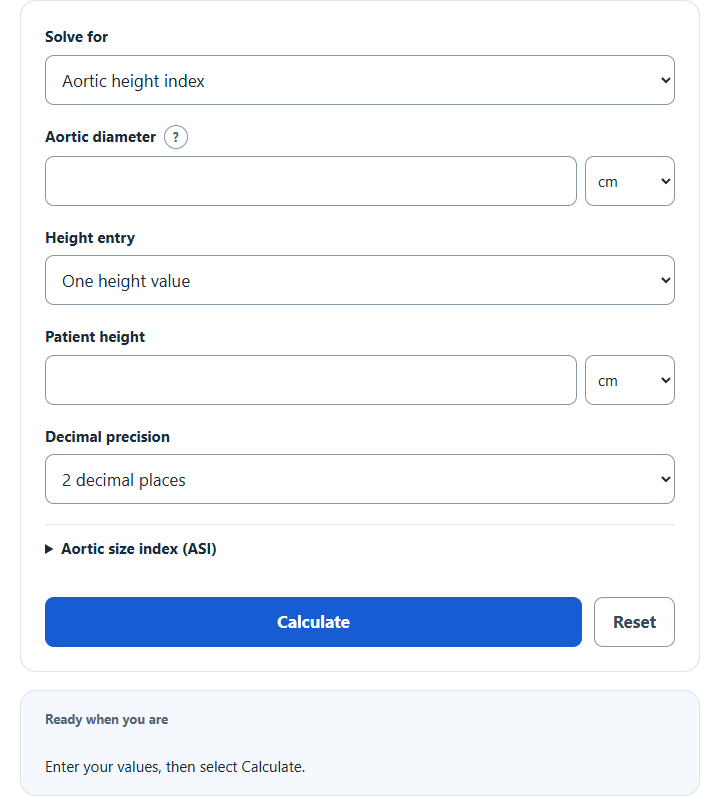
Calculate aortic height index (AHI) from aortic diameter and height, add weight for aortic size index (ASI), and compare AHI with published study bands.
Calculator Functions
| Function | What it does | What it requires |
|---|---|---|
| Aortic height index | Finds the aortic height index (AHI) and, when a weight is added, the aortic size index (ASI) | Requires the aortic diameter and the patient height. Body weight is optional |
| Aortic diameter from AHI | Finds the aortic diameter that gives a chosen AHI at a given height | Requires the AHI in cm/m and the patient height |
| Height from diameter and AHI | Finds the height at which a diameter gives a chosen AHI | Requires the aortic diameter and the AHI in cm/m |
The diameter can be entered in centimeters, millimeters or inches, and the height in centimeters, meters, inches, or feet and inches. Results are rounded to 2, 3 or 4 decimal places. Each result also names the AHI range from a 2018 study of ascending aortic aneurysm that the value falls in.
Aortic Height Index Formula
| AHI | Aortic height index (cm/m) |
| D | Aortic diameter (cm) |
| H | Patient height (m) |
The AHI relates the size of the aorta to height alone. It was put forward as a simpler alternative to the aortic size index, which divides the diameter by body surface area and so also needs the weight [1].
Aortic height index
The formula applies directly. A 4 cm aorta in a person 1.8 m tall gives 4 ÷ 1.8 = 2.22 cm/m, and a 5.5 cm aorta at 5 ft 6 in (1.6764 m) gives 3.28 cm/m. The result is then placed against the four AHI ranges of a study that followed 780 patients with ascending aortic aneurysm [1]:
| AHI (cm/m) | ASI (cm/m²) | Average yearly rate of complications in the study |
|---|---|---|
| 2.43 or less | 2.05 or less | 4% |
| 2.44 to 3.17 | 2.08 to 2.95 | 7% |
| 3.21 to 4.06 | 3.00 to 3.95 | 12% |
| 4.10 or more | 4.00 or more | 18% |
The study’s printed ranges leave small gaps, such as 3.18 to 3.20 cm/m. The calculator compares the unrounded AHI and reports a value inside a gap as between ranges, so 5.4 cm at 169 cm (3.195 cm/m, shown as 3.20) is not assigned a range.
Aortic size index (ASI)
W0.425 × h0.725 [2]
Entering a body weight in the Aortic height index function adds the ASI in cm/m². BSA is the body surface area in m² from the Du Bois formula, with W the weight in kg and h the height in cm [2]. For a 4.5 cm aorta at 170 cm and 70 kg, BSA = 1.81 m², ASI = 4.5 ÷ 1.81 = 2.49 cm/m² and AHI = 2.65 cm/m. The calculator shows the ASI as a number only and does not place it in a range. The ASI was introduced in 2006 with three risk groups: below 2.75, 2.75 to 4.24 and above 4.25 cm/m² [3]; the 2018 study used the four ASI ranges in the table above [1].
Aortic diameter from AHI
At a height of 180 cm, an AHI of 3.21 cm/m corresponds to a diameter of 3.21 × 1.80 = 5.78 cm. This is arithmetic only: an AHI entered here is not a treatment target.
Height from diameter and AHI
A 5 cm diameter and an AHI of 2.5 cm/m correspond to a height of 5 ÷ 2.5 = 2.00 m.
Limits of This Estimate
- For educational use only; not medical advice. The calculator cannot diagnose an aneurysm, say whether an aorta is normal, predict personal risk, or decide whether or when surgery or other treatment is needed. Aortic measurements should come from an imaging report and be interpreted by a qualified clinician.
- The ranges and yearly rates describe groups of patients with ascending aortic aneurysm seen at one center [1]. They are not a normal range, they do not apply to other parts of the aorta, and a group average cannot predict what happens to one person. Clinical decisions also weigh absolute diameter, growth rate, symptoms, family history, and conditions such as connective tissue disorders or a bicuspid aortic valve.
- The AHI is not interchangeable with the aortic size index (cm/m²), with aortic cross-sectional area divided by height (cm²/m), or with a pediatric Z-score.
- The diameter depends on the imaging method and on which segment was measured, so two reports can give different values for the same aorta.
- Sudden severe chest or back pain, fainting, shortness of breath or stroke-like symptoms need emergency care.
Sources
- Zafar MA, et al., Height alone, rather than body surface area, suffices for risk estimation in ascending aortic aneurysm, Journal of Thoracic and Cardiovascular Surgery, 2018: the aortic height index, the AHI and ASI ranges, and the yearly complication rates
- Redlarski G, et al., Body surface area formulae: an alarming ambiguity, Scientific Reports, 2016: the Du Bois body surface area formula
- Davies RR, et al., Novel measurement of relative aortic size predicts rupture of thoracic aortic aneurysms, Annals of Thoracic Surgery, 2006: the aortic size index and its three original risk groups