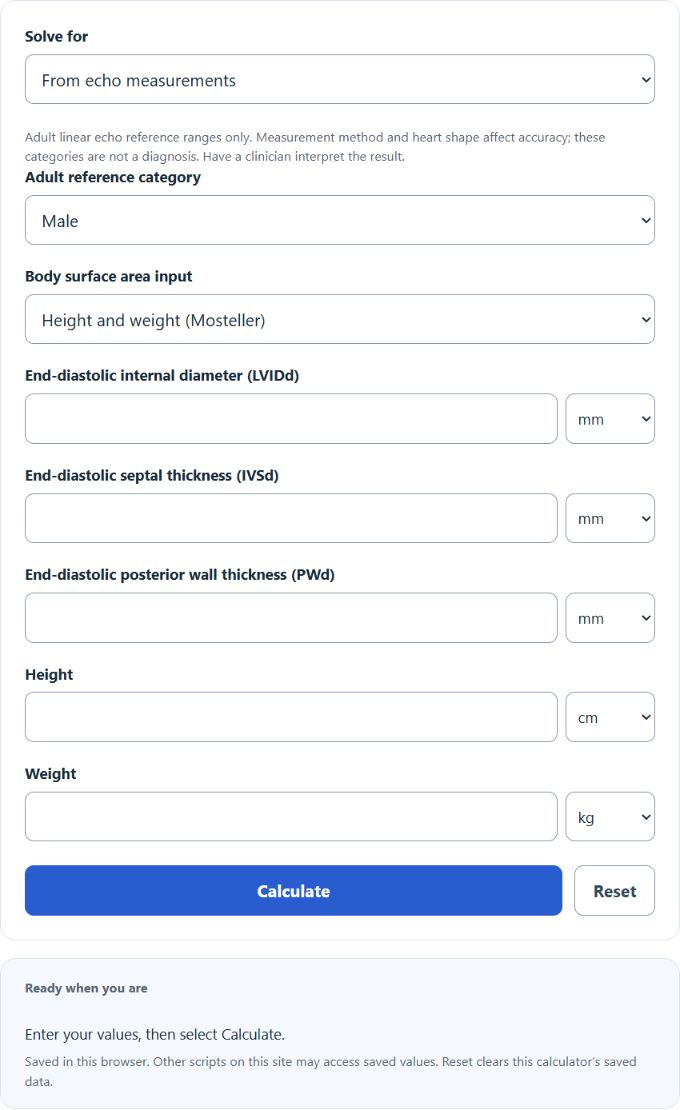
Calculate left ventricular mass index from echo measurements or known LV mass and body surface area, and compare with adult linear-method reference ranges. The comparison is not a diagnosis; echo measurements also provide a geometry pattern.
- All Health and Medical Calculators
- FFMI Calculator (Fat-Free Mass Index) (lbs/m^2)
- Ponderal Index Calculator
- BMI Calculator
LV Mass Index Formula
The following formula is used to calculate the Left Ventricular Mass Index (LVMI):
Variables:
- LVMI is the Left Ventricular Mass Index (g/m²)
- LV Mass is the Left Ventricular Mass (g)
- Body Surface Area is the measured or estimated surface area of the body (m²); the calculator estimates it from height and weight using Mosteller when selected
To calculate the LVMI, divide the Left Ventricular Mass by the Body Surface Area.
What is an LV Mass Index?
The LV Mass Index, or Left Ventricular Mass Index, is a measurement used in cardiology to assess the size of the left ventricle of the heart. The left ventricle is the chamber of the heart responsible for pumping oxygenated blood to the rest of the body. An increase in the size of the left ventricle can be an indication of heart disease, particularly if the heart muscle has become thickened or enlarged due to conditions such as hypertension or aortic stenosis. The LV Mass Index is calculated by measuring the mass of the left ventricle and dividing it by the body surface area, providing a value that can be compared to reference ranges to determine if the left ventricle is of normal size or if it is enlarged. This index is often used in conjunction with other diagnostic tests to provide a comprehensive picture of a patient’s heart health.
How to Calculate LV Mass Index?
The following steps outline how to calculate the LV Mass Index.
- First, determine the left ventricular mass (g).
- Next, determine the body surface area (m²).
- Next, gather the formula from above = LVMI = LVM / BSA.
- Finally, select the known-mass mode and the known-BSA input, enter the values and select Calculate. Alternatively, the echo mode uses end-diastolic dimensions in mm or cm with the corrected cube equation.
- After inserting the variables and calculating the result, check your answer with the calculator above.
Example Problem :
Use the following variables as an example problem to test your knowledge.
left ventricular mass (g) = 150
body surface area (m²) = 1.8; LVMI = 150 ÷ 1.8 ≈ 83.33 g/m². Adult reference comparisons use the linear echo method and require clinical interpretation.