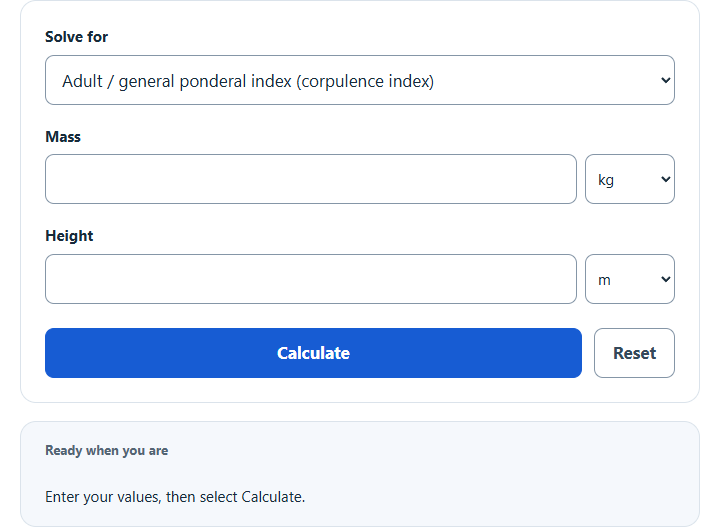
Calculate ponderal index (corpulence index) from weight and height in kg/m³, or a newborn’s ponderal index from birth weight and length.
- All Health and Medical Calculators
- Reverse BMI Calculator
- Height to Weight Ratio Calculator
- Body Weight To Lift Ratio Calculator
Calculator Functions
| Function | What it does | What it requires |
|---|---|---|
| Adult / general ponderal index (corpulence index) | Finds the ponderal index in kg/m³ | Requires the mass in kg or lb and the height in m, cm, ft or in |
| Mass from general PI | Finds the mass that gives a chosen index at a given height | Requires the general ponderal index in kg/m³ and the height |
| Height from general PI | Finds the height that gives a chosen index at a given mass | Requires the mass and the general ponderal index in kg/m³ |
| Infant / newborn ponderal index | Finds the newborn index, 100 × g/cm³ | Requires the birth mass in g, kg or lb and the birth length in cm or in |
Each result is placed in a comparison band: below 11, 11 to 14, above 14 to 16 or above 16 kg/m³ for the general index, and below 2.2, 2.2 to 3.0 or above 3.0 for the newborn index. The bands are rough reference points for the number, not clinical categories.
Ponderal Index Formulas
| PI | General ponderal index (kg/m³) |
| m | Body mass (kg) |
| h | Height (m) |
The ponderal index divides mass by height cubed [1]. BMI divides by height squared, so the two indexes are different numbers on different scales and cannot be read against each other's ranges.
Adult / general ponderal index (corpulence index)
A person of 70 kg and 1.75 m has PI = 70 ÷ 1.75³ = 13.06 kg/m³. Pounds and inches are converted to kilograms and meters first, so 154 lb at 69 in gives 12.98 kg/m³.
Mass from general PI
An index of 13 kg/m³ at a height of 1.80 m corresponds to 13 × 1.80³ = 75.82 kg. The figure is the algebra of the index, not a recommended weight.
Height from general PI
A mass of 70 kg at an index of 13 kg/m³ corresponds to a height of ∛(70 ÷ 13) = 1.753 m.
Infant / newborn ponderal index
For newborns the index is the birth weight in grams times 100, divided by the birth length in centimeters cubed [2]. A baby of 3,500 g and 50 cm has 100 × 3,500 ÷ 50³ = 2.8. The same measurements in kilograms and meters give 28 kg/m³, so the newborn number is one tenth of the general one.
The index at birth describes body proportions, and its usual values change with gestational age, so published references give percentiles for each week of gestation from 30 to 43 weeks [3].
Limits of This Estimate
- The ponderal index describes body proportions. On its own it does not diagnose a condition, measure body fat or set a healthy weight.
- A newborn's value is read against percentiles for the baby's gestational age [3], not against one fixed range, and that reading belongs with the baby's clinician.
- The comparison bands, 11 to 14 kg/m³ and 2.2 to 3.0, are rough reference points only. These estimates are based on the best available data and estimations.
Sources
- Peterson and others, Tri-Ponderal Mass Index vs Body Mass Index in Estimating Body Fat During Adolescence, JAMA Pediatrics (2017): mass divided by height cubed
- JAMA Network Open (2024), Growth Restriction in the Offspring of Mothers With Polycystic Ovary Syndrome: newborn ponderal index as birth weight in grams × 100 over birth length in centimeters cubed
- Landmann and others, Ponderal index for discrimination between symmetric and asymmetric growth restriction, Journal of Maternal-Fetal and Neonatal Medicine (2006): newborn percentiles by week of gestation