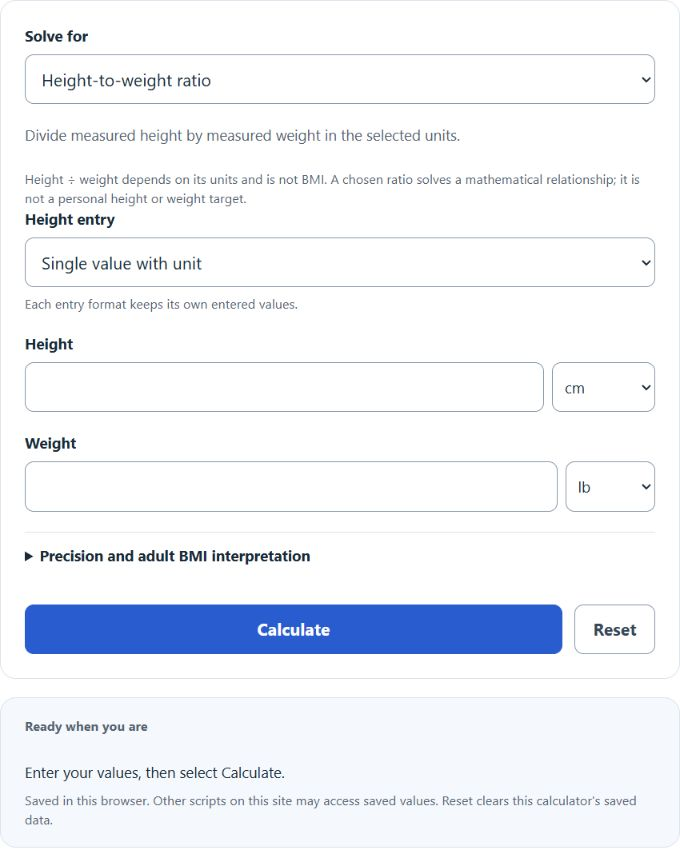
Calculate height-to-weight ratio from height and weight in cm, ft/in, kg or lb, or find the adult healthy weight range for a height (BMI 18.5–24.9).
- All Health and Medical Calculators
- Height Weight Calculator
- Waist to Height Ratio Calculator / WHtR Calculator
- Waist to Hip Ratio Calculator
- Ideal Waist Size Calculator
- Sitting Height Calculator
- Leg to Body Ratio Calculator
- Neck To Height Ratio Calculator
Calculator Functions
| Function | What it does | What it requires |
|---|---|---|
| Height-to-weight ratio | Divides height by weight, and also gives weight divided by height, BMI and ponderal index | Requires height and weight |
| Healthy weight range for height | Finds the adult weights that give a BMI from 18.5 to below 25 at a height | Requires height and the weight unit for the answer |
| Weight at a chosen ratio | Finds the weight that gives a chosen height ÷ weight ratio | Requires height, the chosen ratio and the weight unit |
| Height at a chosen ratio | Finds the height that gives a chosen height ÷ weight ratio | Requires weight, the chosen ratio and the height unit |
Height is entered as one value in cm, m, inches or decimal feet, or as feet and inches. Weight is entered in lb or kg. The Height-to-weight ratio function has two optional settings: the number of decimal places, and an adult BMI category with its reference weight range for ages 20 and older.
Height to Weight Ratio Formula
| Q | Height ÷ weight, in the units entered, such as in/lb or cm/kg |
| H | Height |
| W | Weight |
Height-to-weight ratio
The formula applies directly. A person 70 in tall who weighs 154 lb has a ratio of 70 ÷ 154 = 0.45 in/lb. The same person measured as 177.8 cm and 69.85 kg has a ratio of 2.55 cm/kg, so a ratio only compares with another one in the same units. Feet and inches are turned into total inches first. The result also gives the weight to height ratio, W ÷ H, which is 154 ÷ 70 = 2.2 lb/in here.
BMI is weight in kilograms divided by the square of height in meters [1]. At 70 in and 154 lb it is 69.85 ÷ 1.778² = 22.10 kg/m². The ponderal index divides by height cubed instead, 69.85 ÷ 1.778³ = 12.43 kg/m³, and is shown as a number only. With the adult setting on, the result names the BMI category [2]:
| Adult BMI (kg/m²) | Category |
|---|---|
| Less than 18.5 | Underweight |
| 18.5 to less than 25 | Healthy weight |
| 25 to less than 30 | Overweight |
| 30 or greater | Obesity |
Healthy weight range for height
This is the BMI formula solved for weight, run at BMI 18.5 and BMI 25, the two ends of the healthy weight category for adults 20 and older [2]. At 5 ft 9 in, height is 1.7526 m and height squared is 3.0716 m², so the range runs from 18.5 × 3.0716 = 56.8 kg to 25 × 3.0716 = 76.8 kg, or 125.3 to 169.3 lb. The upper end is where the overweight category starts, so the healthy range stops just below it. The result also gives the weight at BMI 22, the middle of the range, and the weight where BMI 30 begins.
Weight at a chosen ratio
At a height of 70 in and a chosen ratio of 0.45 in/lb, the weight is 70 ÷ 0.45 = 155.56 lb. The ratio must be in the same height and weight units as the entries.
Height at a chosen ratio
At a weight of 70 kg and a chosen ratio of 2.5 cm/kg, the height is 2.5 × 70 = 175 cm. Both chosen-ratio functions are algebra on the ratio. They do not predict what a person should weigh or how tall a person will be.
How to Calculate Height to Weight Ratio
Measure height and weight, pick one unit for each, and divide height by weight. For 5 ft 6 in and 140 lb, the height is 66 in and the ratio is 66 ÷ 140 = 0.47 in/lb. To calculate the weight to height ratio instead, divide the other way: 140 ÷ 66 = 2.12 lb/in. Neither number has a healthy target of its own, because both change with the units and with height. The measure that health agencies publish ranges for is BMI, which squares the height [1].
How to Calculate Weight According to Height
Multiply the square of height in meters by 18.5 for the low end and by 25 for the high end. The table gives the result for adults 20 and older; the healthy weight range is from the first weight up to, but not including, the second [2].
| Height | BMI 18.5 to 25 (lb) | BMI 18.5 to 25 (kg) |
|---|---|---|
| 4 ft 10 in (147.3 cm) | 88.5 to 119.6 | 40.2 to 54.3 |
| 5 ft 0 in (152.4 cm) | 94.7 to 128.0 | 43.0 to 58.1 |
| 5 ft 2 in (157.5 cm) | 101.1 to 136.7 | 45.9 to 62.0 |
| 5 ft 4 in (162.6 cm) | 107.8 to 145.6 | 48.9 to 66.1 |
| 5 ft 6 in (167.6 cm) | 114.6 to 154.9 | 52.0 to 70.3 |
| 5 ft 8 in (172.7 cm) | 121.7 to 164.4 | 55.2 to 74.6 |
| 5 ft 10 in (177.8 cm) | 128.9 to 174.2 | 58.5 to 79.0 |
| 6 ft 0 in (182.9 cm) | 136.4 to 184.3 | 61.9 to 83.6 |
| 6 ft 2 in (188.0 cm) | 144.1 to 194.7 | 65.4 to 88.3 |
| 6 ft 4 in (193.0 cm) | 152.0 to 205.4 | 68.9 to 93.2 |
Limits of This Estimate
- Height divided by weight is unit-dependent and has no universal healthy target. This tool does not diagnose health or set weight-loss targets.
- The adult BMI categories apply at age 20 or older. Children and teens need an age- and sex-specific assessment [2]. The category figures are those published by the CDC as of November 2026.
- BMI is a screening measure and should be considered with other factors when assessing health [2]. The reference weight range is not a personal recommendation, and the ponderal index has no health classification here.
- Pregnancy, body composition, unintended weight change or eating concerns need appropriate clinical assessment.
Sources
- Centers for Disease Control and Prevention, Calculating BMI: BMI formula in metric and U.S. customary units
- Centers for Disease Control and Prevention, Adult BMI Categories: BMI ranges for adults 20 and older, and BMI as a screening measure