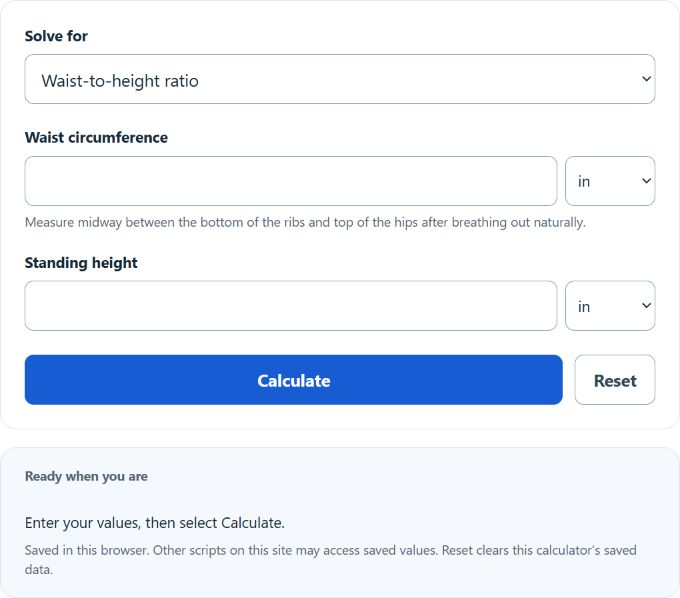
Calculate waist-to-height ratio from waist and height, or solve its algebraic waist or height relationship. Adult NICE central-adiposity bands are shown conditionally within the stated screening scope.
Note: This calculator is for general educational use in adults and is not intended for children/teens or during pregnancy. WHtR is a screening indicator and does not diagnose health conditions. If you’re concerned about your measurements or health risk, consult a qualified healthcare professional.
| Waist-to-height ratio | Central adiposity |
|---|---|
| Below 0.4 | Outside NICE’s defined bands |
| 0.4 to less than 0.5 | Healthy |
| 0.5 to less than 0.6 | Increased |
| 0.6 and above | High |
- All Health and Medical Calculators
- Waist to Hip Ratio Calculator
- Body Fat Caliper Calculator
- Calorie Calculator
- APE Index (Wingspan To Height Ratio) Calculator
- Sitting Height Calculator
- Neck To Height Ratio Calculator
Waist to Height Ratio Formula
The following formula can be used to calculate the ratio of your waist circumference to height.
- Where W is your waist circumference
- H is your height
To calculate a waist to height ratio, divide the waist circumference by the height.
For adults with BMI below 35 kg/m², NICE recommends interpreting WHtR alongside BMI and other clinical factors. Measure the waist midway between the bottom of the ribs and top of the hips after breathing out naturally. Select the correct units for each measurement. See NICE NG246 recommendations and measurement guidance.
Healthy Ratios
The sourced table above gives NICE adult central-adiposity bands: 0.4 to less than 0.5 is healthy, 0.5 to less than 0.6 is increased, and 0.6 or above is high. Values below 0.4 are outside these defined bands and do not by themselves establish underweight. Classification uses the unrounded ratio. This adult tool does not assess children, pregnancy, eating disorders or conditions affecting height, and WHtR does not diagnose health conditions.
FAQ
Waist-to-height ratio (WHtR) is a screening measure that can help estimate risk related to central fat distribution (e.g., cardiometabolic risk). It’s one indicator and should be interpreted alongside other factors, and results can vary for different body types (including athletes) and across age groups.