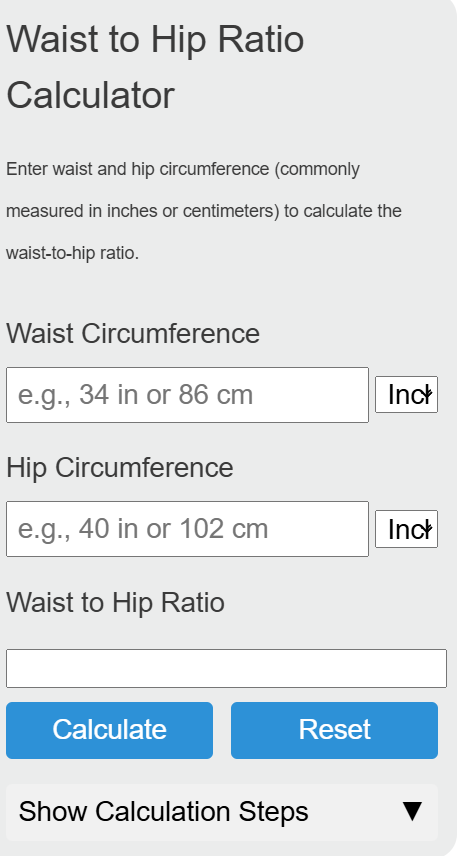
Calculate adult WHR in mixed metric or imperial units, review sex-specific reference bands, test measurement sensitivity, or reverse-solve waist and hip targets.
- All Health and Medical Calculators
- Ideal Weight Calculator
- Body Fat Calculator
- BMR Calculator
- Waist to Height Ratio Calculator / WHtR Calculator
- APE Index (Wingspan To Height Ratio) Calculator
- Leg to Body Ratio Calculator
Waist to Hip Ratio Formula
The waist-to-hip ratio compares your waist circumference to your hip circumference. Use the same unit for both measurements before dividing.
- WHR = waist-to-hip ratio
- W = waist circumference
- H = hip circumference
If you enter one measurement in inches and the other in centimeters, the calculator first converts both values to inches.
- inches = converted length in inches
- centimeters = length entered in centimeters
- 0.3937007874 = inches per centimeter
The calculator then divides the converted waist measurement by the converted hip measurement. The result is rounded to 2 decimal places. Since both measurements are lengths, the ratio has no unit.
Waist-to-Hip Ratio Risk Categories
These common adult screening categories are often used to interpret waist-to-hip ratio. They are not a diagnosis.
| Group | Lower Risk | Moderate Risk | Higher Risk |
|---|---|---|---|
| Women | 0.80 or lower | 0.81 to 0.85 | Above 0.85 |
| Men | 0.95 or lower | 0.96 to 1.00 | Above 1.00 |
Measurement Tips for Waist and Hip Circumference
| Measurement | Where to Measure | Tip |
|---|---|---|
| Waist | Around the narrowest part of your torso, or near the midpoint between the lowest rib and top of the hip bone | Keep the tape level and snug, but do not pull it tight. |
| Hips | Around the widest part of your hips and buttocks | Stand normally with feet together and measure over light clothing if possible. |
Example Calculations
Example 1: Measurements in inches
You measure a waist circumference of 34 inches and a hip circumference of 40 inches.
The waist-to-hip ratio is 0.85.
Example 2: Measurements in centimeters
You measure a waist circumference of 86 cm and a hip circumference of 102 cm.
Rounded to 2 decimal places, the waist-to-hip ratio is 0.84.
FAQ
Does it matter if I use inches or centimeters?
No. The ratio is the same as long as both measurements describe the same body lengths. If the units differ, the calculator converts them before dividing.
What does a higher waist-to-hip ratio mean?
A higher ratio usually means more body size is carried around the waist compared with the hips. In adults, this can be associated with higher cardiometabolic risk. It should be used as a screening measure, not as a diagnosis.
Is waist-to-hip ratio the same as BMI?
No. BMI compares weight to height. Waist-to-hip ratio compares waist size to hip size. BMI estimates general body size, while waist-to-hip ratio gives more information about body fat distribution.