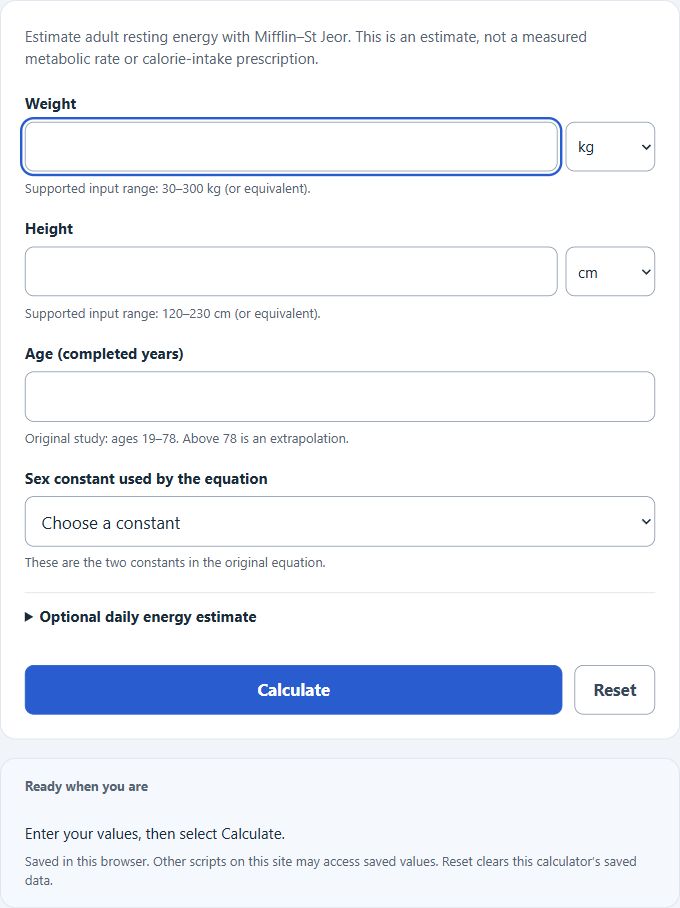
Estimate adult resting energy with the Mifflin-St Jeor equation and, optionally, an activity-adjusted daily energy value in metric or imperial units.
Important: This adult calculator predicts resting energy; it does not measure metabolism or prescribe calorie intake. Activity multiplication is a broad planning assumption. The original Mifflin-St Jeor study included adults ages 19–78, so older-age results are extrapolations. Anyone who is pregnant or breastfeeding, has an eating-disorder history, or has a medical condition or medication affecting energy needs should seek individualized clinical guidance.
Mifflin-St Jeor Resting-Energy Formula
The Mifflin-St Jeor equation predicts resting energy expenditure from weight, height, age, and the equation’s sex constant. “BMR” is retained as a familiar calculator label, but the equation provides an estimate rather than a measured basal metabolic rate.
Mifflin-St Jeor resting-energy estimate: REE = (10 × m) + (6.25 × h) - (5 × a) + s

m = mass (kg)
h = height (cm)
a = age (years)
s = constant (+5 for males, −161 for females).
The equation was derived in healthy adults and predicts a group-average resting value. Individual measured expenditure can differ because of body composition, health status, medications, measurement conditions, and other factors. Indirect calorimetry measures resting expenditure more directly.
The optional daily energy section multiplies the resting estimate by a selected activity factor. Those factors are common heuristics, not the 2023 DRI EER equations and not a measurement of total daily expenditure.
TDEE Calculator
Resting expenditure changes with body size, body composition, age, energy balance, health, and measurement conditions.
Aerobic exercise primarily increases calories burned during the activity itself. Changes in resting metabolic rate (BMR/RMR) from aerobic training are usually small and can vary depending on weight change, energy intake, and training status.
Resistance training may modestly increase resting energy expenditure by increasing lean body mass (fat-free mass), but the overall effect on total BMR is typically modest because most day-to-day energy needs are influenced by multiple factors (including total body size and activity).
Daily Calories Burned
Exercise can increase total daily energy expenditure. Changes in resting expenditure are usually smaller and vary among individuals; a calculator cannot predict a personal training response.
Use the result as a starting estimate only. Do not treat the resting value as a minimum intake or the activity-adjusted value as a prescribed maintenance target.