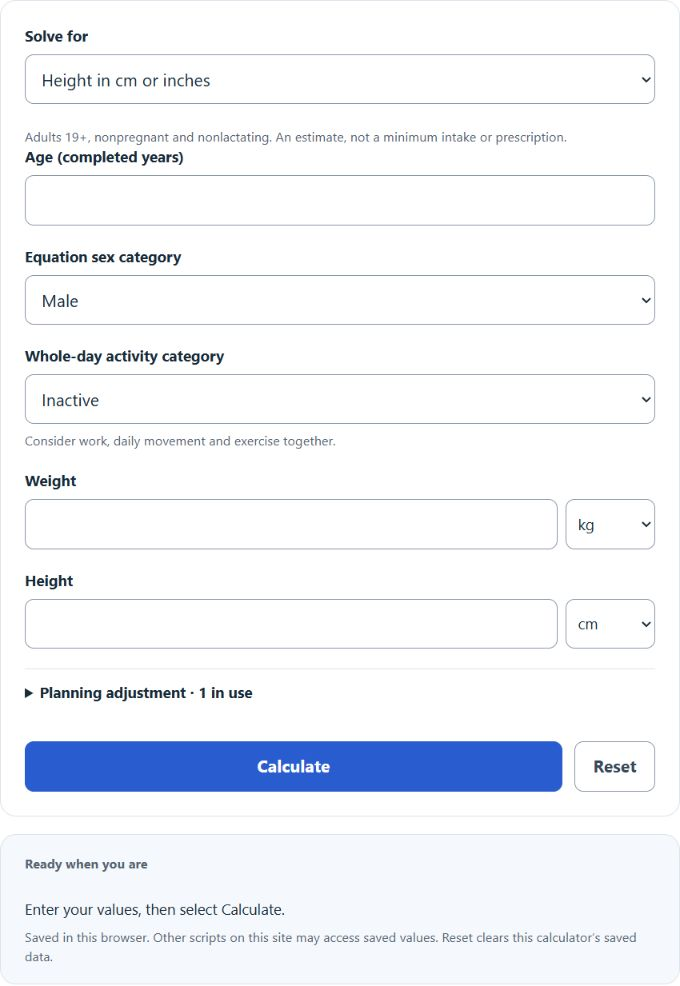
Estimate adult maintenance energy needs with the current 2023 Dietary Reference Intake EER equations for sex and physical-activity category, with an optional arithmetic planning adjustment.
Medical note: This calculator provides general estimates for informational purposes only and is not medical advice. If you are pregnant or lactating, underweight, have a history of eating disorders, or have a medical condition (including diabetes) or take medications that affect appetite/weight, consult a clinician or registered dietitian before using calorie targets—especially aggressive deficits/surpluses.
Formula/source note: This calculator uses the 2023 National Academies Dietary Reference Intakes adult EER equations. They use separate regression coefficients for male/female and inactive, low-active, active, and very-active categories. See 2023 DRI, Table 5-16. Last reviewed: 2026-10-06.
What is EER?
EER stands for Estimated Energy Requirement. In nutrition science (Dietary Reference Intakes), it refers to the average daily dietary energy intake (Calories/kcal) predicted to maintain energy balance in an adult of a given age, sex, weight, height, and physical activity level. In practice, it is commonly used as an estimate of your maintenance calories (roughly your total daily energy expenditure).
BMR stands for basal metabolic rate. It is the estimated amount of energy your body uses at rest under standardized conditions. Several common BMR equations exist (for example Mifflin–St Jeor, Harris–Benedict, and Schofield), and they can give different results. The 2023 EER equations are separate from BMR equations and use a different set of coefficients for each physical-activity category, rather than an older PA multiplier.
Understanding your EER (maintenance calories) can help you set a calorie target for weight change. The energy-balance principle matters (energy in vs. energy out), but real-world weight change is not perfectly linear day-to-day because appetite, NEAT (non-exercise activity), metabolic adaptation, glycogen/water shifts, and measurement error all play a role.
2023 Adult EER Formulas
For adults age 19 and older, the 2023 DRI report provides a separate equation for each sex and physical-activity category. Age is in years, height is in centimeters, weight is in kilograms, and EER is in kcal/day.
Men, inactive: EER = 753.07 - 10.83*A + 6.50*H + 14.10*W
Men, low active: EER = 581.47 - 10.83*A + 8.30*H + 14.94*W
Men, active: EER = 1004.82 - 10.83*A + 6.52*H + 15.91*W
Men, very active: EER = -517.88 - 10.83*A + 15.61*H + 19.11*W

Women, inactive: EER = 584.90 - 7.01*A + 5.72*H + 11.71*W
Women, low active: EER = 575.77 - 7.01*A + 6.60*H + 12.14*W
Women, active: EER = 710.25 - 7.01*A + 6.54*H + 12.34*W
Women, very active: EER = 511.83 - 7.01*A + 9.07*H + 12.56*W
- Inactive: activities of daily living with little additional activity
- Low active: activities of daily living plus some additional walking or similar movement
- Active: activities of daily living plus substantial additional moderate activity
- Very active: activities of daily living plus a high amount of additional activity
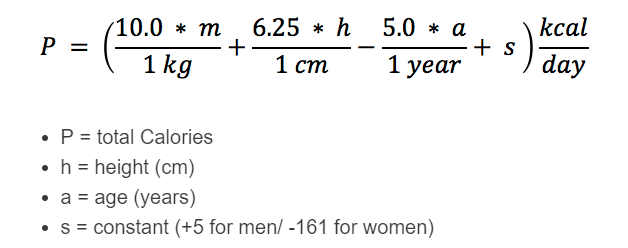
The retained image below shows a Mifflin-St Jeor resting-energy formula. That is a different method and is not used by this EER calculator.

Heart rate (BPM) is not a universal stand-in for calorie burn across individuals because the heart-rate-to-energy relationship varies by age, fitness, exercise mode, and other factors.
How to calculate EER
Now that you have a basic understanding of how EER is estimated, here is a step-by-step guide to using the formulas (or the calculator above).
- First, gather the required information: height, weight, sex, and age. For the best consistency, measure weight under similar conditions (for example, morning after using the restroom) and consider averaging several days.
- Next, choose the category that best matches whole-day activity. PAL is total expenditure divided by resting expenditure: inactive 1.00–<1.53, low active 1.53–<1.68, active 1.68–<1.85, very active 1.85–<2.50. Exercise frequency alone cannot determine PAL. The basic categories are:
- Inactive
- Low active
- Active
- Very active
- If you do regular strength training, have an active job, or generally move a lot outside of workouts, you may fit better into a higher activity category.
- Optionally apply a fixed arithmetic adjustment. This does not predict a specific rate of weight change and is not a personalized intake prescription.
- Enter the values to estimate EER. If an adjustment is selected, interpret the second number only as a planning value and reassess with longer-term trends or professional guidance.
EER and Weight Control
Now that you have an estimated EER, you can use it as a starting point for planning nutrition and activity. Many factors influence outcomes, but, over time, sustained calorie intake above or below your maintenance needs typically leads to weight gain or weight loss.
It’s also important to understand that this is only an estimate. For a more accurate personal target, implement a consistent plan and track results over several weeks (often 3–4 weeks or more). Looking at longer-term trends (for example, weekly average weigh-ins) and adjusting as needed is often more useful than focusing on day-to-day fluctuations.