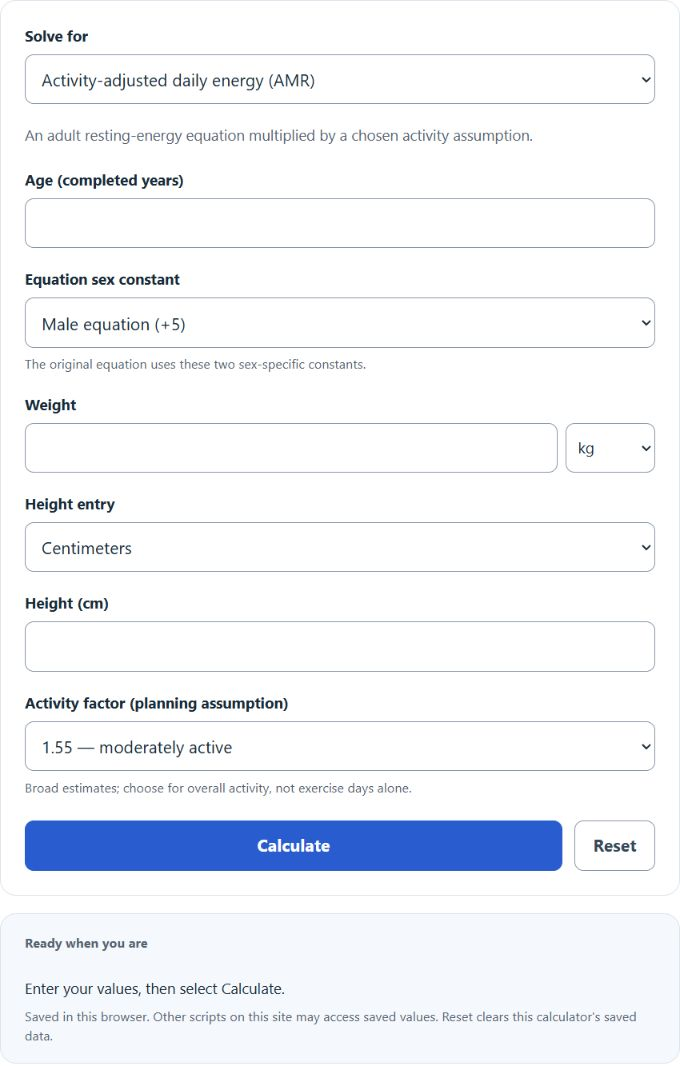
Calculate active metabolic rate from age, sex, height, weight, and activity level using the Mifflin-St Jeor equation, with resting and activity-adjusted daily energy estimates.
AMR and Mifflin-St Jeor Formula
This calculator uses the Mifflin-St Jeor adult resting-energy equation, then multiplies that result by a selected activity factor. “Active metabolic rate” (AMR) is used here as an informal label for an activity-adjusted daily energy estimate; it is not a directly measured metabolic rate.
- W = weight in kilograms
- H = height in centimeters
- A = age in completed years
US inputs are converted before the equation is applied: pounds are multiplied by 0.45359237 and inches by 2.54. The original Mifflin-St Jeor study included healthy adults ages 19–78; estimates at older ages are extrapolations.
Activity Multipliers Used
These common multipliers are broad planning assumptions. They are not the physical-activity categories or equations used by the 2023 Dietary Reference Intakes, and they do not measure an individual’s total energy expenditure.
| Activity label | Multiplier | Calculator description |
|---|---|---|
| Sedentary | 1.2 | Little or no exercise |
| Lightly active | 1.375 | Exercise 1–3 days/week |
| Moderately active | 1.55 | Exercise 3–5 days/week |
| Very active | 1.725 | Hard exercise 6–7 days/week |
| Extra active | 1.9 | Physical job or intense training |
Examples
Example 1: A 30-year-old male at 160 lb and 68 in converts to 72.57 kg and 172.72 cm. The resting estimate is about 1,660 kcal/day. At the 1.55 multiplier, the activity-adjusted estimate is about 2,573 kcal/day.
Example 2: A 30-year-old female at 72 kg and 173 cm has a resting estimate of about 1,490 kcal/day. At the 1.55 multiplier, the activity-adjusted estimate is about 2,310 kcal/day.
Important Limitations
This is an equation-based adult estimate, not a metabolic test, calorie prescription, or diagnosis. Do not use it alone to set intake for anyone under 19, pregnancy or breastfeeding, an eating-disorder history, or a medical condition or medication that affects energy needs. A clinician or registered dietitian can interpret energy needs; indirect calorimetry can measure resting expenditure more directly.