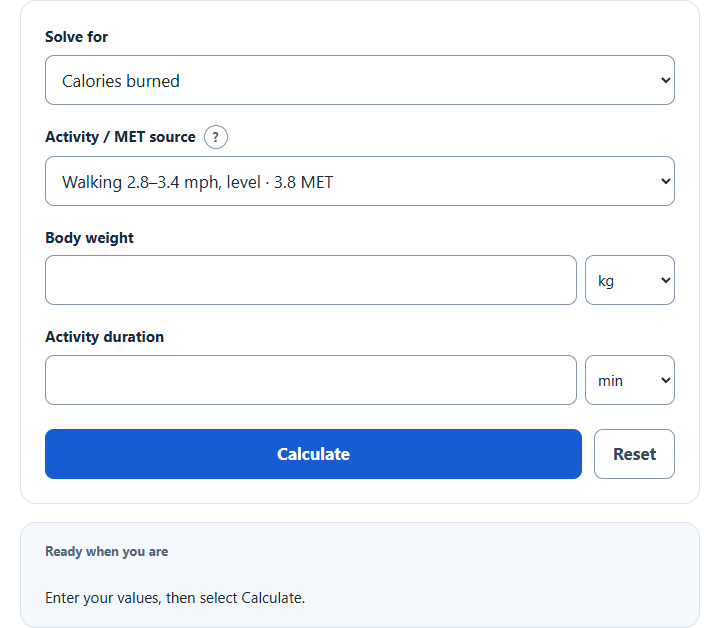
Calculate calories burned with METs: pick an activity or enter a MET value, add body weight and time, or solve for MET, duration or body weight.
For METs from treadmill walking speed and incline, use the Incline Treadmill Walking Calorie Calculator to estimate treadmill METs. Enter steady walking speed and the treadmill’s incline percentage, plus body weight and time for the calorie estimate. Its result includes Modeled MET and estimated oxygen cost. It uses the ACSM walking equation, conventionally applied at about 1.9–3.7 mph; it is not a running equation. You can enter the resulting MET here using Custom MET value.
METs, Calories, and Oxygen Cost
One metabolic equivalent (1 MET) represents a conventional resting oxygen cost of 3.5 milliliters of oxygen per kilogram per minute. Activity MET values scale that reference and can be combined with body weight and duration to estimate gross energy expenditure.
Formula and Method
Gross calories (kcal) = MET × 3.5 × body weight (kg) × minutes / 200. This uses the conventional 3.5 mL O₂/kg/min per MET and an approximate energy equivalent of 5 kcal per liter of oxygen. It gives 1.05 kcal/kg/hour per MET, rather than the rounded 1 kcal/kg/hour shortcut. The other modes rearrange this same equation.
Example MET intensity groupings
| Reference | Range or value | Use or interpretation |
|---|---|---|
| Light-range | Below 3 METs | Low absolute intensity; MET alone does not establish sedentary behavior |
| Moderate | 3 to 5.9 METs | Brisk walking and similar work |
| Vigorous | 6 METs or more | Running and other demanding work |
| 1 MET reference | 3.5 mL O2/kg/min | Conventional resting value |
How to Use the Result
Select a representative activity or enter a manual MET value; the MET solve instead uses supplied gross energy, body weight, and duration. Use the units shown beside each input. Backward solves inherit the uncertainty of the supplied estimates; use gross calories including resting energy, not active calories above rest. The body-weight solve is an algebraic estimate, not a measurement of body weight.
Assumptions and Limitations
The activity presets use the 2024 Adult Compendium for ages 19–59. MET values are population estimates: technique, fitness, body composition, grade, equipment, temperature, and efficiency can change actual energy use. The equation estimates gross calories and should not be treated as a direct metabolic measurement or personalized exercise prescription.
Sources
- Herrmann SD and colleagues. 2024 Adult Compendium of Physical Activities, including its activity-specific MET tables. Net Heart Rate for Estimating Oxygen Consumption in Active Adults describes the approximate 5 kcal per liter oxygen conversion.