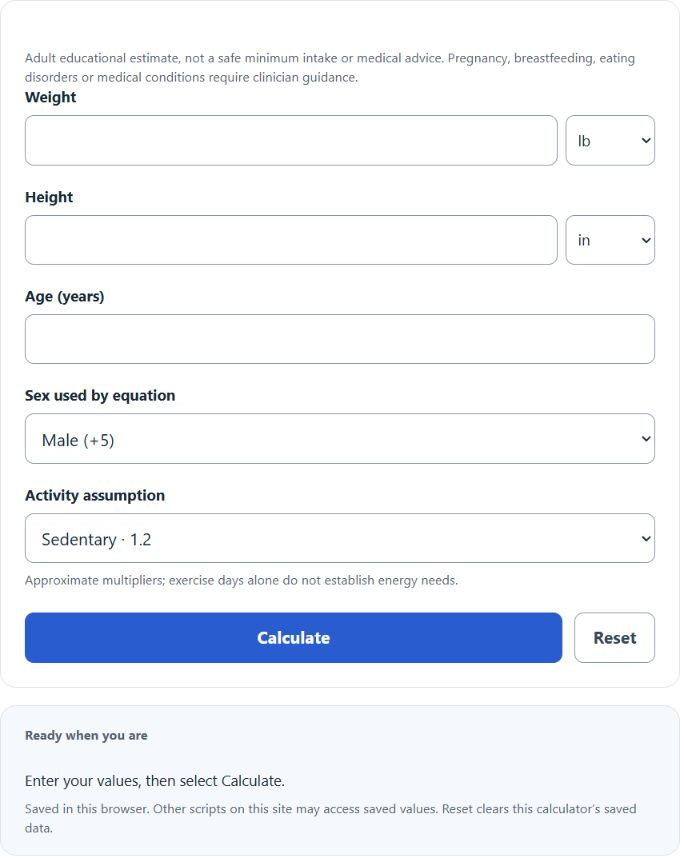
Enter your height, weight, age, sex, and activity level into the calculator to estimate resting energy, maintenance calories (TDEE), and an illustrative calorie-deficit range. These estimates do not determine a safe minimum intake.
Medical disclaimer: This calculator provides estimates for educational purposes and is not medical advice. Calorie needs vary widely—talk with a clinician or registered dietitian, especially if you are pregnant/breastfeeding, under 18, underweight, have diabetes/heart/kidney disease, take appetite/weight-affecting medications, or have a history of eating disorders.
- All Health and Medical Calculators
- Calorie Calculator
- Steps to Calories Calculator
- Jump Rope Calories Calculator
- Push Up Calories Calculator
BMR, TDEE, and Calorie Deficit Formula
This calculator estimates basal metabolic rate (BMR) using the Mifflin-St Jeor equation, then estimates total daily energy expenditure (TDEE) by applying an activity multiplier. A common starting point for weight loss is a modest calorie deficit (often ~250–500 kcal/day), adjusted to your situation and clinician guidance.
Where w is weight in kilograms, h is height in centimeters, a is age in years, s is +5 for males and −161 for females, and A is an activity multiplier.
What Are BMR, TDEE, and an Illustrative Calorie Deficit?
BMR (Basal Metabolic Rate) is an estimate of how many calories your body uses at rest to support essential functions like breathing, circulation, and temperature regulation. TDEE (Total Daily Energy Expenditure) estimates your average daily calorie burn after accounting for activity.
A calorie deficit means eating fewer calories than your TDEE. Many adults lose weight more safely with a modest deficit (often around 250–500 calories/day). Larger deficits can increase the risk of fatigue, nutrient deficiencies, loss of lean mass, gallstones, and other complications—and very-low-calorie diets should only be used with medical supervision.
Because needs vary based on age, body size, medical conditions, medications, and goals, use calculator results as a starting estimate and consider checking reputable public-health guidance (for example, CDC/NIH weight-loss recommendations) or working with a clinician or registered dietitian for personalized targets.
FAQ
What is the lowest amount of calories I should eat?
There is no single “minimum” that is safe for everyone. As a general rule, many adults aim for a modest deficit (often ~250–500 calories/day below maintenance) rather than extreme restriction. Avoid very-low-calorie diets unless they are medically supervised, and get professional guidance if you are underweight, pregnant/breastfeeding, under 18, or have medical conditions such as diabetes or heart/kidney disease (or a history of eating disorders).
How many calories should I eat?
The number of calories any person should eat depends on their current maintenance needs (TDEE), activity level, and goals. For weight loss, a modest deficit is often used; for weight gain, you typically eat above maintenance.
How do I burn more calories?
The best way to burn more calories is to be more active. This can be through structured exercise and/or increasing daily movement (walking more, taking stairs, standing breaks, etc.).
Lifting weights can also help build and preserve muscle, which can support a higher resting calorie burn over time.